HEY! Get updates to this and the CD and 7" blogs via Twitter: @VinylUnderbite

Showing posts with label alive and kicking. Show all posts

26 July 2018

Steve Lacy - 'Moon' (BYG Actuel/Get Back)

This is a far cry from The Straight Horn of Steve Lacy, as it's anything but straight. Moon hails from a period where he was immersed in the Italian free jazz scene (recorded in Rome, 1969) and features a bunch of European musicians who I'm not really familiar with. His wife, Irene Aebi, appears on cello and does vocals on 'Note', which is one of the more memorable cuts not just because of the staccato, one-word lyrics but cause of its whirlwind start-stop madcap nature. Jacques Thollot is on the drums - I only know him from Sharrock's Monkey-Pockie-Boo record and otherwise more as a name – and he clatters and whoops throughout. The overall momentum of this feels closer to the scratchy bending and hacking of the Spontaneous Music Ensemble than much American free jazz going on at the time. The front line being clarinet and soprano sax means we're locked firmly into the upper register, and the bass and drums are fluid enough that it feels like a lot is missing from the centre. Aebi's cello isn't always so present, or it's played in such a way that it's hard to distinguish from the bass. There's generally a thump-thump bassline behind most cuts, probably most melodically on closing cut 'The Breath', but the whole record feels pretty scrappy. 'Moon' is where things get a little loopier, and the swirls of breath and string start to bend and form a parallax effect. The whole thing goes by rather quickly, and it's absolutely uncompromising in its style. Not a full-breath blowout by any means, but maybe that's just due to the limits of the instrumentation and the way that Thollot plays. Drummers can have a huge effect on these matters. Lacy is front and centre on the cover photo but in the mix he's all over the place, darting through the corners of the soundstage and coming to the forefront furtively, only to slip away as he pleases. This is music that plays against itself continually, twisting against a centre that keeps escaping. I'm not sure what this record's reputation is but it's a demanding listen, despite having a light touch. Somehow it feels unique from other Euro-free records of the period, but maybe that's just because Lacy is such a singular player.

10 July 2018

Fela Ransome-Kuti And The Africa '70 With Ginger Baker ‎– 'Live!' (Signpost)

Afrobeat meets British jazz here, or at least Ginger Baker sits in on a second drum kit to make this collaboration. This is the only Fela Kuti record I own but I've heard a lot of those classics from the 70s, and this sounds more or less in line. Tony Allen is a formidable enough drummer that Baker is probably only adding accents and thickening; it's panned a bit so you can get some separation, and this has a pretty excellent sound for a live recording from the time, though there's no credits as to when or where this recording was made. Baker is explicitly introduced by Kuti, who speaks between each of the cuts, and when Baker starts to tap about on the drums, Kuti quickly says 'That's enough, that's enough' and moves into the next song ('Ye Ye De Smell'), which is supposedly written for Baker because he does NOT in fact smell. It's some good natured ribbing I'm sure but Kuti makes it extremely clear who's in charge, as if there would be any doubt. 'Smell' is a banger though, but they are all, of course. This album came out in '71 so it's actually one of Kuti's first releases, and they're already playing a well developed form of their music here. Four songs, opening with the nicely named 'Let's Start' and and propelled by Kuti's shouts and sax, Igo Chiko's fiery solos and of course the drumming, from not just Allen and Baker but the small army of congas and other percussion instruments. There's a long electric piano solo on 'Black Man's Cry' that is also uncredited - no keyboards officially appear on the album, unless it's some sort of insane guitar technique. It's just before he climax of the record building up with the clattery guitars until it just stops and leaves some space for Kuti to begin soliloquising again. When the theme comes back in towards the end (it's a twelve minute piece), with trumpets and sax ringing in harmony, it feels at once like a beautiful orchestrated pop song and the rallying, radical cry its title implies. The final cut is the most somber, being midtempo and transferring all of the polyrhythmic shuffling to be between the beats, though somber for Fela Kuti is maddeningly energetic for most others. Titled 'Egbe Mi O (Carry Me I Want to Die)', it builds to a 'Hey Jude'-like wordless chant, which while sung by the entire band and presumably live audience, attains a wistfulness which is only echoed by the exuberant trumpets. The bands builds it up under this, until it's a somewhat distorted wall of sound, coming back to a lovely theme as is the formula.

27 January 2018

Kemialliset Ystävät ‎– 'Ullakkopalo' (Fonal)

Hi there. It's been awhile; a month+ break taken for no particular reason except sometimes you just need a break. There were some dark days in between this and the last transmission, quite literally dark as recovering from a minor eye surgery led to some light sensitivity, which would have been the perfect time to just sit in the dark and listen to records. Yet, no, it didn't happen, and I actually blame the timing of Ullakkopalo being drawn next in this deck. This is a dense masterpiece, where Jan Anderzen has put together a zillion layers of strange interacting sounds to create a tapestry that is dizzying and awe-inspiring, if you can stay focused enough while listening for awe to form.  And I couldn't, which is why after years of technically loving this record, I rarely listen to it; I don't spend as much time as I'd like parsing through its various confounding movements. Sure, there's a lot of horsin' around, but it's all in the service of something complete. With a load of guest musicians, spread throughout the tracks in a manner where their contributions are pretty much impossible to distinguish from Anderzen's own fuckery, this is a real 'Who's Who' of the Finnish freak underground, except all blended together. I first heard Kemialliset Ystävät about five or six years before this, but that was another world entirely. Then, KY material was based around a loose thrashing about, with a lot of acoustic instruments, a lo-fi texture, and no particular hurry to get to any destination. But by this point (2010), it had become a symphony of precisely assembled sound matter, still based around weird experiments and uncertain tonal sources, but concerned with plot, not just feel. I'm reminded at times of Ennio Morricone scores, Albert Marcouer's great 70s art-pop, shoegaze textures and the Residents, but that's just a few points of reference. Really, this is such singular music that it does it a disservice to compare it to other artists. There are moments where the cheap synthesisers swirl around in a carnivalesque manner, but there's a clarity to it all, and as said above a precision, which hides behind the surface-level madness. Singling out tracks is difficult but a few weeks back a Pekko Käppi record was reviewed and even though they're pretty different in temperament, there's a similar sense of eclecticism to how it's all put together. And now that I've gotten here, reaching the end of this, it wasn't so hard after all to write something about, though I don't know if my words add much value to the listening experience.


14 November 2017

Gregory Jones & Roy Sablosky - 'No Imagination' (Vinyl)

There isn't much more one could want from a record of experimental electronics. No Imagination does quite a lot across its four tracks, and it's the only release by these guys apart from a new wave band called Standard of Living that they were both in; so this was probably seen as their experimental 'side project' if anything, which is a shame, cause I'd love to hear how their musical relationship may have developed over time. The four cuts traverse fairly different territory for a record that is built around two guys with electronics, though my favourite track is Jones-less, only featuring Sablosky plus James Gable on 'transducer guitar' and Marianne Fraenkel on vocals. It's a 15 minute long dirge called 'Intro (Summer Names)', perversely not the first track, but coming after 'No Moon No Mirror' (which is a proper intro). But 'Intro' the song consists of a heavily repetitive guitar strum, firing ecstatic overtones in conjunction with Sablosky's electronics, and the faint intonations of Fraenkel's spoken text. It's just there to feel more than listen to, obfuscating the urge to interpret verbal meaning. Her delivery reminds me of the voice on Blue Gene Tyranny's 'A Letter From Home'; this, to me, is an aesthetic device that I associate with the American avant-garde circa the time of my birth, when this was made. It's a beauty, a real storm of a musical work that feels romantic, adventurous, warm and cold all at the same times as it howls along. There's no acoustic presence on the other three tracks, but they're no less impressive; 'Diverted to Frankfurt (for Twelve Pulse Generators)' is, unsurprisingly, written for 12 pulse generators and the stark palette of their timbre makes this an active, complex convergence of sound. 'No Moon No Mirror' is an ethereal piece for synthesiser where the two musicians tease each other through space, sounding like something from the Kranky records catalog two decades later. It's marred only by a very audible scratch on my copy, which if it were on 'Diverted to Frankfurt' might not be so noticeable but here it shocks the stillness between the synth pulses. 'Forced' is the final cut, another long one, and it resembles the 'Amazon rainforest' approach to electronic improvisations. There's not so much a tonal basis as that of a swarm of insects, and it's as manic and active as the previous two tracks. It's best played loud - the whole record is - so the juxtaposing staccato bursts of static and square waves can get the resonance they deserve. This is a great record for turning your head slightly while listening, to change the way the overtones interact with one's hearing - the best minimalist/drone records have that, and it's nice to be achieved on something so compositionally distinct. Totally great and singular!

7 November 2017

Joseph Jarman - 'Song For' (Delmark)

There really must have been something in the water in Chicago then, because the music that came out of the late 1960s AACM scene is so unlike anything of its own time or any other. This first Jarman solo record is another piece in the puzzle that became the Art Ensemble, and thus fits in alongside the early Roscoe Mitchell recordings and the other pre-Art Ensemble experiments, which converge on that amazing 5 CD 1967/68 box set (if only it could get a vinyl release!). Jar's band at this time contained Christopher Gaddy and Charles Clark, both of whom were dead within a year (according to the liner notes of this 1970s reissue); dual tragedies, of course, all the more because this core trio had a contemplative understanding of space and time that was a really different flavour to the playfulness of the Art Ensemble. As a quartet with Thurman Barker, they're stripped down on 'Non-Cognitive Aspects of the City', a jaw-dropping excursion into outer-limits impressionism, with Jarman's poetic recitation at the centre. This celebration of urban mysticism explicitly references Dada a few times and casts Chicago's skyline as a shifting tapestry of possible worlds, a chaos that pulsates and gives. Gaddy's piano lines are especially elegant, with a mood closer to Paul Bley than fellow AACMer Muhal Richard Abrams. The larger band, found on the other three tracks, contains Fred Anderson on tenor, Steve McCall on drums and William Brimfield on Trumpet, and both sides start with cohesive, melodic compositions. 'Little Fox Run' is waxy, even a bit brittle, and a strange juxtaposition against 'Non-Cognitive'. It punches through the air and announces their arrival, but is too one-dimensional to showcase Jarman's talents. Side B starts with 'Adam's Rib', a modal, evolving progression that creaks towards silence, opening up for the longer form improvisation of the title track, which is segues into. 'Song For' starts by building percussive elements in space before erupting into a push/pull that is free, but never chaotic. Brimfield's trumpet rips over everything and the presence of two drummers makes it kinda choppy, but the band knows when to hold 'em and knows when to fold 'em, and the comedowns and murmurs are some of the piece's most invigorating moments. At times Jarman's alto and Anderson's tenor don't even seem to be in the same room, but then they come together to make great waves of sound. All around, in the corners, you can hear slide whistles, shouting, and marimba; also Charles Clark moseying around and tiny finger cymbals and bells. This flavours the music with sounds not often heard on ESP releases of the time (Don Garrett's work excepted); it's an approach radical and visionary, but quietly so, which can be the most rewarding.

30 October 2017

Bert Jansch and John Renbourn - 'Bert and John' (Transatlantic)

Finally, after guesting on Jansch's last few records and a few solo records of his own, John Renbourn makes a full-fledged collaboration with him. This is recorded in hard stereo, but it's not credited (at least on my copy) who is whom; I think the right channel is Renbourn because he has a punchier style of playing, but both of them do this really close-mic'd and forceful. It's almost like the entire record was done with a 'line-in' recording style, except these are pure acoustics and there's enough glow here to really feel that they were playing together. The record is almost entirely instrumental and the pair wrote most compositions, with the exception of Jansch's 'Soho', Anne Briggs's 'The Time Has Come' and a wonderfully inspired cover of Mingus's 'Goodbye Porkpie Hat'. The latter, when rendered on two acoustic guitars, emphasises the bluesy quality of Mingus's nature and it feels fresh, like a new spirit brought into the melodies. It certainly doesn't come off as an act of appropriation or anything of the sort, and of course it presages the Pentangle records to follow. The rest of the record has a brisk pace, with both guitarists favouring flashy, quick strikes and brisk interplay. The more careful numbers, like 'Orlando', are placed to bring a sense of breath to the sequencing; 'The Time Has Come' as well manages to be contemplative under Jansch's vocal line, without sacrificing any momentum. 'Soho' is a nice paean to city life and the overall tone is very modern, especially against Jack Orion's more traditional material; the records were released in the same year, I'm not sure which one first, but it's a sensible curation. I hear a lot of Gastr del Sol's Crookt, Crackt style here, especially on 'After the Dance', which is absolutely percussive; there's something of the same appeal, the acoustic guitars as razorblades, the occasionally jaw-dropping effects of construction. It's not about their technical mastery, because I'm sure these are raw and green compared to their more mature recordings, but that energy and vitality is felt without being showoffy or retrograde.

26 October 2017

Jandek - 'Lost Cause' (Corwood Industries)

Skipping ahead a decade from Six and Six, Jandek is certainly a lot less monotonous than before, but not any more accessible. Lost Cause is split between acoustic and electric halves, though the electric half is a side-long free-form freakout (titled 'The Electric End') where plodding tom toms are layered with clangy electric guitar and a high-pitched whistling sound that's from some unidentifiable instrument, with the occasional vocal yelp from Mr. Sterling. It's nineteen minutes long and never lets up, and there's some pretty great parts - it's actually the reason I keep this record - though not exactly a smooth experience. The seven songs on side one are occasionally pretty, around themes of heartbreak ('God Came Between Us') and genitals ('Babe I Love You'). There's a whole lineage of loner, private-press acid folk casualties from the 70s (Kenneth Higney, Perry Leopold, Peter Grudzien, etc.) and Jandek's sound is like the most extreme version of this (and privately pressed, too) but somehow minus the acid. Or maybe he was a total tryptamine visionary, I can't presume to know, but his portraits of the mid-to-late 20th century American experience feel removed from any sort of Dionysian rites. I wonder if people thought this was going to be his last record at the time; its no bleaker than usual but just the 'End' in side 2's title and the LP name as well... it's not like anything could stop Jandek, and by this point (1992) he had developed quite a fleshed-out, complete musical vision. I was thinking during the last record how much Jandek's aesthetic has become a trope of today's avant-garde song people, certainly in terms of mood and vocal delivery; this has gotta be seen as some success for him, since initially he appeared to be both uninfluenced and uninfluenceable. Nowadays, he seems to be on a quest to perform with every one of today's active musicians, and that's actually admirable. However, I'm reminded of that story about a famous British wrestler who always wore a mask, and was known for his real face being secret, who announced he was going to take off the mask for a match, got huge attention for it, and then found his career essentially over, once the mask was off. (British wrestling fans will know who I'm talking about, but it doesn't matter). That's Jandek, to me – I was as stunned as everyone else when he suddenly played live in 2004, and then I saw a concert in 2005 and it was good, interesting kinda free rock, but nothing I would get too excited about. And since then, I haven't cared at all. But if I ever change my mind, there's been about 600 hours of new material to digest, including 6 and 9 CD box sets, some albums being entirely a-capella; but I'll pass, for now.

19 October 2017

The Incredible String Band - 'The 5000 Spirits or The Layers of the Onion' (Elektra)

Talk about a shift in marketing - the cover alone would suggest that Messrs Heron and Williamson, reduced to a duo here, majorly 'turned on' after their first album and in their cosmic dialogue with the universe decided to reinvent the Incredible String Band as a fully psychedelicised wonder. I don't know if the music carries through on this promise, though it's a huge step forward in confidence and originality, and furthermore the duo plays together as a band on almost every track, making this feel much more cohesive. I'd say its more a step towards pop accessibility than drugged out wonderbliss. One can hear this from the get-go, on 'Chinese White', where Williamson's bowed gimbri adds a thick drone behind the song, sounding a bit like a Dylanesque harmonica only with a fourth dimension added. That's maybe the psychedelic-influenced ISB in a nutshell - or maybe the confident production of Joe Boyd is to thank. Danny Thompson guests on a few tracks and hand drums are occasionally present, though it's hardly a rock and roll ensemble; the presence of sitar (or guitar affected to sound like a sitar) and flute, weaving through the melodies is a bigger presence throughout. Without any traditionals here, the songcraft feels more akin to the 60s Village scene than to Anne Briggs or Shirley Collins, with only their accent really linking things to any UK folk movement. There's a syncopated quirk to some of the tunes, like 'No Sleep Blues', others look to jazz and blues for direction. Heron's tunes in particular have the hooks, like the indefatigable 'Hedgehog Song' and 'Painting Box'. If I try to imagine this accompanying a late 60s psychedelic/mystical 'trip' I'm sure there's some great psychedelic value; 'Little Cloud' is whimsical and jaunty but lyrically about floating to distant lands; 'My Name is Death' can be the bummer note or the key to understanding the whole experience, perhaps. The closer, 'Way Back in the 1960s', takes a fun, tongue-in-cheek look back to this time, and holds up well as a quasi-novelty number. I realise that writing about so many records here runs the risk of being pointless or uninsightful, and I can't think of what I can personally add about these mega-famous ISB albums, since I have little personal connection to them beyond just enjoying them now and then. The best I can do is to try to relate it to other music experiences, but apart from the resurgence of interest in 60s folk in the 00s noise 'underground', I couldn't think of music further away from the current Now/zeitgeist than this. And even within that decade-past underground, ISB was way too well-known to be seen as cool, when there were an endless stream of obscure burnout loners to discover instead. Still, this album and their next one have gotten many a play, not just my beaten copy (whose lifespan was already worn down long before it entered my possession) but among people in general, as these records remain immensely popular for good reason.

4 September 2017

Hüsker Dü - 'Metal Circus' (SST)

My copy of this classic has a really bad warp, the kind that sends the stylus flying with each of the 45 rotations per minute. It's so bad that it renders the first song on each side unplayable - in fact, unstartable, as the constant pushback of the skip means it can never get into the opening groove for tracking. So 'my' Metal Circus begins with 'Deadly Skies', and an already short EP becomes a bit unsatisfying when two songs shorter. Serves me right for buying this so eagerly at a weird cheap punk shop in Copenhagen - we should always inspect the vinyl, right? 'Deadly Skies' is a fucking great song though, where the lead guitar lines and Bob Mould's voice work perfectly together. I never thought of the title of this record in terms of 'heavy metal' as this sounds properly like early mid-period Dü, but there is a way that lead guitar/voice combo sounds like a banshee screaming, plus the shredding on 'Out on a Limb' has a few pinch harmonics inside. Grant Hart bats 1.000 here, with 'It's Not Funny Anymore' and 'Diane' being two of his greatest songs. The latter of these may actually objectively terrible, if music could be objectively anything, but I love it; it's creepy, built around a simple, plodding rhythm, and with a strange violence that definitively ties this to the earlier, more adolescent period of the band. The drumming throughout this record is mixed really high, and something feels really imprecise about it; I don't think Hüsker Dü would ever again sound (at least on record) like a bunch of midwestern freaks jamming in a garage, and that's another reason to love this. Minus two songs, it's a shame, really just like a good 7". It's almost hard to believe that Zen Arcade was about to follow, but that's also part of the charm of this.

19 August 2017

The Hospitals - 'Hairdryer Peace' (no label)
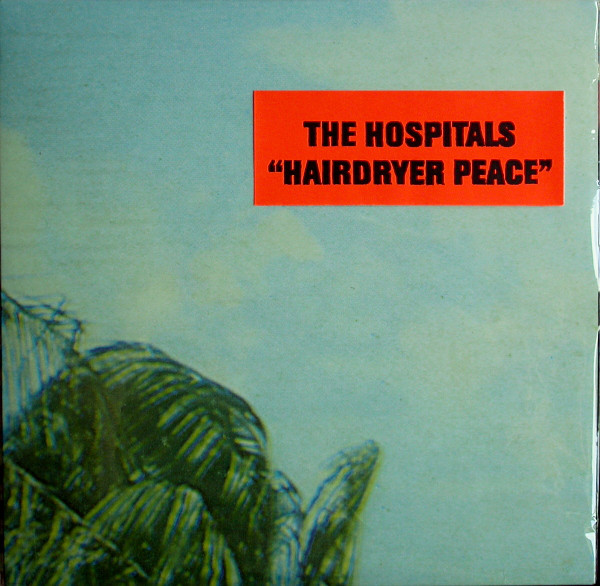
Sonic Youth already released an album called Washing Machine, but that's a more apt household appliance than a hairdryer for reflecting the music of the Hospitals. The floor tom is the most prominently used drum and it's used in a way that sounds like when you accidentally put a shoe in your washing machine and it bangs around on every rotation; it's not quite the same as Moe Tucker, as it's usually supporting a thick wall of mid-range distortion, which I guess could describe White Light/White Heat which is definitely an antecedent, but, no, it sounds like something else. I don't know anything about these guys but vaguely remembered this record getting a bit of buzz when it came out, so I grabbed a secondhand copy for a few bucks when I saw it and don't think I ever listened to it until now. I'm not sure if the Hospitals were connected to the American noise underground or the garage underground, as the sound is halfway in-between. The fidelity is terrible, but there's a commitment to that terribleness that is somehow admirable and it makes this a compelling listen - well, that and that there are some well above-average song structures behind it all. It took a few songs to emerge - at first I thought this was the missing link between Wolf Eyes and the Not Not Fun/Night People style of homemade lo-fi psych. But then 'Rules For Being Alive' came on, a prominently surf-influenced song that made me guess a few things right - that they're a west coast band (hard not to be when you sound like this), that they might have some connection to Sic Alps (Discogs tells me that Mike Donovan was once a member), and that this record was made far more carefully than it might sound at first listen. The lyrics are clear and audible in places and seem to usually describe getting high, fear, or other states of altered consciousness. Everything else is really buried but it's a pleasure to pick things out; these guys step on the DOD pedals always a bit too early and there's some great vocal sea/sweeps, like if Phil Spector blew his budget on rancid tacos and had to make do with what he could. This is so obviously made for a cassette release which makes the vinyl pressing beautiful and ridiculous at the same time, and there's some really catchy songs ('Scan the Floor for Food', 'BPPV') if you can strain through it. Somehow while listening to this I smelled burnt charcoal, felt a musty wind, and kept thinking of The Bachs. Yet the ragged nature keeps this from being a retro trip, and like many great records it feels like an amalgamation of many underground rock currents circa 2008, when this was recorded. I'm not saying it's the Deceit of its day, but it's an exemplary case of white Dionysia of the time and I think it will stand up to future scrutiny.

24 April 2017

Thee Headcoats - 'W.O.A.H! - Bo In Thee Garage' (Get Hip)

Consistency is a virtue, right? And maybe so is prolificness (is that a word?). Discogs lists only 19 full-length albums by Thee Headcoats, which is fewer than I expected, but then Billy Childish has spread his vision over a variety of bands and pseudonyms (which are surveyed nicely on the Archive from 1959 compilation from a few years back) besides this one. Somehow this LP is all I have managed to accumulate, even though they're all eminently listenable examples of a real scene, postmodern primitivism
at its finest. This is a conceptual one, I guess, being entirely made up of Bo Diddley covers. It's recorded live in mono, and it sounds more or less like a dictaphone recording of a raunchy garage-rock band banging it out in some room somewhere -- which is precisely what this is.  Childish translates Diddley's swagger well through his vocals, and the covers are fairly faithful; nothing is sped up or riffed upon (as far as I can tell - I'm not quite super familiar with the originals), and there's a ramshackle quality that suits the material well. 'Greatest Lover in the World' sounds great when recast from the mouth of a white Englishman; 'Keep Your Big Mouth Shut' shows his own vocal capabilities, and has a nice sassy snarl to it. Somehow this all works and doesn't raise any obvious questions about race or appropriation: it's a tribute that is fun, heartfelt, and an easy listen. The rough fidelity helps - it's as much about the sound of this record as the performance, if this makes any sense. Mono records on vinyl often sound great, and this is blistering and raw, especially when the cymbals start to blur together into a tinny haze. Somehow everything is exuberant enough to work, and thus this document of a band likely just fucking around one afternoon, nearly 30 years ago now, is somehow completely fresh and living.

21 February 2017

Harangue (Wilder Pryor/Enamel)

I have always loved the verb 'harangue' and it's delightful to find a band taking their name, and from my hometown as well! This was released a few years after I left town and I don't know any of the band members, but the bigger surprise is this sound - a real departure from Pittsburgh's usual emphasis on heavy rock riffs and volume. Though Harangue is loud, exploding with a somewhat raw recording that has an edge of fuzz on everything, which is to say the vocals, drums, piano and electric guitar. But what's different about it is the style of songwriting - five long songs, built around a very stylised singing style and the interplay of the piano and the guitar. The vocalist sings in a way that is nearly yelping, but still tuneful and focused. The closest comparison would be the Canadian band Frog Eyes, who I like a lot but have no records by; Harangue's vocalist has the same slightly crazed sonority and affect, and I could even say I hear a little bit of Jello Biafra in here too. It all really gels; opening cut 'Wisteria' is like knives in the darkness, and the speedy jam at the end of 'Brittle, Empty Mornig' shows what a tight musical unit they are. When cymbals start crashing it definitely gets messy and feels like you're in a basement with a determined group of young men; there are atmospheric guitar scrapes in places (the spacious bits, like 'Whitewashed Wall') and instead of solos or instrumental interludes, it feels like the whole band works together trying to take the songs into different directions. They get long - 'Uniformly Chaotic' is positively epic in scope - but it never feels samey or repetitive. Yet after the record ends, there's still a ringing in my ears. It seems like they've disappeared already, leaving only this, a limited local release and who knows what they went on to be. 

15 February 2016

Godspeed You Black Emperor! ‎– 'F♯ A♯ ∞' (Constellation)

I heard about this band from the Internet; the exalted droneon list, the archives of which I still dream of (and will continue to mention on here until someone unearths them). Some rumours were coming in about this really wild large ensemble band from Montreal who were doing massive soundscapes with a full string section and they had this crazy name and projected films while they played. I was intrigued and I saw them! It was on my first-ever trip to New York City, to catch a cool show at the Cooler headlined by Tower Recordings (who I don't think we even stayed to see), Sandy Bull (who was fucking great and I suspect I already told this story back when I covered his record), Roy Montgomery (the reason we went), and then the opening band, Godspeed You Black Emperor!. What a fucking delight; they were crammed onto a small stage, falling off it (probably a cellist or someone had to be on the floor) and they made this slowly crawling drone which built into a real racket and they really played, you know - really poured their hearts into it, all melodramatic and epic and swinging for the fences and whatever. My mind was blown. I bought this LP, an ornately packaged limited pressing on the fledgling Constellation label (later reissued on CD by Kranky with an extra 20 minutes, and you know I have that too so if we ever make it to the CDs again I can listen to it again) and it had all these neat photos and cryptic Xeroxes and drawing and artwork inside and a crushed penny! (crushed by a train, supposedly, so I can't tell if it's a Canadian or American penny and it's so cool anyway that I overlooked the fact Wimp Factor 14 already did that on a 7" years before) and the music, oh the music, well it's everything my little heart could have dreamed of. I was 17 years old. And I played the fuck out of this record, all the time, until the CD came out, but then I sorta played the record still cause the CD mixed things up and it wasn't quite the same - and looking now, while brushing dust off it, I can see that I scratched the hell of of it - it's really taken a beating over the years, even though I haven't probably played this at all in the past ten.We got song titles on the CD ('The Dead Flag Blues') but I just knew this as 'nervous, sad, poor' cause that's what scrawled into the runout groove, and side B as 'bleak, uncertain, beautiful'. This has Ennio Morricone draped all over it, but then this voice that sounds like Sam Elliott starts talking about his wallet being full of blood, and it's really cinematic, and then the second piece starts which is just a bunch of shimmery drone strings - electric guitars which sound like glass, an echo into a sunset, and some sliding tonalities. For as much as I now think about this band as being all about films and violins, there's so much guitar and bass that you could really mistake them for a rock band, and it's so soundtracky that it's nice to cover this right after Goblin, though it's all subdued and mellow, just making a groove. When the drums come in about halfway through side 1, all ride cymbal gallops, it sounds what I always imagined Calexico to sound like (but I've never listened to Calexico). This blew my mind almost twenty years ago and now it sounds good, but rather incomplete - it just rolls along, never quite fulfilling the promise of the spoken intro which is all mysterious and malevolent - it turns into another semi-ambient, delay-pedal driven haze, which is not unlike those interstitial segments on early Deerhunter records, and then a sorta jaunty, carnivalesque coda (where some jingling bells counterpoint a chord progression and a passionate violin lick). It's a good bummer trip all around though maybe it just coasts a bit on mood. Things stop, a voice says "I don't know what to do", someone fucks around on a banjo for a bit, and then the side is over. And then the flip; it opens with bagpipes! More voices, an organ drone, and the heretofore unheard-of-at-least-in-my-1997-record collection instrument of bagpipes (cause I didn't yet have that great Pierre Bensusan album 2 - check the archives!). It's all little sound vignettes here - some more soundtracky Morricone stuff, then a little interlude of processed vocals which could be right off an 80s 4AD record, and then another clean channel guitar post-rock piece. This melody builds and builds, the strings kick in, the drummer starts rocking out, and eventually it's a wall of sound that keeps crescendoing and crescendoing. It ends with a locked groove, cause, F sharp A sharp INFINITY, dig? You know, around the same time as this, Mogwai were doing these wall of sound instrumental pieces that all the kids were going wild about, but I never got much from them - to me, their music was always too cold, too distant. GYBE! were all about their emotions, wearing their wet romantic visions on their sleeves even if (let's be honest) they're somewhat entry-level art-school moves. I'm not knocking this band at all - this is as lush and inviting to listen to now as it was in 1997, and I'm regretting how much I kinda turned on them (more about that later) - but hindsight shows me now that even as sophisticated as this sounded to my teenage ears (because a string section = instant sophistication, dig? as well as the abstractions of instrumental music and cryptic packaging), the music, at least on this record, is really a series of short sketches (probably mostly improvisational) woven cryptically into something which appears superficially greater as opposed to the grand vision I thought they had. And the aesthetic feels somewhat in line with this perception I have of the Montreal avant-garde (I have never been there, of course) - not necessarily that different from, say, the first Lewis Furey record or even Leonard Cohen in his most hedonistic days. That's not to discount anything about this band - they are/were great (they are still around!) but their true greatness was really yet to come and I realised it later.

11 May 2015

Frosted Ambassador (Kindercore)


The Frosted Ambassador is another in the long line of pseudo-anonymous LPs, except the man behind this one (Eric Harris of Olivia Tremor Control) never was very good at keeping the secret. Naming the project after an existing Olivia Tremor Control song (and one that Harris's drumming played a prominent role on) was a dead giveaway, and when I asked him in person years ago if this was his work, he denied it with a knowing smirk. Anonymity isn't necessary though; this isn't particularly mysterious music, descending from the Olivia's neo-retro-psych pop (and I realise 15 years after their heydey, the "neo" and "retro" parts of that silly descriptor are already anachronistic and meaningless). This is largely instrumental, but has a bit of singing on a few of the untitled songs (where space is provided on the sleeve to write in your own song titles) - mostly on the opener, which is a real barnstormer. This could have all the members of Olivia Tremor Control playing on it, because the trademarks are all there: 4-track psychedelia that pushes the limits of the format's fidelity in occasionally spellbinding ways; thick, fuzzy basslines; steady, often marching band-styled drumming, and lots of little instruments peering around the cracks. Everything is pretty organic, including the electronics, which are limited to tape manipulations,  simple Casio tones and beats, and effects-pedal processing. It's as colourful as the album art indicates, with fluttering rock chords offset by chimes, bells, ethnic instruments (though played in a fairly major-key manner), and the occasional field recordings or other samples. It's very palatable accessibility, and it really stands up nicely against the Olivia's "proper" albums. The more goofy, erratic parts are built around the tape manipulations, which even when they jerk around in a start-stop way, they have a warm melodiousness to them. The penultimate track is the deepest work, with thick slabs of sound over which a million melted video games battle for some sort of supremacy. Maybe this is the record for people who would like Olivia Tremor Control if they removed all of the Beatles influence - if you wanted OTC to sound more like Bügsküll, here's your ticket.

11 November 2014

Fire Engines - 'Lubricate Your Living Room' (Pop Aural)

This first record by the Fire Engines doesn't feel fully-formed, though that's maybe just because it's mostly instrumental. My other Fire Engines record (we'll get to this in a sec) has most of this one on it, and that pressing sounds slightly better than this earlier effort. It's funny to think of this happening in 1980 Edinburgh, which means it's possible these guys played shows with the Exploited. You couldn't get further away from Wattie & co. while still being rock music (well, I suppose you could); the monotony and tight rhythm section + jagged, sharp guitars sounds not unlike Gang of Four's blueprint, though I guess this was the blueprint for about 70% of British bands at the time. Fire Engines really excel at the long instrumental jams - 'Discord' is an epic, seemingly endless bashabout, and the two-part title track is a long-form exploration as well. They aren't unmelodic, though they prefer to focus on pounding guitar licks than pop hooks. The monotony has a fun, poppy flavour, unlike the Fall's nihilism or Flipper's drugged-out dirges. It's a statement of a new musical frontier - where the rhythmic concerns are of foremost importance and the traditional rock frontman recedes to the distance (though singer David Henderson can yelp like the best of them, when he bothers). I remember these guys doing a reunion show when I was living in Scotland, maybe 8-10 years ago, and I skipped it because it was in Edinburgh and expensive. I think they were actually opening up for a Beefheartless Magic Band, or maybe I'm just conflating two shows around the same time, neither of which I went to. Either way, it would make sense, as there's some real spiritual unity between Fire Engines and the Magic Band's most notorious efforts. The brutal, plodding 4/4 drums that rarely break for fills or flourishes anchor the guitars, but it's somehow spirited and uplifting. A sarnie and tomatoes makes a nice album cover, too.