.jpeg)
HEY! Get updates to this and the CD and 7" blogs via Twitter: @VinylUnderbite
Showing posts with label clatter. Show all posts
Showing posts with label clatter. Show all posts
18 June 2014
Family Fodder - 'Monkey Banana Kitchen' (Fresh)

29 September 2011
The Curtains - 'Fast Talks' (Thin Wrist)

5 September 2011
Creative Construction Company - 'Vol. II' (Muse)
 This is an all-star AACM record, featuring six musical geniuses but none household names except for Braxton. I think this was recorded in 1971, though the liner notes are confusing and this release is from '76. It's the second half of a concert, the first half of which I have never heard and I believe these two records make the totality of Creative Construction Company recorded output. As you can imagine from any record that is one composition split over two sides, this is a long, freewheeling group improvisation. It's a uniquely satisfying trip, though, exploring in 35 minutes pretty much everything you'd want from an AACM record. Leroy Jenkins and Muhal Richard Abrams steal the show, if you ask me; Jenkins is always a favourite presence for me and here he flirts around with toys and harmonicas, sometimes sounding like an accordion to jab against Braxton's meanderings. Leo Smith is underrated, as is percussionist Steve McCall -- hell, all these dudes are underrated. The live recording puts a hell of an echo on the drumset - the end of side one sounds like it's recorded in a cave, and it sets a pace for the dark modal piano that opens the flip. When they get quiet, as they often do, there's a bit of AACM magic. Richard Davis gets the bow out a lot, and these are my favourite bits. One part on side two I think has Braxton on contrabassoon while Davis scrapes away. It's like a worm rolling around, stuck on a hot sidewalk after the rain; it sneaks into something furtive and suspenseful, particularly with Smith wanders in. Ornette Coleman is credited as 'Recording Supervisor', no doubt to sell some copies - I suspect he was there at the Washington Square Methodist Church, checking out the gig, and that's about his entire involvement here. This is group improvisation as it's meant to be! And also, one of those rare instances when a supergroup actually is. Seek it out.
21 October 2010
Car Commercials - 'Eric's Diary' (Soft Abuse)
 Clearly this is some sort of companion piece to Judy's Dust, as it has a similar title, the same style of paste-on covers and the same inversion of teenage nostalgia/futurism. The sounds inside, though, take such an alien, unsettled gambit that it's almost impossible to reach inside this bauble. The few vocal hooks that peer out of Judy's Dust feel like Top 40 compared to Eric's very strange Diary. It's a bit hard to tell what's what, since there seems to be an extra song on each side, but there's much more of a keyboard presence here, though played somewhat ironically on the (aptly titled) 'Teenage Pact' -- the Casio sounds are pushed to the forefront over manic drummin' and strummin', and it serves to isolate Car Commercials' apparent disinterest in their own music. There's less warbly walkman shit here, but the fidelity isn't any better - this is almost like the outtakes of Judy's Dust. 'Bad Plans in Action' and 'In A Hallway' use maddening guitar figures - any sort of riff has disintegrated, leaving only the excess gestures. Vocals, as well, are far more in the stream-of-consciousness/yelping style, though the lyrics are clear enough if you want to suss out whatever these guys are on about. The snare drum and feedback squeals are the punctuation of this otherwise unending miasma. It's a strange and challenging trip, for sure; and though it has the same sonic elements as the 7" and first LP, yet somehow it feels stark and bare. There's a part just before 'Oh My God, it's happening' where my record skipped and it made a rather infectious rhythm loop, but the rules of this game dictate that I had to bump the stylus along. And what came next? More feedback, muttered words and cold clattering. The closing tracks on each side are the most extreme of any Car Commercials vision to date. 'Everything Hurts Me' is long and tough-going -- it's attenuated towards painful yelping and frustrated outbursts, and it starts to take on a hall of mirrors quality. The end of side 2 ('Blew It') which may actually be two tracks (it's hard to tell) is the opposite - sparse, bare, and the most Shadow Ring-style they've ever done --- except minus all the attitude, just bathed in awkwardness. in the middle is a huge piece of silence, and then a fragmentary church-organ coda (maybe this is the bonus track? ). The typewritten track listing has what's clearly intentional typos, certainly a metaphor for the music, so maybe this is Pussy Galore refracted through 15 subsequent years of avant-damage. This is the type of record that I could become easily obsessed over, as it makes me want to keep exploring it's unlit corridors, even though I know there's no fun there.
7 April 2010
Anthony Braxton / Derek Bailey - 'Duo 2' (Emanem)
 This is the second half of a concert, which was split onto two records, but we only get to hear the second. It starts slow - slow enough that you can imagine they are just getting warmed up again after an intermission. Braxton shifts around between flute, soprano clarinet, regular clarinet, contrabass clarinet, soparino sax, and alto; there's a good bit of flute to start off, as he navigates the edges of the hall's ambience. And how you can hear it! Derek Bailey is dicking about with some prepared fretboard stuff, and the sputtering really echoes, to the point where you can imagine how well-behaved (or non-existent) the audience must be. Bailey is never exactly a smooth operator and here is no exception. When Braxton is flowing, Derek's like ripples in the stream, and when in the middle of side 1 Braxton gets into some proper sax bursts, Bailey feels totally lockstep with him. There are points where it sounds like Braxton is blowing through some cheap plastic tube - whether this is an effect of the clarinets or some weird form of technique, I'm not sure. The choppyness recedes a bit and the two end the side in some sort of dysfunctional harmony. I like it; it's a hell of an exploration of their instruments and it's nice to hear Braxton in a purely improvised setting, so far away from the jazz idiom. On side two, Derek is playing electric and he's rocking that tone/volume knob, creating tonal ebbs and flows that offset Braxton's shrill trills. The reverb, though electrified, still has a mindbending effect. These are birds, covered in coffee grinds, flying into mattresses. At some poinst there's a muddy pond that someone is skimming rocks across, and it ain't always Derek throwing them. By the end of these 43 minutes these guys have gone, almost hyperactively, through almost every sound you could imagine. There's a frantic buzzing alto section at the end during which Bailey is going all Django on us, and you realise why Emanem felt the need to document this meeting for commercial resale - because it is immense.
10 August 2009
Axemen - 'Big Cheap Motel' (Siltbreeze)
 Just about every Kiwi noisenik has been in and out of this band at some point, but their available material has been scarce, at least outside of the NZ cassette scene from the early 80s. This vinyl reissue of one such tape, from '84, is quite welcome; it's done with minimal remastering and the properly lo-fi quality is saturated. I mean, this is when lo-fi meant lo-fi; cheap and warbly, but the guitars still know how to slice through things and the low end is surprisingly present as well. The live portions of this come from a concert where they wrote a set the night before to protest the milk company sponsoring the event for their sexist ads. The songs are as ramshackle as it gets, with drum set falling apart, bass farting in and out of time, sax glue and these little prickly guitar lines that skirt all over the place like a stone skipped on a frozen pond. The sloppy black and white graphics, plus the lyrics, suggest some crust-punk, Crass records kinda thing - and I think that spirit is here, cause it's certainly "punk" in some way. The band is all-male but just about every song attacks male attitudes head-on; there's not much subtlety in a song like 'The Pornographic Milk Drink' or 'Can't stand up for 40-inch busts' but I don't think I bought this record looking for subtlety. I can go back to the Au Pairs record from the other day for that -- but funny how the name Axemen suggests a big cleaving phallus? The avant-leaning tendencies of the Axemen come more from ineptitude than staying up all night studying MEV records; but there's also a freedom present, meaning that I don't think these guys had really tightly defined rules about what could and couldn't be done. And these days, that factor is more thrilling to me than whatever subcultural boundaries a certain record might skirt. The purpose of listening to this in 2009? I'm not sure that I can venture a proper guess; I guess great rabblerousing is timeless and this certainly tickles the alveoli. There are a few soaring, anthemic songs that get fairly melodic and recall the Clean's earliest and best work; Wikipedia says that Peter Gutteridge was a member once so maybe there was some cross-pollination at work, and it's a small island anyway.
23 June 2009
Area - 'Event '76' (Cramps)
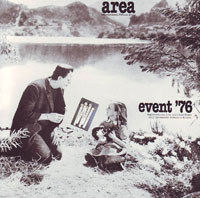 Here's where they really lose the plot, at least for the rockist Area fans. Boasting a somewhat compromised lineup featuring Steve Lacy and Paul Lytton (who sneaked onto Maledetti, if you remember from yesterday's post, and 75% of this album is titled 'Caos part II' so I guess it's the logical followup), this is a full album of free improvisation, containing no trace of the bombastic rock riffs found on Crac! or Arbeit Macht Frei. Despite the jazzy pedigree this is much more akin to NWW-list free playing (ah, that has become a genre of its own now!) such as Jacques Berrocal, Futura label stuff, maybe MEV. But for me this is a great step forward in showing what rock music can be. This whole record is recorded very weirdly - in the red at times, with a strange chorus effect on everything and unusual reverse fade edits popping up, even when the crowd cheers at the end. Lytton's cymbal crashes sound like trashcans and occasionally dominate the proceedings, but it gives the whole record a raw feel that makes the fucked up synths, babbling, and tape manipulations have a rhytmic centre. I love this record and I think it's a must-hear for anyone interested in any of the tangents that cross it: Euro freedom, prog rock, free jazz, musique concrète. But it's really in the context of Area's other work that makes this record slay so much - it's like all of the outtakes and indulgences that they restrained themselves from including on the studio albums - all at once, and all on top of each other. On the cover we get a still from Frankenstein, a scene also featured prominently in Victor Erice's Spirit of the Beehive which I just watched. It's pretty appropriate for the Frankenstein monster on this record: curious, and certainly monstrous, but gentle and approachable. I wonder what the difference is between this recording and what the audience actually heard that night in the Università Statale di Milano -- I'm guessing it was a bit clearer than the saturated sounds on this vinyl, but maybe it was incomprehensible live too. I imagine Stratos running back and forth like a madman or maybe he was just bent over a table of electronics processing his voice. This is a fitting way to end the Area section of the Impenetrable Prog Gauntlet, and I'm sad I don't have Stratos's solo album to be the icing on the cake.
30 April 2009
Amon Düül - 'This is' (Metronome)

You ever wonder why Amon Düül split? I'll tell you the answer - "chops". Amon Düül II, which we'll get to soon, are total wizards with their instruments. I mean, it ain't King Crimson but it ain't the Ramones either. But you listen to this one, and it makes the Ramones look like Yngvie. I'm never one to fellate musicians for their technical ability, and in fact, it's the utter lack of it that makes this record interesting and compelling. The first track is the quintessential hippy strumjam. It goes on and on and on, sounding like a loop of a jam band being filtered through a kazoo. It shifts only so slightly, but mostly stayed locked to it's (somewhat irregular) ryhthm. When the track finally ends (it's hard to tell since the bands aren't clearly marked on the vinyl) it switches to a Teutonic guitar riff for a few moments before the familiar heavy rhythm lurches back into place. Bonehead German hippies - whose fashion on the sleeve make them look more like a biker gang, membership restricted to te back rows of the classroom. Stereo effects galore, mangled vocals, and megathick warm fuzz make a pretty sick blanket to picnic on. Side two "varies" a bit: the pieces open up and changes are actually recognizable. The vocals and synths sound haphazard, if not random, though the songs still don't go anywhere. At the very end we get some heavy tape manipulations overtop of a somewhat more frantic strum; it's fucking amazing and meatheaded and trippy, and unfortunately just too short. I did some Internet "research" to discover that this is the same album usually called Psychedelic Underground, just repackaged/retitled. That is a better title because it really sounds underground, as in covered in dirt and never seeing any sunlight. This (and the two subsequent records) all came from one big jam in '68, supposedly. I like how the songwriting credits on every track are all 'Amon Düül/Amon Düül' - lyrics and music?
21 April 2009
Byron Allen Trio (ESP)
 Source: Jerry's, 4 May 2002, priced at $7 but discounted to $6. Thanks, Jerry!
I'll let you in on a secret about Dislocated Underbite Spinal Alphabetical Encourager Templates: those images you see on every post, of the album under discussion, are mostly stolen from elsewhere on the Internet. I only bother to snap a photo if I can't find an existing image that matches my album cover. So this pristine b&w jpg to the left is actually from Amazon and probably represents the CD issue. My LP, an original on ESP from '65, has this image on a yellowing piece of paper pasted on a thick warped black cardboard sleeve. The vinyl itself is in terrible condition -- probably rated "poor" if I was a collecting type -- and sounds accordingly fucked. The surface noise actually overpowers the music, and let's be honest - this wouldn't be anyone's favorite ESP record anyway. Though that may be because the Byron Allen Trio are a bit overshadowed by some of the label's other big names. I don't know any of these guys but they play well, finding a post-Ornette vibe that keeps taking three steps forward and then two steps to the side. Drummer Theo Robinson plays like a trappier Sunny Murray, and Allen's alto is a sneaky one. Maceo Gilchrist is the bassist but like many of these early ESP sides, the recording doesn't do any favors to the low end so there's points where I have to strain to hear. During his solos the surface noise destroys any hope of understanding but it's cool - it's like hearing a record from 100 years ago. The cover art is actually pretty cool in an introspective/freaky way.
Subscribe to:
Posts (Atom)