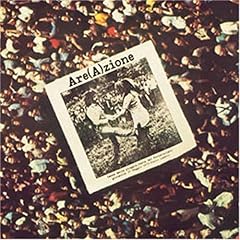
 The cover to this live album suggests that it's taken from a concert in which there are about a million people there, like an Italian Woodstock; the sound is appropriately trumphant for such a grand presentation of Area's music. This record proves that Area were tight as hell live, and the recording is pretty-hi-fi while still containing that 'live' atmosphere. The more experimental side of Area seen on their second album isn't as prevalent here, as the whitenoise/tape manipulations are definitely more a studio thing - but if you like the rock 'n riffs, you'll find much to delight you here. The first side has the crowd-pleasing prog jams, a rock onslaught that never loses sight of pure technical aspiration yet still wets the panties of the screaming girls pictured in the liner notes. Stratos really comes alive on 'La mela di Odessa (1920)', which vamps a bit harder than the studio version (maybe at the expense of dynamic range, but fuck, I should listen side-by-side another time). Side two embarks on a jazz-fusion tip, with a speedy rumble crunch that takes center stage, relegating Mr. Stratos to the background. The album ends with some guitar heroics rather reminiscent of Albert Ayler's most iconic riffs. Now, while this is a cool enough album I don't know why I'd ever really pull it out instead of the studio recordings. I'm sure if I became a die-hard Area fan I'd appreciate the nuances of the improvisational sections here, much like a Deadhead jizzes over millions of alternate versions - but the rest of the Encourager Template calls, reminding me that I have too many goddamn records to give any of them the deep attention that (some) deserve.
HEY! Get updates to this and the CD and 7" blogs via Twitter: @VinylUnderbite
22 June 2009
Area - 'Are(A)zione' (Cramps)

21 June 2009
Area - 'Crac!' (Cramps)
 Is this actually a slight step backwards? I mean, it's awesome for sure, but a bit more restrained compared to the electronic mind-fuckery of it's precedent. The experimentation seems slightly more relegated to the details here; with headphones there's some insane dressing on these salads but not as much meat, y'know? Except for the last song, which is a goofy, lurching stop-start debacle, Crac! is very much a 'prog rock' album. I'm not complaining - I guess Area decided to make Crac! a more "guts" album, and as I listen I can't stop tapping my feet (in 27/9 time) and grooving on it anyway. Demetrio is in fine form, blasting away on the opening track and doing some weird American-accented vocalising on 'La Mela di Odessa (1920)' (which it fits the funk-horn stomp). Ares Tavolazzi's basso elettrico is not just played funkier than before, but it has that somewhat "boingy" quality that you expect from progressive rock. Some of these riffs are epic, and some of the melodies are actually catchy. In "Gioia e Rivoluzione" Area present an actual "pop" song - with acoustic guitar strum, bouncy bassline, and relatively accessibly singing, but I don't think they're selling out - just taking their message of revolution politicalVOCALmusic to a larger audience. So yeah, not my favorite, but bonus points because a 30-year old (perfectly preserved) sticker of the 4xegg cover image fell out of the jacket.
18 June 2009
Area - 'Caution Radiation Area' (Cramps)
 The Italian Get Back gang reissued this in a lovely package with super thick vinyl (preserving the original Cramps label) and a heavy cardstock cover that could stop a bullet; plus they were thoughtful enough to include a plastic inner sleeve mounted inside the paper linernotes, so you don't scratch the record like paper does, but it doesn't bunch up like plastic usually does. This second Area record came out in '74 and it's leaps and bounds beyond their first one. It starts with a super fast keyboard/gutar riff that suggests they've stepped up their game, instrumentally, since Arbeit Macht Frei, but then things start to get weirder. 'ZYG' stars with some arrows of synthy white noise fighting with each other, before forcing itself into a rock structure. Ten-minute 'MIRage ? MIRage !' which opens the second side, is a work of utter brilliance. We get a taste of free jazz; a sort-of-drum solo up against someother tape-affected percussion; a thickly layered bit of Stratos (whose first name is now DemeNtrio) whispering, moaning and gasping; and the usual progrock pyrotechnics though minus a bit of , um, whatever that thing is that Yes does that you hear a little bit of in Area's first album. If there's one criticism it's that the piece just feels like a succession of twisted parts rather than a cohesive whole - but thats totally okay if the parts are this mind-melting. The last track, 'Lobotomia', is the most fucked up of all, with shrill toys, delayed chimes, and the feeling of lifting into the sky. Yep, these Eye-talians have found their voice, and maybe they never sounded more on-target. For a band that's on the Nurse With Wound list, you can sure bash your head to it like it's a dumb guilty rock release. This may be the highest synthesis of all of the different strains of brilliance this band was capable of, balanced across one vinyl disc.
16 June 2009
Area - 'Arbeit Macht Frei' (Cramps)
 Here's the thing about the Discloated Underbite Spinal Alphabetised Encourager Template: every once in awhile, without realising it, you'll find yourself immersed deep into the Impenetrable Prog Gauntlet. It's hard to see the end of it, since there's so many weird angles and changes, and often a good explorer has been known to disappear in the darkest regions of the IPG, never to be seen again. Even though it's against official Policy, I'm gonna warn you that the last record we looked at (Arbete and Fritid) actually was the secret entrance to one such Gauntlet, which is dominated by a gang of mostly Italians called Area. Area subtitled their name with "international popular group" which was perhaps meant to be ironic. They were stridently political, but I don't understand Italian and I have no idea what it means to be stridently political in Italy, since I just assume that everyone is at least somewhat political. After all, fascists and commies are still fire-bombing each other in the streets every week. Therefore, I'm incapable of dissecting the layers of irony and/or passion captured by the title and artwork. I like to think of Area as "prog as fuck" because they employ many of the concepts that have created our idea of Progressive Rock in the 1970s: jaw-droppingly fast contrapuntal riffs, complex neo-classical song structures, the occasional tendency to go super dorky with flutes, 6-string bass or smooth saxophones, and a willingness to fuck around and break rules. How much the latter concept is explored generally has a direct correlation with how much I like a band, because I'm not really that interested in flashy showmanship. Arbeit Macht Frei has showmaship a-plenty, though there's significantly less investment in the rulebreaking category than their later records. But it's a debut album, and a grand statement for sure. Vocalist Demetrio Statos doesn't overpower the band, though his dramatic opera voice may not be for everyone. This is the only Area record I would put in the same box with commercial prog like Yes and Crimson; there's definite group jamming and heavily affected instrumentation (though the guitar and keyboards, which do have great tones, don't leap away from Western tuning or anything). It's only the last song, 'L'abbattimento dello Zeppelin' that hints at the gradual rejection of rock music that is to follow - the contrabasson gets a little bit more free (perhaps in reference to the title), and the guitar solo sounds like it's off a Wooden Shjips record. Statos's weird mumbling/yelling in the middle is layered over some sparse, surreal free improv and it's just weird, man - til the rock kicks back in, or does it? Open up the gatefold cover and it explains all. A photo of a concentration camp bearing the titular inscription, across from a handgun emblazoned with the Area logo - it's like Marco Ferreri's object from Dillinger e morto going head to toe with the forces of fascism, through the music of Area. Or something. I noticed that the musicians all look very tired in the photo; I guess it's hard work playing that fast and intricately.
6 June 2009
Arbete och Fritid - 'See upp för livet' (Musiknätet Waxholm)
 Though Sweden is currently on the tongue of all socialism-fearing political pundits today, it's really not a scary place. Even Arbete and Fritid's masterpiece, this double album, is more inviting than frightening. It's not even close to being their most "out" record, sounding downright 'accessible' at times - but then, there's still the indescribable Weird that is present throughout. There's a lot of singing, sometimes cartoonish and sometimes very human, but the voices never sound like demons or totalitarians. The traditional/folk background is the strong suit of this band and this record shows a lot of it. In fact, large sections of this record feel pretty removed from the Idea of Electricity. Fiddles, bells, and a light acoustic strum drive the second LP face, and some more campfire singalongs pop up at the end of side 4. The modern eruption comes on side 3, which takes on a dirt-encrusted 1970s hard rock edge. But it's the edges of this album that are the most interesting parts, particularly the opening track. It's a long improvised piece, slowly fading in over about 15 minutes, and it's what won me over when I first heard this album. None of the musicians overplay; they all hold back and let space build. It's not the most remarkable atmospheric prog track I've ever heard but something feels a bit special about it. The last side of this double LP is a mish-mash of their many directions. It starts with some lovely guitar soloing over a soft bassline, a Harmonia-style Krautjam with a delicate breath. Later, there's some more folky violin melodies, or at least what I always assume Scandinavian folk is supposed to be sound like. The gatefold LP has a great Exile on Main Street feel and there's a booklet inside with all of the lyrics written out. I'm somewhat glad I don't understand any Svensk - there's some narrated sections as well - cause the lyrics could run the risk of being incredibly stupid. And I'd consider Arbete and Fritid to be some of my favorite practitioners of their genre/s - rock, folk, prog, what have you -- so I don't want anything to destroy that image. There is just so much to hear inside the four walls of this record. There's no better aural experience that can make you l feel like you're sitting in a field drinking a dubiously brewed local intoxicant with a group of old Swedish men that you've known forever yet never met.
5 June 2009
Ara - 'Pick up and Run 2007' (What The ...?)
 Lexington, Kentucky husband-and-wife duo Ara grew out of her solo project; he plays in Hair Police and other weird projects but brings the dirty lightbulbs to this recording. We get two live performances, one on each side, followed by a coda of fireworks and the sounds of "hanging out". It's a weird title, Pick up and Run, as it somewhat jars with the hanging out feeling; the music, well, it loops back on itself all the time too. Ara really showcases Sara O'Keefe's talents with reeds; despite the murky fidelity you can hear a great range of tones. Actually, the murky fidelity enhances this record - it's unmistakably part of the Ara sound, if such a thing exists. The vocals and reverb sing through the vinyl and my copy is a little bit warped so there's an even better ebb and flow to these already elliptical musings. The second side has a drumset, musing in an appropriately lackadaisacal Cloudy Murry manner. When it starts to get too jazz it pulls back into psychedelic folkdrone, and vice-versa; this tension is pretty key to the understanding of the whole album. The self-released cassette, which will maybe be reviewed on the forthcoming Erratic Delusional Majestic Spindle Preprocessor blog, feels like the first step and this a steady gait. We await the gallop (and apologies for the horse metaphor, but, hey, it's Central Kentucky we're talking about ....)
4 June 2009
Aphrodite's Child - '666' (Vertigo)
 Any record that starts out with a chant of 'defile the system!' before exploding into a trumpet-accented psych-pop song drenched in fake crowd noise is A-OK by me. Add in the presence of a young Vangelis Papathanassiou (yes, that Vangelis), a weird inner gatefold painting of a car jacknifing through a brick wall, and the cryptic liner note of 'This work was recorded under the influence of "Sahlep"' and I'm even more interested. Did I mention it's a double-LP concept album based on the book of Revelation? While not as Satanic as the cover/title suggests, it's a scorcher. The album, while long, is pretty evenly split between catchy songs, instrumental rock, and a few 'out' jams thrown in, most notably the song that is just an infinity symbol (awesome idea, dudes!) which has the sexiest female orgasm vocals this side of Brainticket. Though there's some slight Jesus Christ Superstar tendencies, A.C (hey, another A.C band!) employ enough wigged out guitar solos and perfect psych production to make this a total classic. The bass thumps in just the right way, and there's some obligatory Greek instruments to remind you of the flavor of this trip. What strikes me now is how catchy these songs are - Vangelis has some real pop hooks up his sleeve that are best situated alongside West Coast psych like Moby Grape or Jefferson Airplane. There's a few goofy genre excursions, such as 'Who Can Find the Beast?' -- which is a bit too 'Bad Bad Leroy Brown' to be convincing (these are Greeks, after all). Side four opens with the big jam, with some axetastic riffing and mixed-in moments from earlier in the record, before ending with the pure pop of 'Break'. This was a smash hit and deservedly so; if you haven't heard this, seek it out and hold onto your (Greek Orthodox) Bible.
23 May 2009
Anti-Pop Consortium - 'Tragic Epilogue' (75 Ark)
 These guys should have been so awesome. The music media proclaimed that "hip-hop" and "experimental" had finally found their place together, 'cept whenever I listen to this (or, come to think of it, anything else ever described as such) there's too much of the former and not enough of the latter. What makes this so "experimental"? That these guys are kinda nerdy, like weird words, and employ more stoner/lo-fi production methods than radio-friendly rap? I guess I must accept the reality: I just don't like hip-hop; if I want experimental + language I'll go to Robert Ashley or Henri Chopin. The instrumentals are probably my favorite part, which, I know, says more about me than about the music itself. Maybe I'm being too hard on them, but I don't think time has been too kind to this; there's a few 'interesting' elements, but interesting in a Logan's Run kind of way. Maybe they're talking about slingshotting into the sun and walls turning inside out, but it still has that rap diction. That masculine affect is a turn-off; it makes me think that the real radicals are the white kids doing sound poetry in the basements of Columbus, OH and other such dens of weirdness. Saying 'Control-alt-delete' in a rap song was probably a little more edgy in 2000 but now you might as well rap "I'm a Mac, I'm a PC." The Wire used to jizz over these guys if I remember correctly - well, mission accomplished cause they opened up for Radiohead on tour and thus ensured their audience would be eternally white kids who went to college round the turn of the millenium (well .... I must admit, my hand is raised there). Not that there's anything wrong with that - far be it from DUSAET to suggest that hip-hop must have some radical communicative purpose; we're even less keen to engage in stupid debates about 'authenticity' or 'keeping it real' or whatever. And I hope I don't sound too hung up on the white audience thing - there is absolutely nothing wrong with that. My point is that out of the 1,100 or so records that will ultimately get their time here, I feel like I can connect to just about every one of them. This is one where I cannot; and like all 'reviews', this says more about me than the music.
17 May 2009
Antennas Erupt! - 'Magical Energy' (S-S)
 Antennas Erupt! - I guess the exclamation mark is part of it - are some young guys from a jazz background, with a California vibe. Though the horns lean on melody they display a strong predilection for getting 'free with it; still, this record is a million miles from some neo-freejazz ESP-worshipping skronk fest. Instead they bring in some grooving rock structures, and melodies that suggest the finer folk-dance flavors of Black Saint and Sinner Lady, Liberation Music Orchestra, and Carla Bley's work (all of which will be visited in future installments of DUSAET). It's the good side of fusion, though this bears no relation to stuff like Tony Wiliams Lifetime or Bitches Brew. Antennas Erupt! are into the good life - fun and energetic, driving on the freeway with the top down, eating at reasonably priced ethnic restaurants - but with a purpose. Serious, but not too serious. Fun but not too frivolous. They're willing to sing a bit, and compose some great aggro-classical counterpoint, but open up the throttle a few times too. I've seen them live and can vouch that they are a brilliant live experience; despite the relative 'accessibility' of their sound I think they might exist outside of any 'scene', and thus recognition may continue to 'elude' them. Versatility is the name of their game and I have no doubts they could shift between a totally direct message and the wildest explorations of the outer soundosphere. Plus, you gotta love a band with a song called "Healthy Vaginal Walls" that doesn't sound like the Mentors. S-S has done a lovely edition here in white vinyl with a cool blue and white screened foldout cover; I'm not sure if there's any still available but it's definitely worth tracking this down!
11 May 2009
Animal Collective - 'Here Comes the Indian' (Paw Tracks)
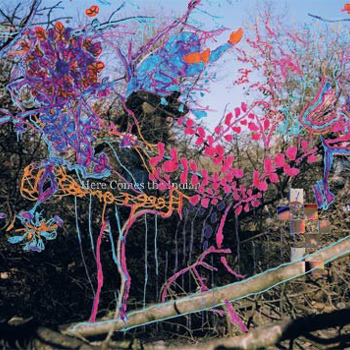 The first record to be feature all four Animals was a pretty big deal in my world when it came out, though I don't think I listened to it nearly as much as I thought I would. More likely I decided it was brilliant and then shelved it and forgot about it under the mountain of other things coming in back then, cause listening now its like I've never heard it before. I mean, those were the days ... before these guys even had a Wikipedia page! The nervous energy from Danse Manatee is there, and there's also some vocal harmonies doubled with heavily processed sounds - the blueprint for Sung Tongs and all that followed. All the scraping and ringing is done in such earnest - it's all so fucking tightly composed and exact - and it really does feel like a 'statement' of sorts. The effects boxes might be a little more overt here, compared to their later (less sourceable) weirdness, being that you can actually recognise the digital delay that's all over this like yogurt on peacock feathers. Mid-00's impressionism can be such a beautiful thing: a million precedents of Other musics and a million refracted walks in the woods, through the glossy-eyed calibrations I and a million peers shared in 2003. Maybe when all is said and done this will be what I remember as their best album; that's often the case with the one just before the "breakthrough" (which usually just refers to terms commercial) for lots of artists. Course, I haven't heard their newest record, which people keep telling me "changes music forever". Even if it did, would I want that to happen? My breakthrough was Danse Manatee - after struggling for so long myself wanting to find pop music as fractured and extreme as what I imagined it could be, that record was it - but this one is no slouch, either.
6 May 2009
Amon Düül II - 'Wolf City' (United Artists)
 We continue our look at "every other Amon Düül II record" with Wolf City, from '72. Post-Lemmings AD2 should really be Amon Düül III, as there's some lineup switcheroos and a fairly new direction, though the Internet informs that there actually was an Amon Düül III in the 1980s, also known as Amon Düül UK. Maybe instead of a new direction it's better to say that Wolf City continues the evolution of trends that are audible back in the Phallus Days. The main trend is really 'songwriting', as this conforms more to a classic pop/rock album, or maybe defining prog-pop (in a dude way, not like Steely Dan). The vocals are way up in the mix and there's a lyrical swing that carries through the whole record. Something feels "tighter" despite the element of 'space' still thick in every song - Germanic space, not American-style open-form space (they're different, really!). The instrumental jam has a bunch of Indian musicians creating a microtonal soup, classic appetizer of the early 70s; somehow it feels like the missing link between the earlier records and this. With all the singing in English, crisp production, and fairly accessible structures, this doesn't feel like das Sellout. Actually the rhythms are crunchy and thick enough that this almost feels like a proto-metal record, reminding me of a band like Budgie. The vocals on some tracks are pure N.W.O.B.H.M., and maybe were heard by a few German kids (the Scorpions?) even if Chuck Eddy calls this later period their "prog-rock downfall". Another stunning gatefold, though this one is less spaceship and more bad trip.
4 May 2009
Amon Düül II - 'Dance of the Lemmings' (United Artists)
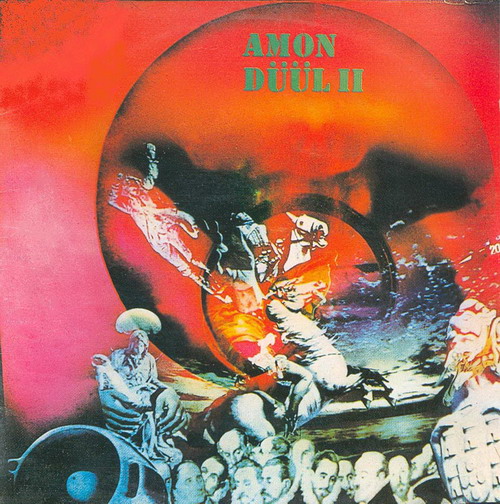 Sometimes I think 1971 was a high point in the cultural ooze, though I'm fully aware that we always fetishize the impossible, and this blogspotter was not yet alive so I guess I'm guilty as charged. Maybe '71 smelled really bad or everyone was itchy, but I think there was something good in the water because first-rate records and films kept shooting out like inchoate meteors. We've had to skip Yeti and jump to Amon Düül II's masterpiece, Dance of the Lemmings. The band is honed down to only four people (since Phallus Dei's covershot suggests it was once quite the party) and they've never been further away from their roots (see our review of This is Amon Düül for more on that). Side 1 is given to the 'Syntelman's March of the Roaring Seventies' suite, and the Krautbuzz rarely has hit peaks like this. 'Pull Down your Mask' is just one of the four parts but the one most memorable for its haunting creepy vocals. Until the end, it's relatively genteel and clean-sounding, yet still trippy, psychedelic, and whathaveyou. At some point in my salad days I figured out that just turning on distortion and volume does not alone make music 'heavy'; weight comes from the spaces between the notes, the timings, and that which cannot by automated. I think 'Syntelman's March of the Roaring Seventies' taught me the same thing about psychedelic music. It's postively barren and sparse when compared to today's hordes of knob-turning noise kiddies, but more 10th dimensional and mindbending than most 'psychedelic' dross. And it's a bad trip, indeed. It's like the band has reinvented itself from prog nerdlers into utter bummermongers, and nothing could be more perfect to usher in the decade of bad vibes that was to follow. Even the back cover, with scary goat-skull-tree-man on a comfy sofa, screams 'stay the fuck away'. And the scythe-wielding Amon Düül logo is rendered in a way that would make even the most hardened suburban metalheads skip a breath and force out a "cool". But can they keep it up over the course of a double album? Of course they can, and they do, and it's the second side where we get the walls of burning solder, sawing folk fiddles and klassic kosmische edges. Plus, for a few bars they kick this perfect hip-hop beat. The third side is a soundtrack that is obv. more improvised than the first half but still has some insane movement. There's a lot of piano and some swell bass drones; it all feels a bit edited together, but that's okay cause I'm not a purist about those things. This may be the closest to 'jazz' we've seen from AD2, though it's really space-jazz. Bonus points for the records being split into sides 1+4, and 2+3 -- a testament to the olden days of those record flipping contraptions. I believe we could press a 2xLP like that today and call it a "throwback". Side four brings us back to the 'songs'. This side is instrumental, in the classic rock rifftastic arterial way. Some weird editing at play: halfway through, one track fades out on a flange-heavy drumbeat and then after a moment of silence, fades back in with the same beat. A bit of conceptual brilliance or the only way to cover a mistake? Also, is it just a bit stereotypical to make side 3 your "extended jam" side and return to songs at the end? Though maybe this defined the trend. I feel like I should say something about lemmings, who are thought of in popular culture as suicide-prone little creatures and thus an appropriate metaphor for the dark vibes of this album. But actually, lemmings have no such inclinations - this is just some murderous lies spread by the Disney corporation. And I've also made it through this whole review without mentioning the amazing spaceship gatefold, complete with primitive PDA and space-elephant.
2 May 2009
Amon Düül II - 'Phallus Dei' (Sunset)
 The more technically skilled side of the Amon Düül collective made this first album in 1969 and started a whole new strain of German rock music that is still influencing kids today. The first side is surprisingly conventional rock, though of the very progressive variety, if progressive means lots of chord changes, modal riffs, and polyrhythms. Side two is the 20 minute title track - which is a pretty great title, if you sprechen sie bit of Deutsch - and it starts off in a very progressive way, if progressive means dark synthetic hellbeast screaming drone vortex. It falls into place though with the ragin' riffs and rhythm shifts, before taking on a weird neo-classical/folk content. Maybe I just get all tingly whenever I hear a violin being played like that but I think they were really looking at Grosse Bretagne. When you can feel the fire ticking it's most effective, but I keep thinking ahead to Yeti (which sadly won't be reviewed here, as we don't have a copy) and the gnarly wizard cookout that was to follow. I'm pretty sure I saw a Kurt Kren film one that had this album as the soundtrack, though it looked more like the proper German cover than this disappointing British value series cover. Interesting though: the back cover touts some of the other records in the series that may be of interest to Amon Düül fans, such as Shirley Bassey and Del Shannon.