 America Records is actually a French label but the liner notes don't tell us where this was recorded. The title could mean many things - some intergalactic plan to rule the world, or some special instructions for hooking up your speakers in some Brian Eno method - but really I think it's misleading, cause this sounds to me like the beginning of phase TWO for the AE of C. The record opens with Jarman's 'Ohnedaruth', a swirling mass of oceanic cymbals that explodes into full-on, free, loft-style blowing -- and it never lets up. There's solo after solo and the guys sound great but the intensity never lets up and it becomes a bit, I dunno, horizontal? Bowie somehow manages to sound a bit richer than the rest though maybe that's just my bias. The second side is a tribute to Albert Ayler wonderfully titled 'Lebert Aaly', except it makes me think that my sides might be mislabeled. Cause, the rocking reverberations on 'Ohnedaruth' sound more like the ESP-styled Ayler records, almost like these genre-busters are dipping into a genre to show their affection for the then-just-deceased Cleveland gale. 'Lebert Aaly' would actually resemble a Jarman composition more, with it's open cadences, thick chords, and careful pauses. It's definitely more on the modern classical tip and why would you compose a tribute to Ayler in that style? It's not a eulogisin' piece, at least not to these ears. But that doesn't mean I don't think it's beautiful and dynamic and shows (on yet another LP) a different side of these dudes from the 11 sides we've already heard.
HEY! Get updates to this and the CD and 7" blogs via Twitter: @VinylUnderbite
15 July 2009
Art Ensemble of Chicago - 'Phase One' (America)
America Records is actually a French label but the liner notes don't tell us where this was recorded. The title could mean many things - some intergalactic plan to rule the world, or some special instructions for hooking up your speakers in some Brian Eno method - but really I think it's misleading, cause this sounds to me like the beginning of phase TWO for the AE of C. The record opens with Jarman's 'Ohnedaruth', a swirling mass of oceanic cymbals that explodes into full-on, free, loft-style blowing -- and it never lets up. There's solo after solo and the guys sound great but the intensity never lets up and it becomes a bit, I dunno, horizontal? Bowie somehow manages to sound a bit richer than the rest though maybe that's just my bias. The second side is a tribute to Albert Ayler wonderfully titled 'Lebert Aaly', except it makes me think that my sides might be mislabeled. Cause, the rocking reverberations on 'Ohnedaruth' sound more like the ESP-styled Ayler records, almost like these genre-busters are dipping into a genre to show their affection for the then-just-deceased Cleveland gale. 'Lebert Aaly' would actually resemble a Jarman composition more, with it's open cadences, thick chords, and careful pauses. It's definitely more on the modern classical tip and why would you compose a tribute to Ayler in that style? It's not a eulogisin' piece, at least not to these ears. But that doesn't mean I don't think it's beautiful and dynamic and shows (on yet another LP) a different side of these dudes from the 11 sides we've already heard.

9 July 2009
Art Ensemble of Chicago - 'Les Stances a Sophie' (Nessa)
 This seems to be one of the more popular Art Ensemble of Chicago records, though I doubt that anyone has seen the film of which it's the soundtrack to. There's a good reason for this enduring popularity of this record - it fucking slays, and opens with 'Theme de Yoyo', a rolling fun jam with Fontella Bass's playful lyrics. It's certainly odd hearing these guys laying down a straight pop song - even straighter than the Brigitte Fontaine material - but it's full of soul and energy, and it's bouncyness seems to suit the band well. This is the first time we get Don Moye in the band, though he hasn't really hit his stride -- he is simply the drummer here, not yet ready to put on the facepaint himself. But really, this is the least facepainty AE of C record out there. The slow, neoclassical steps taken in the middle of this record have a cool, modal detachment that suggests they were watching a lot of Nouvelle Vague films during their stay; not having seen 'Les Stances a Sophie', I can't be sure, but I imagine these slow, spaced reeds paint a perfect backdrop to whatever the film is about. We get variations on a theme by Claudio Monteverdi split across the middle of the album and maybe that's the true highlight of this record for me. Over all these albums I've heard the Ensemble play raucous, genteel, loose and tight, but these Monteverdi cadences are a beuteous ramification of Western tradition streaming through the masks. Fontella Bass comes back at the end and this time they rev up the engine, letting her rip too. It resembles those early Gunter Hampel sides at times though with something, I dunno, blacker, about it all. If Putney sed the Borman 6 girl's a-gotta have soul you'll find it here, but with a stack of Ishmael Reed novels too.
5 July 2009
Art Ensemble of Chicago - 'Certain Blacks' (Inner City)
 This used to occupy the spot of "least favorite Art Ensemble record worth keeping", for I perceived it as only pseudo-AEoC. The lineup contains Chicago Beau, Julio Finn, and William A. Howell, and none of the three compositions are by the "actual", "real" Art Ensemble members. This record is copyrighted 1976 and I saw this as the beginning of their downfall, but I couldn't deny some pretty killer grooves here so I kept it in the collection. Now I read that it was actually recorded in 1970, in Paris (which is not owned up to on the sleeve) so now it's recontextualised - some Chicago friends came over to visit, perhaps, and they had a recording session where they decided to let loose a bit. The visitors led things, and they decided to rock out with their cock(s) out, for once, right? And now if I think of this as fun and stop worrying about it being a great artistic statement against the already mighty pantheon of Art Ensemble releases, I can really enjoy it. The first side is "Certain Blacks" with a goofball chant that comes and goes around a total American-style loft jam. There is a more gutbucket approach here - maybe it's Finn's harmonica but it just feels ballsy and bluesy, melodic and dissonant at the same time. Howell's drumming is propulsive if not particularly distinct and it keeps things going. I guess if I was more of a student of the reeds I could hear the tonal aspects that identify the Art Ensemble's signature, but it all gets lost a bit through the new veil of, gasp, accessibility. Side two is even more "inside" - it opens with "One For Jarman", a clean, open descension around Beau's piano riff. It recalls some of the bouncier bits of side 2 of Chris McGregor's Brotherhood of Breath record, though with somewhat more translucent intervals. The last piece, a Sonny Boy Williamson jam, is like a bar room brawl magnified by a muddy trench, and it ends with the most bombastic, direct groove ever released under the Art Ensemble moniker. (Well, at least out of what I've heard). It's cool to embrace your roots and around the time this record was actually released I think they were starting to head in that direction.
4 July 2009
Art Ensemble of Chicago - 'Live in Paris' (Get Back)
 Wikipedia incorrectly reports that Don Moye plays on this, which is an easy guess to make since this came out in '74, but the recording is from '69 in pre-Famoudou Paris; I'll stand by the liner notes. But more confusing is the essay in the gatefold, which is from the late 70s so it refers to events that haven't happened yet when this music was being made. Also I should note that my cover is slightly different than this as the word "Live" is actually in grey, and it says "Live in Paris" and the Affinity logo isn't in the bottom right. A beautiful black gatefold with four black sides of great black music - about 100 minutes of it! The first record is "Oh Strange", supposedly a Jarman/Bowie tune though it sounds like a group improvisation if I've ever heard one. It's long and sprawling and it changes a lot but has some absolutely jaw-dropping moments of groupthump. At one point near the end of the second side the band shifts into a detuned, strummy banjo-led bit but instead of referencing some American folk music or country lineage, it's a warped abstracted soundworld. If you told me it was some cassette from the corners of the American underground avant/noise scene of maybe 3, 4 years ago, I would have no reason to doubt you. This prescience is evident at all points of the piece but it sounds most 'current' here; clearly, the rest of the world is still catching up to these guys. The second LP is "Bon Voyage", penned by Bowie, which explodes with a drumset-led freeform freakout. I assume the drums are being played by Malachi Favors though we also hear bass and marimba or vibes or something pulsing underneath. Whoever's doing it is a madman, exploding in little shouts with a rampant nervousness that drives the horns to accelerate towards the sun. Bowie is seriously one of the most expressive trumpet players ever, even if he's just shooting flutters to the winds - they feel so human, and so warm, that they bring a dynamic basis to the colder moments. When it finally starts to settle down we get a really melodic, repetetive trance and then special guest Fontella Bass, aka Mrs. Lester Bowie, chants with the rest of 'em. This record really sounds 'live'; great fidelity, but you can hear the room and feel the energy of the audience (Ils ont été perplexe, non?). I don't mind the fadeouts at the ends of sides 1 and 3 either - it's almost necessary to have a breather in the middle of these dense pillars. Listened to chronologically (by recording date, not release) it's a nice release after all the carefully calculated space on the last couple of records. Some might decry that they've moved into a more traditional free jazz area here, but there's still so much depth and sensitivity in their playing that's more like they moved free jazz into their area.
3 July 2009
Art Ensemble of Chicago - 'Reese and the Smooth Ones' (Get Back)
 I hate to keep comparing each Art Ensemble release on these blogs to the previous ones, but when you're dealing with 9 albums in a row by a single artist you tend to look for continuity. If their Paris soujourn (which is our starting point in their discography) began with the 2fer CD of Jackson/Message's playful, maybe even zany, excursions -- and was followed up by the somber, tentative People in Sorrow - then Reese and the Smooth Ones splits the difference. Which is to say that this is a complex beast, a work that is decidedly more distant than its predecessors. The two sides are strangely labeled as both "Reese", a Roscoe Mitchell compositions, and "The Smooth Ones" by Lester Bowie, but it's not delineated where they begin and end, and if "Reese" starts side one followed by "The Smooth Ones", it also starts side two and "The Smooth Ones" comes back as well. What this label might be saying is that the whole record is one piece that is simultaneously Mitchell's "Reese" AND Bowie's "Smooth Ones", and that neither begins nor ends in a traditional sense. Though we don't have two compositions being played on top of each other. The opening of this record is a very exact, synchronised group-step that is cranked up with distorted tones and buzzing. It's like the dirty, cheap-amplification sound of Konono no 1 only human breath alone drives this clanging. The intonation is slightly off, or maybe it's supposed to sound detuned or microtonal or something. But what does it say? This may be the first occurance of the noted "difficult" sounds of the Art Ensemble, for as non-traditional as their earlier records are in terms of style and aesthetic, there is something very direct and fluid there. But here, I'd even say it's cold. When it stops and shift to the quiet/sparse vibe you feel like the Smooth is making it's presence felt. But as the momentum starts to pick up, we get oddball instruments thrown in - gongs, steel drums, other weird pieces of percussion - and full on tribal drumming by the end. It continues for awhile and feels so herky-jerky but kinda awesome, cause all those screeching sax lines and crashing cymbals reach the ecstatic pulse but not in an ESP/loft way. It's like, Paris, man, and Chicago too - the CTA superimposed on (Malachi dans) le Métro, a screeching out-of-control subway with the physics all wrong smashing through the Mediterranean and ending up on some African savannah. The heat musta been sweltering in Studio Saravah in the middle of August; I bet they didn't have any air-conditioning. Post-Varèse neo-classical composition can meet traditional African flavours, and it can knock your socks off if you're in the right mood. Prepare to feel your brain and your blood both reverberate.
Art Ensemble of Chicago - 'People in Sorrow' (Nessa)
 I couldn't find a cover via Google image search that actually looks like mine, which is yellow ink on a white background. It's a truly beautiful (if hard to read) design that is sadly marred by some magic marker scrawlings on the back of my copy. But the sounds within are beautiful and unmarred, unless you count elegiac misery through tonal illusion as some form of detriment. This long piece, split onto two sides, is the yang to the yin of Jackson in the House/Message to Our Folks. Whereas those pieces were chaotic, lively, and exuberant, People in Sorrow is an apt title. This is much closer to Roscoe Mitchell's Sound: space breathes, the notes expand, and there are some definite throwbacks to ballads of jazz past, though through a damaged prism. At times it feels like each of the four musicians are wandering through a desert, conserving their energy yet crying into the wind. There are moments of Third Stream/post-modal hoohah, but undercut by little bit of percussion and, whattatheycallit, "little" instruments. To go back to the cover art, it's interesting how stark and monochromatic the jacket design is, because this music is pure colour. These Paris Art Ensemble records are so special for many reasons. Before Don Moye joined the group, these guys took it upon themselves to provide the rhythm - I mean, they had to. But instead of making Malachi Favors carry it all they equally share rhythmic duties as well as all other soundroles. It's part of their approach - it's what makes them an Ensemble, right? And those early Chicago AACM sides (the solo Mitchell and Jarman, plus early Anthony Braxton -- all of which we'll get to later) are such a bold statement of a sound, that I can't help but feel that the Paris residency was partially about spreading this new gospel. When you listen to People in Sorrow - or rather, when I listen to it -- I hear four geniuses who grew up in the tradition of jazz but have decided to strip away the composition and leave only the feelings, images and accents. There are gestures back to a lot of things - Third Stream as I said before, but also Bowie's utter passion for Dixieland creeps in even on this most wispy of Art Ensemble releases -- but it's never concrete enough to materialise. Dislocated Underbite Spinal Alphabetiser Encourager Templates is proudly supportive of music that dissipates before it is being played; and yet despite our enthusiasm, this probably isn't the first record we reach for when looking to jam these guys. But dark moments are never easy.
28 June 2009
Art Bears - 'The World As It Is Today' (ReR)
 A title like this would suggest a bold statement of an album, something both philosophical and direct. Well, sure, this is the pen of Chris Cutler, after all. If you didn't think the man who wrote File Under Popular could knock it out of the park, then you're truly underestimating him. This is concise - a 45rpm mini-album, maybe a long EP - yet leaves nothing to be desired. The lovely little booklet rearranges the running order into a three lyrical groups. 'Law', 'Democracy', 'Truth', 'Freedom', 'Peace', and 'Civilisation' are classified as "6 corpses in the mouths of the bourgeoisie", but despite this heavy concept, the songs are light as air. I often forget how traditional the Art Bears actaully could be, at least in terms of instrumentation; most of these songs are drums, piano and guitars and they achieve their innovation largely through structure, composition and affect rather than effect (if you get my drift). Though 'Civilisation', at the end of side 1, is a thick, slow composition that sounds like Morton Feldman pushing a pram. It hangs in the air and never lets go, always on the verge of resolution. Vocally, Dagmar is perfect -- I can't imagine anyone else interpreting a song that is somewhat anti-democracy and transforming it into something so magical. The second lyrical group is "4 songs" and contains catchy tunes like 'The song of the Dignity of Labour Under Capital' which is more like Brecht than Engels, thankfully. The final standalone song is 'Albion, Awake!', ending the album (and the career of Art Bears) on a platform of hope, though first transformed through the most tape-manipulated section of the band's ouvre. Perhaps this twisted unraveling is an abstracted musical story of the workers of the world. The final line is 'Let banners fly like shrapnel and efface the sky!' and while I jump up with my red flag, I then think to the reality of everything that has happened since 1981, and then I get depressed, and then I just listen to some more records to wash away the pain. The real pain, of course, is that my copy of this is slightly warped, which renders 'The Song of Investment Capital Overseas' and 'Democracy' rather unplayable.
Art Bears - 'Winter Songs' (Ralph)
 I'm not sure where the idea of the "power trio" first came from, but I think it should apply here. There's not a weak link in this triangle. My copy of Winter Songs is missing an inner sleeve -- I image lyrics and credits or some sort of liner notes should be there. So I don't know if there are lots of guest musicians present or it studio magic and overdubs are being used to make this mix so thick, because it can't be Frith playing the bass and the piano at the same time. It doesn't really matter except that I wanted to talk about how in addition to the peerless compositions on this album, the actual playing is remarkably expressive. On a song like "The Summer Wheel," Frith and Cutler are so in-sync that it's hard to believe. Cutler's drumming is so languid, yet with a momentum; Frith chases after it, and occasionally kicks it forward like a stone being kicked down the road. If Hopes and Fears is their pastoral record, this is their gothic one. Although there's still an overall medieval theme in the lyrics (and artwork), this is the sound of the black death. The earthy chord changes are gone and in place are strange intervals and macabre tunings. Even if the piece is someone bouncy, like '3 Figures', there's something still a bit doom 'n gloom going on. 'Rats and Monkeys' was a single from this album and it's easy to see why Ralph records would jump on it. The frenetic pace, layered affected vocals and herky-jerky violin part make it feel like the end of the world is happening. Krause really explodes here; most of the vocals are double-tracked or more, and she seems more inspired. The gusto is used to dramatic effect - she has a way of turning on the electricity in a way that the most powerful vocalists in music can do (Beefheart comes to mind, actually). With the political changes going on in Britain when this was recorded, you can feel the rage seeping through tone-refracted misery. The UK was entering a long winter and these are the chronicles. If this is a protest album, its avant-obfuscations probably meant they could only preach to the converted. I first heard it too late anyway - well into the reign of New Labour, which is a whole other can of worms, a horror probably unthinkable to them at the time.
27 June 2009
Art Bears - 'Hopes and Fears' (Random Radar Records)
 Art Bears are the cream of the crop from that whole scene of musicians that are sometimes called R.I.O. I mean the intellectually-motivated, politically strident, highly prolific gang that stemmed out of Henry Cow (represented by one of those rock music "family tree" diagrams in an insert that came with the first Henry Cow CD boxset many years ago). And oh, what a crop to be the cream of. I don't need to list the many accomplishments of Messrs. Cutler and Frith, and Dagmar Krause is a figure who will pop up several times on this blog. And when I say Art Bears are the best, I don't mean to slight the Cow, the Work, the Lowest Note on the Organ, Lindsay Cooper solo, the Catherine Jauxniaux stuff, Aksak Maboul (who I'd probably have to say are worthy of joint 'cream' crown-sharing), La Societe des Oiseaux etc. It's just that Art Bears were particularly revelatory to me. Prog is a great egg to start chipping away at, and Henry Cow were one of the first prog bands that appealed to me, but Art Bears were ultimately more my thing. I guess it's because they adhered to song structures while maintaining an uncompromising approach to experimentation - not that they are the first band to ever do this, but they do it in a way that blends their incredible eclecticism with their own personalities. There are enough artistic brushstrokes to tickle under the testicles of the sublime, yet still with a coherence that is very direct. Hopes and Fears is their first album, and it actually emerged from Henry Cow sessions. It's funny that this is thought of as being a Henry Cow album since it feels like the most stripped down and simple Art Bears record to me (while Winter Songs, recorded as a trio, feels much more dense). Maybe that's because the songs on HaF have a somewhat folky feel, with a lot of guitars and keyboards, though they occasionally explode into anthemic, driving rock (check out 'In Two Minds', which Wikipedia claims is influenced by the Who but I think that's just cause the piano line is stadium-rockish). This album feels really pomo-rustic to me, like you're walking the Yorkshire Dales but still thinking about the contradictions of capitalism. The lyrics touch on self-reliance ('Labryinth'), surrealist feminist narrative ('Joan'), media ('The Tube') and I think romance though maybe just relationships between humans -- yet the whole album feels infused with someting distinctly British. It's like there's a current that drains through the whole history of music from the British Isles and Hopes and Fears is just another stone in that stream. Dagmar's German accent doesn't alter this, but maybe I just associate her with this sound so much that I've given her an honorary U.K. passport. The bouncy instrumental bits make distinct overtures to these antecedents, though I really feel it more in the lyrics, which often strike pastoral chords in me. Also, most of these songs could be set in any period in history; there are few words that indicate that this record was constructed in the late 1970s. The more wild musical adventures are really going to come on the next two albums, though there are some chilling effects on the instruments. 'The Tube' in particular is a clawing, braying maelstrom of dark drones, and if you mixed out Dagmar and told me it was late Shadow Ring I'd never doubt you.
25 June 2009
Areski & Brigitte Fontaine - 'L'Incendie' (Get Back)
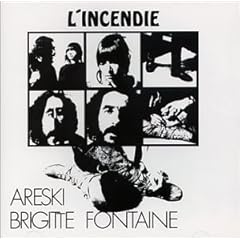 Areski and Brigitte Fontaine make such a cute couple; he's the bearded musical voyager and she's the arty answer to ye-ye pop. Together they were the Gallic version Richard & Mimi Fariña, or maybe Mickey and Mallory. Now, my French is barely beyond high school level so I don't know what the hell they're singing about and I'm afraid to stop and figure it out, but there's a pleasure to be found in ignorance. Side A has Areski's darkly shadowed face on the label. The nursery rhyme glow is there on some songs ('Le 6 Septembre'), sung like a round or other sort of children's workshop. We also get whacked out porn guitar behind Brigitte's fantastic voice ('L'Engourdie') and then dark medieval churchy dirges like 'Nous Avons Tant Parlé'. It's a grab bag of sounds from the 60's/early 70's, with the Eastern vibe laid on thick. When you flip to side B (so you can look at Brigitte's face spinning), you get Areski's solo vocals over bongos and snakecharmer flutes. It's one of only 2 songs over 3 minutes, yet it feels particularly long because it's Brigitte who I came to party with and I can't hear her. But the other "long" track is the whispered 'Après la guerre'. Intimate and kinda sexy, with the odd plink and pluck in the background, it's like that scene in the Blair Witch Project where the one girl just puts the camera on her face in the dark and cries about how scared she is. I thought L'Incendie was their first album but it's hard to tell since when Get Back reissued it, they didn't bother to include any additional contextual notes, such as a date. Some Google 'research' places it at '74, and therefore after Comme la Radio, but I always thought it was '71 and had filed it before. So now when writing this, I have to save this draft til I've reviewed Comme la Radio which means I'm listening to them out of order, an error I will correct when I refile (so Encourager Templates take 2, coming in April 2012, doesn't make the same mistake). Which means this bit I wrote below is now totally wrong and irrelevant, but instead of recycling it for a future qualifying post I'll just dump it here:
I'm always really interested in the records made just before the unfuckwithable ones. I'm drawn to records like The Colour of Spring, Vampire on Titus, The Dreaming - slightly flawed, perhaps, but made during a creative stride with the masterpiece just visible in the distance. Sometimes I like these predecessors even more than the "big" albums, plus sometimes you've listened to the more acclaimed album too much. I recognize Comme la Radio as the masterpiece but have more often pulled out L'Incendie because of this factor. I've always imagine Fontaine as the one calling the shots (despite Areski's top billing - I mean, that's just alphabetical, right?) and feeling frustrated at all of the fruity arrangements - that despite this record's eclecticism, it still just wasn't quite right, ie: she's almost there, but not yet. And only when paired with the Art Ensemble of Chicago do her songs really explode into something magical, but she had to wait til the next album for that. So knowing this, it's improved L'Incendie a bit in my eyes -- you can hear the hesitation, the uncertainty, the hope. And ending with 'Le Chant des Chants', so strident yet abrupt, waiting for a coda that is yet to come.Yeah, well, screwed that up for sure....
24 June 2009
Areski & Brigitte Fontaine - 'Comme la Radio' (Editions Saravah)
 Sometimes a few minds come together and make a record that exists in its own magical vacuum. I'll probably say that about a lot of albums throughout the duration of this lengthy project but you'll just have to get used to my repetition, repetition, repetition. Due to my idiosyncratic filing system, I keep this under 'A' for Areski even though it's really Brigitte Fontaine's show. This is because I owned L'Incendie first, where Areski gets top billing; when I finally scored a vinyl copy of Comme la Radio (a dream fulfilled, really), I didn't bother to refile. Plus I quite like it in the A's because it's rather close to the Art Ensemble of Chicago, the 'backing' band on (some of) this record, who we will be visiting again very soon. So yeah, this record is awesome, by which I mean it's totally mindblowingly great if you like folk or jazz or foreign people or psychedelic music cause it's all of those things plus more. It's like an ice cream sundae with a rainbow streaming out of it. Fontaine's songs are kinda long and jammy, almost in an Astral Weeks way, though the instrumentation is really sparse and the production -- my god, the production! This record sounds a bit like it was recorded in a mailbox, though that suggests that it's thin which isn't really right. Maybe it's better to say it's "distant". And kudos for that - it's probably hard to make a record with the Art Ensemble of Chicago and keep the reeds mixed low. But Areski and Fontaine realised that the beat is the real current they want to ride, so the percussion is up front, the vocals are flush up against it, and the other instruments are there, but not in the forefront. This was made after the Art Ensemble had been in Paris for a few years, and they were about to go home and hook up with Don Moye and enter a whole new period. By it's very nature the songs are gonna hold to a more rhythmic structure than what these dudes were laying down on Tutunkhamen, Reese and the Smooth Ones, etc. - but it feels like the dark side to the Les Stances a Sophie material. Areski's presence is really prevalent too, at least one assumes the dark guitar stuff is him, and he sings lead on 'Le Brouillard' but it's cool. And the credits indicate that most of the percussion is him, though it's clearly funked up by Malachi Favors. But it's clear Fontaine is the driving force behind this. I've always had a real starry-eyed view of the French idea of "pop", probably influenced by a teenage appreciation of Stereolab and Godard films. Side one feels almost like a new form of pop being invented. Side two is the more exploratory side and it burns with a pulse that synthesizes a bunch of disparate strains of humanity. Lyrics, well, I don't know really even though they are printed in a nice purple ink;; I'm happy to just smile and let it all wash over me.
23 June 2009
Area - 'Event '76' (Cramps)
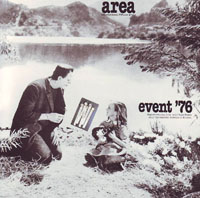 Here's where they really lose the plot, at least for the rockist Area fans. Boasting a somewhat compromised lineup featuring Steve Lacy and Paul Lytton (who sneaked onto Maledetti, if you remember from yesterday's post, and 75% of this album is titled 'Caos part II' so I guess it's the logical followup), this is a full album of free improvisation, containing no trace of the bombastic rock riffs found on Crac! or Arbeit Macht Frei. Despite the jazzy pedigree this is much more akin to NWW-list free playing (ah, that has become a genre of its own now!) such as Jacques Berrocal, Futura label stuff, maybe MEV. But for me this is a great step forward in showing what rock music can be. This whole record is recorded very weirdly - in the red at times, with a strange chorus effect on everything and unusual reverse fade edits popping up, even when the crowd cheers at the end. Lytton's cymbal crashes sound like trashcans and occasionally dominate the proceedings, but it gives the whole record a raw feel that makes the fucked up synths, babbling, and tape manipulations have a rhytmic centre. I love this record and I think it's a must-hear for anyone interested in any of the tangents that cross it: Euro freedom, prog rock, free jazz, musique concrète. But it's really in the context of Area's other work that makes this record slay so much - it's like all of the outtakes and indulgences that they restrained themselves from including on the studio albums - all at once, and all on top of each other. On the cover we get a still from Frankenstein, a scene also featured prominently in Victor Erice's Spirit of the Beehive which I just watched. It's pretty appropriate for the Frankenstein monster on this record: curious, and certainly monstrous, but gentle and approachable. I wonder what the difference is between this recording and what the audience actually heard that night in the Università Statale di Milano -- I'm guessing it was a bit clearer than the saturated sounds on this vinyl, but maybe it was incomprehensible live too. I imagine Stratos running back and forth like a madman or maybe he was just bent over a table of electronics processing his voice. This is a fitting way to end the Area section of the Impenetrable Prog Gauntlet, and I'm sad I don't have Stratos's solo album to be the icing on the cake.
Area - 'Maledetti' (Cramps)
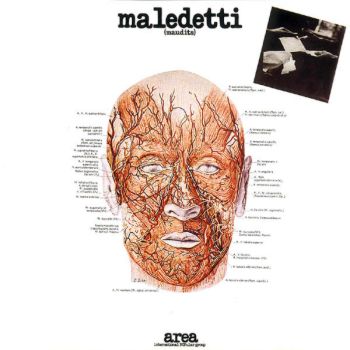 And now, my favorite Area record -- or did I say that about Caution Radiation Area? -- Maledetti is all things to me. It's their most surrealistic and fucked up record, both in the overall Dadaist structure and in the incredible, genre-best closing track 'Caos (parte seconda)' . It's also (I will argue) one of their most complete records, as there's a little bit of everything here. In a perfect world, their reputation would rest on Maledetti alone. You get snippets of a very jazz-oriented Area, perhaps the jazziest we've heard yet with a real McCoy/Garrison current in 'Gerontocrazia' and also an extended lineup that features Steve Lacy and Paul Lytton. The chord changes, complex time signatures, and blister-inducing rapid instrumental passages are here too. You get a second side that in addition to the insane 'Caos' jam (which sounds like Jac Berrocal after eating too much spinach, while watching Benny Hill episodes with the sound muted) opens with a "massacre" of the Brandenberg concerto. You get a track that is Valerie Solanos's 'scum' manifesto set to music, vocalised by the one and only Demetrio Stratos (I've noticed that the spelling of his surname changes from album to album, though there's actually a signature in the liner notes for this one). And you get the surrealist flag in vibrant colors, raised on the opening track 'Evaporazione', which sounds like the tape recorder accidentally left on and is a brilliant and insane way to begin an album. This isn't all "out" like the next entry in our Area gauntlet is, but just bizarre enough to achieve, I dunno, perfectione? Great artwork too; if you ever had any doubts about why Area were on the NWW list, start here. What's the criticism? That it's too short? But not really, cause it doesn't even leave you wanting more. It's often easy to be distracted by diverse sounds. I'm not necessarily impressed by an artist who merely demonstrates that they have a big record collection -- I mean, you can always start an alphabetic blog to do that! We all have shitloads of influences but if you can't take your precendents and make it into something that is yours, then what are you doing besides recycling other records? Area manage to find the perfect balance here - the jazzy parts may trigger a million associations in my mind, but ultimately it's still Area. We get a few measures of Terry Riley, a few measures of Cage, a few minutes of Bach - but it's chewed up and digested and magnified by Area's own brilliance. Soldier on, boys. Though the end is nigh.
Subscribe to:
Posts (Atom)