I fell in love with Microcastle while falling asleep to it every night on earphones, during a tumultuous period of my own life. Bradford Cox's subtle songs really spoke to me then - I began to imagine deep rivers of melancholy underneath what would otherwise be simple, even gothy lyrics. This is a 'mellow' album, akin to low-key classics like Mekons Journey to the End of the Night or Big Star's third album. That's not to say Deerhunter doesn't function as the exploratory rock band they established themselves as in previous releases - especially on side 2 - but that there's less of a bass-led groove here, and this is a record more concerned with melody, lyrics and texture than jamming out. Maybe this explains my love for Microcastle - even though it's a 'breakout' album, it's somewhat of a departure. The record opens with 'Cover Me (Slowly)', a slow instrumental intro, starting the theme that's expanded in 'Agoraphobia'. This immediately marks a distinct change from Cryptograms-era Deerhunter - it's much more dry, more precise, and almost overly mild. Actually, it sounds just like the song 'AT&T' by Pavement, and this might also be why I fell in love with it. Microcastle veers between songs of desolation and strange, missing nostalgia, always rooted in pain and loss. 'Little Kids' is a built around an addictive melody, with a guitar riff that could be sing-song cute in another context. It's a song that paints a dark portrait of adolescence, which slowly ascends into a thick sheet of soundhaze without ever letting go of it's sing-along chorus. Most of the delivery on Microcastle is slow and restrained; the image of death lingers over everything, but you have to really work for it. The title cut is a beautiful minimalist sketch built around Cox's voice and an electric guitar which, when it finally explodes into the full-band stomp, has quite a payload. 'Calvary Scars' continues this wobbly, sparse delivery, letting the guitar overtones quilt up behind the voice; 'Green Jacket' fades to almost nothingness. The flipside starts with the melting shimmery 'Activa' before breaking into 'Nothing Ever Happened', the clear 'single' from the record. This twisting tune is driven by a strong bassline and it feels like a holdover from Cryptograms - not the waxed-paper vision of the rest of the album, but an appropriate inclusion anyway. The tune ends with a dizzying, descending guitar line that has traces of the Feelies around the edges. The jangle creeps in throughout the album, sometimes just as colour and sometimes as structure. 'Never Stops' and 'Saved by Old Times' both employ a confident 4/4 drive around their moaning, yearning tales of seasonal affective disorder and living in the past. A great album,yeah, but it's only half the package; like Cryptograms, Kranky is making sure I get my money's worth of Deerhunter for this purchase. Weird Era Cont. was thrown into this as a second LP, intended to be some sort of bonus album to combat leaked mp3s, or something like that. It's a bit of a Dead Letter Office, consisting (I guess) of Microcastle outtakes, but it's still pretty solid. The most successful tracks are fast rockers, such as 'Focus Group' and 'Operation', yet they're still holding a more stripped-down feel than anything on the regular album, which suggests that these tracks are unfinished. But a less polished Deerhunter is still nice; the sketches are lovely. 'Cicadas' attains a nearly free-jazz clatter; 'Ghost Outfit' is little more than a synth experiment, but interludes are lovely; see side 2's 'Slow Swords' for a real mood piece. These instrumental jams recall the ambient/song dichotomy of Cryptograms, though 'Weird Era' sounds more like No Neck Blues Band and 'Moon Witch Cartridge' is kinda goofy. 'Vox Celeste' brings out the more shoegazer qualities of their work, with vocals melting into a sea of reverb (but the vibe is still good, good). It's brother, 'Vox Humana' starts with big Phil Spector drums, which slowly recede into the distance as the mid-range gloom takes charge, subduing Cox's semi-spoken vocals under the warm reverb. The whole thing ends with a bubbly, melting version of 'Calvary Scars', thus tying the two LPs together into a conceptual whole.
I am attempting to listen to all of my records in alphabetical order, sorted alphabetically by artist, then chronologically within the artist scope. I actually file compilations/various artists first (A-Z by title) and then split LPs A-Z and then numbers 0-9 with the numbers as strings, not numeric value. But I'm saving the comps and splits til the end, otherwise I have to start with a 7 LP sound poetry box set and that's not a fun way to start.
HEY! Get updates to this and the CD and 7" blogs via Twitter: @VinylUnderbite
20 May 2012
Deerhunter - 'Cryptograms/Fluorescent Grey' (Kranky)
Somehow Deerhunter have crept into my life and become this powerful, meaningful band - the kind of rich n' deep artistes that fulfill almost everything I'm looking for in music (but struggle to continually find as I get older). Big words I guess, but I mean them -- there hasn't been an indie/rock artist that I've connected to this much in years. My love affair really began with Microcastle, but Cryptograms, the predecessor, is also fantastic. It's a strangely structured album, and this 2xLP reissue spreads it awkwardly over three sides, making it even harder for me to view it through the traditional bipartite rock album lens. Deerhunter would have never belonged on Kranky during their early Labradford/Bowery Electric/Tomorrowland days, but in recent years the label has embraced more song-based efforts and this record's pretty much a perfect fit. Bradford Cox began his ascent into the pantheon of great contemporary songwriters here, but it was a sneaky climb. Some of the catchiest songs on Cryptograms are crammed into the back, like 'Strange Lights' and 'Haze St.' - the former could have been a bright, brassy college radio hit, at least in my college days. In terms of album sequence, Deerhunter here continually shift between the songs and the more ambient workouts, of which 'White Ink' and 'Red Ink' are the centerpieces. The most brilliant thing about Deerhunter is not this dichotomy though, nor the moments of integration when the sound exploration is built around a strong song (such as the dazzling title track, or the thunderous 'Octet'); the brilliance is in Cox's songwriting, which attains some of the most true melancholy I've ever listened to, but in a subtle way. Emotionally, Cryptograms doesn't jump out at me as much as the later records, but I haven't really invested myself in this album as much as the subsequent two. I know that any investment will pay off as it has for Microcastle and Halcyon Digest - this is a band in a brilliant run of music right now and I don't know where it's going to end. Cryptograms is building up to this wave, but not quite there yet. However, this lovely gatefold release is packaged with the Fluorescent Grey EP, and this is precisely the moment where the brilliant run begins. These four songs are about as perfect as things get, Deerhunter's Watery, Domestic. I really do think of Deerhunter like Pavement because I think Cox might be my favourite songwriter since them, and there seems to be as much depth, to me, in these songs, as in Malkmus's 'Greenlander' or 'Home'. The title track of the EP is where the creep factor begins - it's an exploration of death and obsession, lyrics almost perfectly underwritten, and it's just a great achievement. 'Dr. Glass' sets down a misleading groove with a fun woodblock/handclap accent, though it's about useless bodies. And this is what I love again - the subtle darkness, disguised by a flamboyant, psychedelic colour, yet it's not exactly like other psych music. 'Wash Off' is among my favourite Deerhunter songs too, and an excellent way to end (more so than 'Heatherwood' ends Cryptograms, which seems to demand a nonexistent coda). It's sharp and smooth at the same time, twisting around with wicked caresses. "I was sixteen" is the refrain, the counterpoint to "You were my god/in high school", making this EP really about adolescence, which of course rhymes with fluorescence. So fucking good. Please keep it coming.
Elton Dean's Ninesense - 'Happy Daze' (Ogun)
They're called Ninesense cause there's 9 of them, get it? Elton Dean was in Soft Machine but here's a place to show off his jazzy side. This is from '77 and the liner notes, laid in out a lovingly hand-written manner, talk extensively about the history and composition of the band. I like this record lots, but I have a major soft spot for the South African expat/Chris McGregor axis, of which Louis Moholo and Harry Miller are present here. That's a hell of a rhythm section and they really start off with a warm inviting ball on 'Nicrotto', and then into a propulsive, slow swing on 'Seven for Lee'. The other 7, led of course by Dean's confident if slightly indistinct alto, never overplay. This is a who's-who of 70s British jazzbos, with some names I sort of recognize and others that I don't at all. The duo of Marc Charig and Harry Beckett are the high points for me, who play trumpet, cornet, flugelhorn and tenor horn (though I'm not one to really distinguish these). They give the ninetet a bright and brassy assonance that cuts through the repetitive themes laid down by the saxes and trombones. The opening cut 'Nicrotto' is such a beautiful start to a record - such a gentle swell of harmony - and yet it also starts pulling away from itself about halfway through, where Keith Tippett's piano revs the whole band towards a discordant mess. It comes crashing back down into some nice, smouldering ashes, and the record never actually gets better. 'Seven for Lee' maybe gets a bit too Apollonian for my tastes, but it works well against the more outré sounds heard elsewhere, and it has an excellent start, lurching out of the aforementioned ashes. The flipside is a bit more traditional, opening with 'Sweet F.A.', I assume a paen to the football association of England. This is where Dean and Tippett really get their freak on; long, dizzying solos fill the 11 minutes of this song, over Harry Miller's repeating bass chords. It's jazz-by-numbers, but Tippett's solo in particular is stunning, sounding like he has 4 hands. The closer, 'Three For All', is not as wild as it's title might suggest, falling into a hard-bop groove that works because of the confident rhythms behind it. Tippet's piano chords punctuate all the right moments, giving this a nice momentum. Happy it is, a daze it's not, but it's a successful outing for sure.
6 May 2012
Dead Luke - 'American Haircut' (Florida's Dying)
There's a new strain of psychedelia kicking about the American underground the last few years. It's characterised by a return to lyrical songwriting (after the more jammy, improvisatory neo-pysch made large by people like NNCK and MV/EE) and voluntarily lo-fi production techniques. Dead Luke fits right in with this, with lots of strummy guitars, drugged out organs, and reverb-drenched vocals, occasionally unintelligible. I guess this is a one-man band, though with a few guests, and a thick, full sound. I listened to this record inside out because both sides are labeled "A", so I (of course) started with side B by accident, which leads from a hazy midpoint ('You're Bringing Me Down') into 'God Bless the Midwest, God Roast the East Coast', a rambling, scattered sketch. 'Lil' Red Ridin Hood', compositionally credited to an anonymous third party, is a deceptively complex tune. Like much of this record, it hides behind a twee wall, with home-made style casio keys and a bouncing melody. But by the end, it builds up nicely, and the recording fidelity is revealed to be more than just a 4-track mess - there's a lot of clarity there, it's just chosen sparingly. When Dead Luke stretches things out, such as 'Sunrise', it's quite welcome - there's a sea of tremolo to sail across. Said track, which ends side A and therefore ends the record for me, is a melting semi-instrumental with great Eastern tinges to the acoustics, and deep, reverberating percussion. The voices in the background are distant and murmuring, giving this track a hash bar feel. 'Trapped in Lust', the proper opener, has a stark, confident, and relatively sparse feel that shows this guy's songwriting chops. More has probably come since this came out in 2010 but I don't know where to go next - but this is a nice random pickup that fits in well with the sounds of today.
20 April 2012
Dead Kennedys - 'Bedtime for Democracy' (Alternative Tentacles)
The DK's last record is one that I've barely listened to, though it comes as a nice surprise. Here, they find the perfect balance between the fast and furious hardcore sound of In God We Trust, Inc. and their more flowing guitar leads. There's 21 songs here and they come by fast, but this is the best production technique since Fresh Fruit (credited to Biafra, though the engineering to someone else) so it's significantly more pleasureable to listen to. By 1986, Dead Kennedys were deep in the Reagan mire and starting to be consumed by other things - Jello's spoken word career was just beginning, and the whole Tipper Gore/PMRC thing became all consuming. Let's talk about censorship! But first, let's get this last album out of the way, which tackles all of the usual topics and a few new ones. 'Shrink' gets into sci-fi territory, as Biafra discusses mankind's tendency towards miniaturisation. 'Gone With My Wind' is a thrashy suicide tune, and probably should have become more of a punk classic. Side two also debuts 'A Commercial', a hip-hop style skit that tries to skewer everything at once, and sorta flops. It's actually when the DK's avoid larger societal issues and address the problems within the punk scene that I think they shine here. 'Do The Slag', penned by East Bay Ray, is by far the most fun track. 'Chickenshit Conformist' and 'Anarchy for Sale' are bubbling with Jello's bile, and also highlights. Or maybe this signals the time when punk became consumed by it's own internal struggles, and actually we should be lamenting this insularity. Regardless, 'Chickenshit' (along with 'Cesspools in Eden') is one of the only moments of musical variety here, clocking in at over 5 minutes with actual intelligble lyrics at points. It's an epic, a better epic than 'Cesspools' hard-rock plodding, and (along with Frankenchrist's 'MTV Get Off the Air', which sadly I don't have) among the finest of late DK's songs. This LP should have come with the 'Fuck Facts' fake newspaper, but my copy was missing it (no doubt because I bought it at a Scottish car boot sale for 20p). This progression through most of Dead Kennedys discography has been fun, but ultimately I think back to their first album and 'Forward to Death', still their finest moment. Oh well.
15 April 2012
Dead Kennedys - 'Plastic Surgery Disasters' (Alternative Tentatcles/Faulty Products)
Plastic Surgery Disasters, with it's Michael Wells cover, for some reason actually horrifies me. I'm fine with other great gross-out covers, including the original Big Black Headache, but something about this really upsets me. But the music? Well, it's underrated, at least by me. I always forget how good Plastic Surgery Disasters is, as it's overshadowed by the fresh fruit of Fresh Fruit and the cohesive controversy of Frankenchrist. Middle DKs is, well, confident. The surf-lick guitars are moving slightly more in the heavy metal direction (listen to 'Bleed for Me' if you don't believe it), and the hardcore thrash edges of the In God We Trust EP are toned down (though the production/mastering not much better). Jello's voice has never sounded more waddly-good, and the opening cut, 'Government Flu' is majestic. By this point he's mastered the ability to ratchet up the hysteria, and it saves otherwise mediocre songs like 'I am the Owl'. Some of the vitriol might be misplaced - 'Terminal Preppie' feels more like material Descendents should be covering, and 'Trust Your Mechanic'/'Well-Paid Scientist' are back-to-back assaults on expertise. I almost want to accuse Dead Kennedys of subtlety here, as 'Moon Over Marin' is more poetic than an environmentalist rant should be. It's also one of the best cuts of the DKs career, with an anthemic guitar line that belies the sarcasm everything else is rooted in. This LP is either played to death or again mastered badly, but do I really want a Dead Kennedys record to sound like a booming arena-rock masterpiece? Let the buzz and distortion wash over everything like a, well, 'Buzzbomb'.
19 March 2012
Dead Kennedys - 'In God We Trust, Inc.' (Alternative Tentacles/Faulty Products)
I forgot I had this DK's EP and then got pretty excited to listen to it when it came up next in this never-ending alphabetical death march. In God We Trust, Inc. is a major step away from the surf-bounce that underpins Fresh Fruit; it makes it's presence known rather quickly with 'Religious Vomit'. East Bay Ray's often inventive guitar leads are mostly absent on this record; instead we get the furious thrash-punk you know they were capable of (and is heard most certainly on Fresh Fruit songs like 'I Kill Children', but here it's more aggro, sharper). There's little correlation to the goofy, performative punk we heard before, except at the end of side two (with 'Bigger Problem Now' and the cover of 'Rawhide'). Side one blazes past; Biafra is spitting out words, often unintelligibly, and getting through a lot of lyrics in little time. The targets are the usual - religion, the medical industry, poor environmental regulations - and the subtlety nearly non-existent. But can you argue with lyrics like 'All religions make me wanna throw up / all religions make me sick' / All religions suck'? (I, more or less, concur). The production is piss-poor; everything is an indistinct cacophony of solid-state amps, and this platter spins at 33rpm for some reason when a faster mastering job might have helped. On side two, Biafra begins by commenting on how we're hearing take four of an "overproduced" Martin Hannett recording of 'Nazi Punks Fuck Off'. Of course, it's the best-sounding jam on the record, but it's not really produced by Hannett. 'We've Got a Bigger Problem Now' shines light onto why this is a tighter, angrier DKs; it's a redux of 'California Über Alles', this time chronicling the more terrifying reality of the Reagan presidency. And that's where it all makes sense; Fresh Fruit for Rotting Vegetables was a product of the Carter administration; there really was a bigger problem by 1981, and it didn't turn out well for anyone. Except the super rich, of course. This version is practically a novelty track, beginning with a (actually lovely sounding) lounge/swing take, full of 7th chords and false swagger. Jello's doing his thing here, maybe the genesis of his spoken word/extemporaneous style he'd build his later career around; it actually reminds me of some of the Sun City Girls recordings featuring Uncle Jim. When it kicks in, we finally hear the scary clown-vibrato of his voice which is largely absent on this EP (or else it's just produced so badly we can't hear it). I remember when among the frustration of George W Bush stealing the 2000 presidential election, one of my friends pointed out that "Well, at least this will usher in a new golden era of punk and hardcore." This may or may not have happened (I largely checked out of that world, unfortunately), but it's interesting to think how this particular subculture might have developed had Reagan never taken office. I'm sure DKs would have kept writing songs like 'Let's Lynch the Landlord', but what about artists like Black Flag? The Minutemen? Camper Van Beethoven? I sure wish Reagan had lost, but let's at least see this as a (very very tiny) silver lining.
13 March 2012
Dead Kennedys - 'Fresh Fruit for Rotting Vegetables' (Cherry Red)
The first time I bought Fresh Fruit for Rotting Vegetables was in 8th or 9th grade, at a local chain store called Camelot Music. The format of choice, of course, was the cassette, and I rocked the shit out of this tape in my high school years. The political-themed satire was not lost on my young mind, nor were the fast tempos and rocking guitars. I loved Dead Kennedys, even delving into Jello Biafra's spoken word records (which I actually used to own on vinyl! Hooray for podcasts in expensive formats). Listening now, I still think the band never made a record better than this, but they're also playing in a really weird style that I didn't pick up on when I was young. Dead Kennedys really don't sound like anyone else, ever, even in punk. It's too melodic for hardcore, and too theatrical overall. They have a strange surf-music edge that cuts through everything else, and then Biafra who sing-shouts like a rabid animal being electrocuted (which inadvertently made him one of the unique vocal stylists in all of rock music, though he'll never be recognised as such). Biafra actually wrote the words and music to the majority of these songs and he has tendencies towards Phil Spector-style 60s pop. If you don't believe it, listen to 'Let's Lynch the Landlord', which is pretty much a bouncy Ronettes song with novelty lyrics. But DKs are too sophisticated to be novelty music, even novelty punk, and there are moments of genuine anger at the forthcoming Reagan 80s throughout the lyrics. All are readable, of course, on the brilliant Winston Smith collage if your copy is lucky enough to have one included. Mine wasn't, but then a few years ago at a flea market in Scotland I found a copy of this record with the actual LP missing, but collage intact. And as political theatre, Biafra is hilarious, since the punk song is the perfect format to taunt without needed footnotes or citations. Some of Fresh Fruit's finest moments are the less pointed ones, such as 'Stealing People's Mail' or the brilliant 'Your Emotions' (written by guitarist East Bay Ray). But the high point of the whole record comes from former guitarist 6025's contribution, 'Forward to Death', which is a perfectly articulated burst of pure nihilism. It feels out of place on Fresh Fruit, probably suiting a different band, which is probably why 6025 was out of the picture by the time they recorded this. But thank Franken-Christ that they still recorded it. His other contribution, 'Ill in the Head', contains a bit of edgy guitar interplay that is another reminder how precisely good DKs are as a rock band. The two most famous songs from this album are 'Holiday in Cambodia' and 'California Uber Alles', both of which I've listened to so many times I can't even hear them anymore. That 'California' was articulate enough to critique Jerry Brown for neoliberal populism is remarkable, I suppose. But the twisted cover version of 'Viva Las Vegas' which closes the album is maybe the truest expression of Biafra's America - a messy ball of chaos and vapidity which, despite his anger, he secretly loves.
12 March 2012
The Dead C - 'The Operation of the Sonne' (Siltbreeze)
An old friend of mine (who I have mentioned before, such is his influence on my own musical development - and he reads this blog. Hi!) once told me about a crazy drunken stoned fling he had. The woman in question actually had a Dead C tattoo, a story that I found incredible on many levels, but especially because it was not a tattoo of the Dead C logo, but of the band itself. On her chest, if I remember his tale correctly, she had the comic-book drawing of messrs. Morley, Russell and Yeats rocking out - the same drawing which adorns the label of side 2 on The Operation of the Sonne. If you're still out there, mystery woman, come to me. In the meantime, there's a tear in my eye for this, the last vinyl foray for this band that we'll cover. Operation is a departure, though that's an easy assessment to make for a record built around only three songs, and only one of them resembling a "regular" Dead C song (a la 'Power', 'World', etc). What really makes this a departure is the experimental nature of the jams. There's electronic elements present, spazzing everywhere on side 1 and dominating 'Mordant Heaven' (which may bear some resemblance to Trapdoor's 'Heaven'). Like a car alarm soaked in despair, 'Mordant Heaven' is about the battle between the guitar riff and the repetitive synth loop, or ring modulator, or whatever it is. But 'Mordant' is actually the most conventional Dead C track here. The opener, 'The Marriage of Reason and Squalor', is an epic, smashing beast where Bruce Russell recites some hermetic text, the biggest nod to his occultist tendencies we've yet encountered. It's deep, not necessarily in lyrical content but in thick slabs of low-mid greasepaint. It might be the most memorable track here, but it ain't the best - that award goes to 'Air', which is the entirety of side two. 'Air' is aptly named, and almost non-existent at points. The first 75% of this (as well as much of the record, to be honest) is Yeatsless, unless he is playing guitar or radio static or something. Throughout, guitars try to start a riff, actually proceeding from the more angular, disjointed side heard on the last track of Clyma. But do they get anywhere? It's hard to say - every bit of direction seems to change. At times they sound combative, at other times, unaware. There's a slow procession towards silence, and the middle section of 'Air' is a long, slow breath. This could have got them signed to Kranky, in 1994, if they cared. Then, the volume level jumps, like a recording error more than anything, and we get the group jam you've all been waiting for - except we really don't, because it resists every urge to thrash about and make a ruckus. It's not so much a kinder, gentler Dead C as it is a Dead C more interested in free currents. But there's something still so anti- about it all for me; you fill in your own blanks. Things change after this - The White House, Repent and Tusk close out their Siltbreeze years and also are CD-only I believe - and though those records have many, many, merits, it's really the beginning of Phase II.
11 March 2012
The Dead C - 'Clyma Est Mort/Tentative Power' (Ba Da Bing!)
Here we go again, but I don't think there's anything I need to say about Clyma Est Mort again, since I posted a review only moments ago -- but I did listen to it again, and I must say the Ba Da Bing reissue does sound better: brighter, louder, and more dynamic. Whether this is due to some remastering job, the thicker vinyl, or just my own psychosomatic imagination, I don't know. But we'll talk here about Tentative Power, a 12" EP included here as the other half of the gatefold. At first glance this might appear to be some of the Trapdoor Fucking Exit tracks in a different sequence, but listening actually reveals them to be different recordings. 'Hell Is Now Love' and 'Bone' come from a 1991 Siltbreeze 7" and both versions are reedy and clangy compared to their TFE counterparts. The first featured an even more nervous run through 'Love' than what's on the CD, with Morley's vocals unusually high, causing me to double check that this was actually supposed to be at 45rpm (it is). 'Power' and 'Mighty' are always welcome - how many versions can there be? - and these come from a Forced Exposure 7" also from '91. 'Power' in particular takes it's time to get revved up, and the reverberations sound brilliant on this. The two obscurities are at the end - 'Radiation', an meandering jam with an organ, and another version of 'Power' from 2006 (!), subtitled 'Fallujah version'. This is probably the least remarkable, apart from the presence again of an organ of keyboard in the distance -- but 'Power' always retains a certain, well, power.
8 March 2012
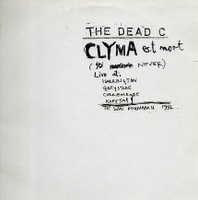
The Dead C - 'Clyma Est Mort' (Siltbreeze)
I suppose this is the live album that Tom Lax praises in the liner notes to the CD issue of Eusa Kills, which is a shameless bit of self-promotion since he was responsible for releasing it. I forgive him, cause he's right - this is an essential document of what a brilliant band sounded like at the peak of their powers. That it's actually a "fake" live album is irrelevant -Lax has detailed the construction and release of this record in a Volcanic Tongue column, which I can refer you to. But of course it's live - just not in front of an audience! The album starts off with a sludgy, dim wall of detuned guitar, and when Morley's voice breaks in, it's like dawn breaking through the clouds. How appropriate that the track is called 'Sunshine'! The improvisatory nature of Clyma Est Mort is evident and also familiar by this point. There's lyrics, though they seem fairly improvised on jams like 'Dirt for Harry' and 'Electric' : "Shave your legs, shave your arms!" It's a good mix of hits and less familiar tunes; side two gets into the more aggro/hardcore side seen on the Dead C vs. Sebadoh single ('Highway' and 'Ein Kampf, Ein Seig'), and this take on 'Sky' is probably their best recorded one (not counting the YouTube version already alluded to). This 'Sky' has a fat undertow that drags throughout, sputtering into a weirdly unidentified radio broadcast. And, how about 'Electric'? The guitar is a sinister buzz-saw and it slowly gurgles and erupts, like it never wants to end. On the flip is a slow, heavy take on 'Power' that might also be the definitive version. It sounds like 100 layers of screeching guitars, assembled in a raging maelstrom that takes the best Lee/Thurston jams and casts them into another dimension. Yeats propels it along, climaxing when needed, conveying the lyrics 'take your fucking shit out of here' with the utmost urgency yet languid thumping. The jam out on the end is utter fucking magic. After a nice take on 'World' (Lax's favourite tun of their) the album closes with 'Das Fluten, Das Fluten (Oh Mama I can't go)', a real Dead C oddity as it's a Beefheart styled jam. In a band with so many versions of their classic songs, and so much overlap, it might seem like overkill, particularly if you listen to a bunch of these in a row like I have. But like most of the multi-record gauntlets in this project, I've found a renewed passion for these records when listened to in a linear way, and right now I feel like I could keep going even if they had 100 more versions of 'Power' to sort through.
15 February 2012
Dead C - 'Eusa Kills/Helen Said This' (Ba Da Bing)
I love this, and thanks to Ba Da Bing again, it looks and sounds great. The cover is the most beautiful blur, just like the songs: a building, swirling morass of dissonant guitars both cloudy and clangy. And the mastering job on this, certainly a front-runner for "best Dead C album", is sterling. Drop the stylus on 'Scarey Nest' and listen to how the screaming voices ring out of the platter, and then compare to the flat-sounding CD edition. (Don't worry, we will soon). This is probably the most song-based Dead C record but it's as uncompromising as Tusk. It's actually fairly minimal - the production is top-notch studio recording, much more hi-fi than our various versions of 'Max Harris', and for this I am glad. I had this for so many years on CD so I never thought of it as two sides, but it's a classic rock album structure. 'Now I Fall' is the epic to bring Side 1 towards it's ringing conclusion, titled 'I Was Here' in response. The two songs fit together beyond their titles, thanks to the distorted Bigmuff vocalising and juxtaposition of rhythmic repetition with free-form swirls. And on the flip is 'Children', the destroyed cover of T.Rex's 'Children of the Revolution' (no credit given, of course). Often forgotten as one of the greatest cover versions, the Dead C are actually quite faithful through their destruction. 'Maggot' is the side 2 epic, a seemingly endless journey through glue-soaked guitars soaked in glue. The elegiac 'Envelopment' is a perfect closer - a strange moment of serenity. New Zealand may have never produced a finer album than Eusa Kills. But wait, there's more! Ba Da Bing has lovingly packaged Eusa Kills with the Helen Said This EP as a 45pm bonus 12", thus pairing what's probably the Dead C's finest full-length with their finest short-length. I remember reading about how 'Helen' was the Dead C's greatest song, which I finally found on the Trapdoor Fucking Exit CD, and though I don't think it compares to 'Power' or 'Hell is Now Love' or maybe even 'Scarey Nest', it's sure fucking great anyway. And like 'Scarey Nest' it has a drilling one-note guitar solo, though it's not so much a solo here as part of the general jamm/mess. We're back to slightly-better-than-Wakman fidelity and it's great, never stopping the tune from churning, lifting off, and eventually reaching it's tranquil extended coda. I remember seeing them live, finally, at the big crazy Thurston-curated ATP a few years back, and their freefrom Language Recordings-style sound slowly built into the hits. And when they played 'Helen' I felt like I had completed some full circle. (If I was hip to their sound in 1995, I coulda seen 'em in a small club in my hometown, but unfortunately I was still in diapers then, musically). 'Bury's on the flip and this is the tranquil, Stars of the Liddy beauty that these guys rarely attempt, but they do it so masterfully it makes you wonder what other stars were aligned in 1989 down there. This was originally released on Flying Nun, which is almost as mind-blowing as the music.
7 February 2012
Dead C - 'DR503 / The Sun Stabbed EP' (Ba Da Bing)
Subscribe to:
Posts (Atom)