Re-released posthumously after his death, this second Howlin' Wolf record is one of those classics that has the iconic cover and the iconic sound, and I'm not sure what I can write here that would really do the record justice. If this project is in many ways about my personal feelings on a record and my relationship to it (which is certainly more interesting than hearing someone write about how great Pet Sounds is for the 60000th time, I hope) then I have little to say here. Every time I have ever played this record, which is culled from a bunch of disparately recorded singles between 1957 and 1961, I've enjoyed it immensely. And that's all I can really say about it - I like Howlin' Wolf, really who doesn't? - but he's never been someone I made a personal connection to. His voice was always what I latched onto, but listening today I'm really appreciating the space in the recordings and how, for 'electric blues', they really take their time to get places. 'The Red Rooster' is barely there, shuffling along with guitar bursts only as Mr. Wolf seemed to feel like it; it's Hubert Sumlin who I think does the really sharp leads on most of this record, and some of them are pretty fucking cutting. 'Wang-Dang Doodle' is the obligatory dirty sex entendre that all late 50s blues records have (well, that and 'Back Door Man' and probably all of the other cuts too), and on this the repetition of the rhythm section is remarkable, as they seem to hang back from the 12 bar progression or at least give it a pleasantly monotonous feel. 'Spoonful' has a real trashcan sound, again quite spacious and the surface noise from this repress might as well be part of the mix, as I couldn't imagine this without it. Surely for as much as I'm a fan of Captain Beefheart I must recognise Wolf's influence on him vocally - there's parts on this record where his vibrato is so extreme that it sounds like he must be singing into a piece of waxed paper. I'm also really into the piano playing on this record, which is noodly, all upper register, and sometimes just a series of trills punctuating between the 12 bars. It's true that this is definitively 'urban' in comparison to the 'country blues'/pre-war sound that is so collectible, and I don't think it's just because the instruments are electrified - there's something about the feel, like you can imagine the hot city air when it was recorded, and maybe it's just the group nature as opposed to a solo artist. So yeah, I've just done the exact thing I said I wouldn't do - blandly described this record instead of trying to find a personal connection to it. My father's record collection is all either classical music or blues from this style/era, though I'm not sure if he's a Howlin' Wolf fan or not. I guess there's a feeling of some sort of connection to him when listening to this, though it's a grasp, to be honest. Actually, listening to this makes me think of Little Howlin' Wolf, whose music has little to do with this besides the name but is truly indescribable and (I think) inspiring - but we're still a looooong way from the Ls. And by the way, this is the 500th post!
I am attempting to listen to all of my records in alphabetical order, sorted alphabetically by artist, then chronologically within the artist scope. I actually file compilations/various artists first (A-Z by title) and then split LPs A-Z and then numbers 0-9 with the numbers as strings, not numeric value. But I'm saving the comps and splits til the end, otherwise I have to start with a 7 LP sound poetry box set and that's not a fun way to start.
HEY! Get updates to this and the CD and 7" blogs via Twitter: @VinylUnderbite
23 August 2017
The Housemartins - 'London 0 Hull 4' (Go Discs)
When I lived in the UK (about a decade ago), Kingston-upon-Hull was the punchline of the entire country, a once-respectable Yorkshire city that had fallen into such decline that it had become synonymous with the idea of hopeless post-Thatcher devastation. One could apparently buy a flat in the city centre for as low as £20,000, and I often suggested that it should be colonised by weirdo artist types since it was affordable and (I assumed, probably incorrectly) somewhat lawless. I didn't know what I was talking about then, so Hull became some sort of symbol to me. I understand that things have picked up somewhat since then, making Hull if not exactly a hotspot of Northern culture certainly an option for people looking to set out and create their own universe. I'd be curious to visit now, as I've only ever driven through the city en route to Zeebrugge (by ferry) and it looked like an interesting place. Certainly it's produced a fair share of notable musicians over the years - Throbbing Gristle, Mick Ronson, Luke Poot, Aby Vulliamy - and of course the Housemartins. Now I suspect they're almost forgotten, just a footnote to the career of bassist Norman Cook aka Fatboy Slim aka a million other things, or the precursor to the Beautiful South, a band I never listened to but always imagined were pretty good. This is 1986, the year of the famous C-86 compilation which the Housemartins are not on, but could be. This is indie music with a folky, white soul edge, and the band was aggressively independent and aggressively socialist. The inner sleeve contains some handwritten words to inspire the masses, with 'Take Jesus - Take Marx - Take Hope' at the bottom, and these are the majority of the lyrical themes. 'Flag Day' is the most memorable song, an anti-patriotic ballad which stretches Paul Heaton's voice to its most emotive, drawn over it's slow pace. It's probably the classic cut from the album but it's not my favourite - I prefer the Housemartins when they're more uptempo, such as 'We're Not Deep' or 'Get Up Off Our Knees'; the latter is a stomping attack on the ruling class, with the necessary inspirational chorus that makes pop music great. The Housemartins lyrics are a little bit superficial, but thats not really a problem - it's probably one of the reasons this record ages so well. And maybe that's what 'We're Not Deep' is about, but the anger is cut with a healthy dose of sunshine (and some ba-ba-bas). London 0 Hull 4 (a great title, though illogical, since there is no football team just called 'London', and the score would be more accurately written as 'London 0 - 4 Hull' anyway, a nice away win for Hull City A.F.C, unless it just refers to the number of musicians from Hull vs the number from London) definitely sounds like it's from the 80s, but the decay of the North is felt more than explicitly discussed, and there's a driving optimism throughout. 'Happy Hour', which bears a bit of resemblance to 'Sheep' (and each start the two sides of the record), is another unforgettable pop song, though over the years I've enjoyed it (about 20 now) I never have been clear what it's about - a female immigrant bartender putting up with sexual harassment is my best guess. A cover of 'Lean on Me' (but not the Bill Withers tune, another one) and 'Flag Day' are the only two really slow songs, and thus where the soul aspect comes out the most, and these white Northerners are pretty convincing. The piano playing on 'Lean on Me' particularly exemplifies this, as it leans into the dramatic builds and Heaton's soaring voice reveals a depth not often found in late 80s British jangle-pop. There's not a dud on London 0 Hull 4 and I always think this surpassed their followup album, with the brilliant name The People Who Grinned Themselves To Death, though weirdly I've never found a cheap copy of that so we'll have to move past it.
21 August 2017
Hotlegs – 'You Didn't Like It Because You Didn't Think Of It' (Philips)
I think it was 10cc we started this whole thing with, way back in 2008, but Hotlegs is where 10cc started and I've always loved this collection, in whichever form it might be packaged. I'm not completely clear on the recording lineage, and if this is everything recorded under the Hotlegs name or these are alternate versions or whatnot. I know the proper album release had the amazing title Hotlegs Thinks School Stinks and, come to think of it, Hotlegs is an amazing band name, but so was Frabjoy and the Runcible Spoon and they never really made it out of the gates. You can totally hear the early genius of these guys here, and just because they can master pop-rock production and songwriting with heavy traces of irony doesn't make them a novelty act. I mean, sure, 'Neanderthal Man' is the classic example of the British one-hit wonder generated by a studio team, but 'Fly Away' actually touches me and 'How Many Times' was the followup single that should have even been a bigger hit. I'm not a diehard Godley/Creme fan (and let's not discount Stewart who was also equal partners here and in 10cc) but I know spatterings of their career and there's so much joy here, as in How Dare You, as in L. Some of the songs here are less memorable - not exactly throwaway, but more like genre romps with a weird twist ('The Loser' and 'Desperate Dan' for example) – and of course it's a long way from the experimentation that Godley and Creme specifically would get into later (I've never braved Consequences but maybe I should try it). I'm a sucker for power pop made by weird nerdy white guys (which I guess is all power pop) and Hotlegs has it in spades. Hotlegs, even more than 10cc, loved the thick acoustic guitar strum with soaring vocals overtop, and the three-song 'Suite F.A.' which closes this record makes great use of that technique. This is not about the English Football Association (sadly) but some epic quest story of someone going off somewhere and then returning. It's all done vaguely enough that you could read anything into it, so maybe we could imagine it to be about the football FA if we think it's about a young centre-half off to get his first cap for his country and then going back to play for his second division side after. Oh, I'll even defend 'Neanderthal Man', because you can hear how it was made by fucking around in a studio one night with a leftover drum beat; it's the 'Rock and Roll (part 2)' of its day but I don't feel icky hearing it because it wasn't made by padeophiles (as far as I know). Great, great stuff; proof one can indulge in irony without the resulting product being an empty shell of phoniness, without being a joke.
19 August 2017
The Hospitals - 'Hairdryer Peace' (no label)
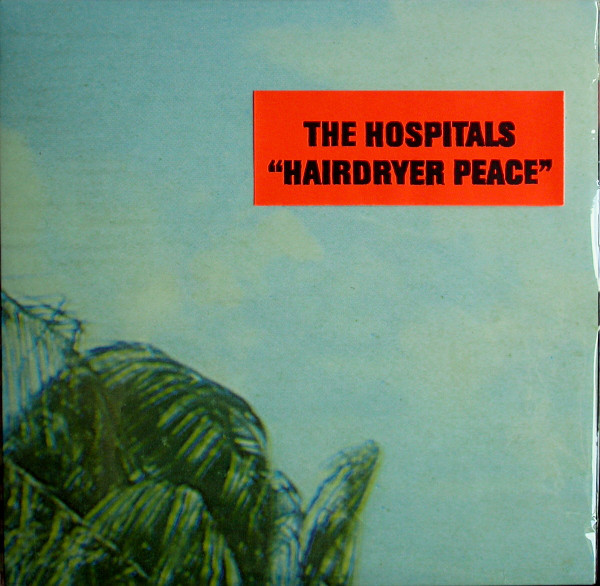
Sonic Youth already released an album called Washing Machine, but that's a more apt household appliance than a hairdryer for reflecting the music of the Hospitals. The floor tom is the most prominently used drum and it's used in a way that sounds like when you accidentally put a shoe in your washing machine and it bangs around on every rotation; it's not quite the same as Moe Tucker, as it's usually supporting a thick wall of mid-range distortion, which I guess could describe White Light/White Heat which is definitely an antecedent, but, no, it sounds like something else. I don't know anything about these guys but vaguely remembered this record getting a bit of buzz when it came out, so I grabbed a secondhand copy for a few bucks when I saw it and don't think I ever listened to it until now. I'm not sure if the Hospitals were connected to the American noise underground or the garage underground, as the sound is halfway in-between. The fidelity is terrible, but there's a commitment to that terribleness that is somehow admirable and it makes this a compelling listen - well, that and that there are some well above-average song structures behind it all. It took a few songs to emerge - at first I thought this was the missing link between Wolf Eyes and the Not Not Fun/Night People style of homemade lo-fi psych. But then 'Rules For Being Alive' came on, a prominently surf-influenced song that made me guess a few things right - that they're a west coast band (hard not to be when you sound like this), that they might have some connection to Sic Alps (Discogs tells me that Mike Donovan was once a member), and that this record was made far more carefully than it might sound at first listen. The lyrics are clear and audible in places and seem to usually describe getting high, fear, or other states of altered consciousness. Everything else is really buried but it's a pleasure to pick things out; these guys step on the DOD pedals always a bit too early and there's some great vocal sea/sweeps, like if Phil Spector blew his budget on rancid tacos and had to make do with what he could. This is so obviously made for a cassette release which makes the vinyl pressing beautiful and ridiculous at the same time, and there's some really catchy songs ('Scan the Floor for Food', 'BPPV') if you can strain through it. Somehow while listening to this I smelled burnt charcoal, felt a musty wind, and kept thinking of The Bachs. Yet the ragged nature keeps this from being a retro trip, and like many great records it feels like an amalgamation of many underground rock currents circa 2008, when this was recorded. I'm not saying it's the Deceit of its day, but it's an exemplary case of white Dionysia of the time and I think it will stand up to future scrutiny.
Hugh Hopper - 'Hopper Tunity Box' (Compendium)
The catalogue number on this record is 'FIDARDO 7', what does that mean? A few years after 1984 we find Hopper leading a band through a number of compositions that much more closely resemble the jazz-rock fusion which Soft Machine was known for– especially at this point in time (1977). There's still elements of the warbly, underwater vibe of 1984 here, especially on the second half. The high point is a cover of 'Lonely Woman', which is undercut with an uncertain echo - a real beauty of a track, and the main reason I hold onto this record. There's even a reprise of 'Miniluv', the opening cut from 1984, though it doesn't resemble the original in any way, thanks to the fleshed out band - Gary Windo, Mike Travis on drums, a little Mark Charig (but not enough!), fellow Soft Machiner Elton Dean on sax, and some hot piano/organ playing by Dave Stewart or Frank Roberts, depending on the track. The fusion numbers aren't amazing but they're fine, which is how I feel about post-Third Soft Machine for the most part. Dean and Charig play nice together when they're there; 'The Lonely Sea and the Sky' is a lovely composition with a nice, rolling vibe. 'Gnat Prong' is a hard rocker, akin to Area at their most bombastic. No vocals, and good production, so it's a nice example of the era, while being somewhat forgotten against the bigger names and main projects from this scene. I somehow ended up with a lot of records that have this style/sound, far more than anyone should own, and while I like progressive rock (in theory) I far prefer the tracks here that use 'progressive rock' as a starting point rather than an example. I think there's a reason people will hunt down copies of 1984 but there's not much interest in Hopper Tunity Box.
2 August 2017
Hugh Hopper - '1984' (CBS)
'This is a very angry record,' starts the liner notes, though I don't really hear it - I hear something exploratory, cautious, and with great moments of drama. Maybe Hopper's found a way to process anger, to work with it and churn it into something beyond piercing bile. Hopper's the bassist from Soft Machine and on this first solo record he really goes into the outer limits, taking the (then-)sci-fi theme of 1984 as a starting point and really running off to create something otherworldly. There's a lot to be said about CBS releasing a record this experimental in 1973 - all of this from the corporation who would later bring you Kevin Can Wait! Hopper spends most of this record attacking his bass guitar from a gestalt angle, generating soundscapes with additional percussion and something called a mellophone. The long, moody opener 'Miniluv' sets the tone, consisting of deep bass drones that slowly explore the available space - it's a track very rooted in physical existence, reminding me of Maryanne Amacher's drone installation pieces, or something that would be on the French Futura label in the same decade. The second side's 'Miniplenty', also a long one at 18 minutes, picks up where this leaves off and incorporates some weird percussive sounds. There was an occasional twitchy, staticky sound that kept making me jump, mixed in a way suggesting that there's something happening on the other side of my flat and not in the record itself. It's a great effect and it adds to the nervousness of the buildup, which eventually gets resolved at the end of the record in a cacophony of sounds. There's some thick synth riffs, sound a bit like square waves, and other parts that you swear could be lifted from a Wolf Eyes cd-r circa 2004. There's only one track which stops this from being a total new age, dark psychedelic abstraction from start to finish, and that's 'Minipax I', which resembles a bit of a jazz-rock thing. It's not bad and has some sharp soprano saxophone playing by Lol Coxhill, but it sticks out like a sore thumb. I don't know if this was pressure from CBS to make something that would be more palatable to Soft Machine fans (and could actually be played on the radio) or if Hopper really wanted to include this - the same band works out more extended techniques later. And I suppose the only thing that makes it so identifiably 'jazz-rock' is that the instruments sound like the traditional instruments they are, and not like a Heldon outtake; as a composition I guess you could say it fits the mood of the record, with crunchy guitar chords and a slightly motorik beat. It's a minor quibble; 1984 is a great fucking record and doesn't really need those few extra minutes but they're not without their pleasures.
31 July 2017
D.R. Hooker - 'The Truth' (Subliminal Sounds)
How do you argue with an artist who looks like this? D.R. Hooker's record is famous more for its obscurity than its music, which is unfair. It's Christian psych at its best, not built around heavy guitar crunching like the Fraction Moon Blood record, but mostly flowing pop-rock songs that show Hooker's talent for songwriting -- if only he had gotten a larger audience at the time! And his voice isn't bad either - not enough to stand out against the million other rock voices of the greatest decade (the 70s, of course, with this coming out in '72) but with an expressiveness that's enhanced by the occasional echo/delay flutters applied at the ends of key verses and lyrics. But it's the backing band that excels here. 'Forge Your Own Chains' has a great swing to it, showing a precision of rhythm but a languid pulse, almost funky. Opener 'The Sea' is beautiful, elegant in its vocal melody and accented with sharp guitars. I don't know who these guys were, really - the rhythm section are the Sheck brothers, one of whom is credited on an Edgar Winter recording, but not much else that's recognisable to a layman. 'The Thing' is maybe my pick of the album, with sharp riffs courtesy of Hooker's own guitar, crescendoing into a cacophony with some gurgling analogue electronics and a psychedelic sheen. Or maybe it's 'I'm Leaving You', where Hooker's Jesus-lite persona gets its biggest test, as he becomes a funky soul vampire crooning about the end of a relationship over a wall of screaming flanged guitars. It's pretty fucking secular, but then the whammy of the title track, followed by 'The Bible', is where he really lays down the Word. 'The Bible' builds into an almost orgasmic peak, with Hooker's intoning of 'The bible, the bible' being so hypnotic that when it all gets quiet for a second and revs back up it's a stunning effect. When listening to this I like to stare into the off-centred spiral on the label, and take in the smell of acrid Christ-smoke, wet ferns and sand that this album seems to give off. The whole thing ends with some deliberate, obvious backwards speech, which I'm not going to risk destroying my belt-drive to hear but I assume it's imploring us to praise the Lord, or maybe praise Hooker himself (you gotta wonder about anyone who dresses up like Jesus and self-releases rock music, right?). The big complaint here is the fidelity - I assume this is a bootleg like most of these private-press reissues (supposedly there were only 99 copies of the original) so it was probably mastered from a non-mint original. Or maybe it's supposed to sound like this - this wasn't exactly Abbey Road studios to begin with, and this is lo-fi or rather 'mid-fi' before any such term existed. There's a constant sense of having dust on my stylus, distortion around the edges and a pretty murky mix when things get thick (which they often do!). So I kinda wish there was a properly remastered version out there, but maybe there is, as this has been reissued a zillion times and I just got this '99 repress secondhand. Apparently he made a second album (which I haven't heard) with the promising title of Armageddon - maybe would be a nice pairing with the decidedly anti-Christian Comus?
30 July 2017
The Honeymoon Killers - 'Les Tueurs De La Lune De Miel' (Riskant)
Don't confuse them with the early Jon Spencer band! This Belgian group actually put out an album before this under the band name Les Tueurs de la Lune de Miel, but it wasn't as bouncy or sharp as this one, and the band name was a mouthful, even though it just means 'honeymoon killers' in French. Marc Hollander & Vincent Kenis from the brilliant Aksak Maboul are present here and their influence is felt, surely. These songs are bursting with energy, driven by either the vocals of Yvon Vromman or Véronique Vincent, and there's all sorts of electric energy tracing around the edge. Somehow punk is never very convincing when sung in a French accent but 'Fonce À Mort' comes pretty damn close; there's random dub/echo effects on the drums, broken glass synth lines, and saxophone bleats to keep you on your toes. Every song is driving and dancey without being monotonous; they're not a million kilometres from American bands from the same time like Pylon or Suburban Lawns. 'Ariane' is the hit I always play the most, which is actually instrumental; there's another version of it I heard on the radio once, from a 7", which is even better. The lyrics are printed in French and German for this German edition. I struggle with my high school level French to get what the songs are about, but 'Flat' starts off by talking about listening to Fleetwood Mac and 'J4' seems to narrate a story of domestic life. But I could be totally wrong; it doesn't really matter, since I'm enjoying the whole package. Aksak's more avant-garde tendencies are held in check here, with some straight-up hooks and fun keyboard parts, a goofy version of 'Route Nationale 7' that is practically novelty music except it's just so good, especially when followed by 'Ariane', a spacey anthem of paleofuturism. It's where pop music can be radical and challenging and while this would sound like a post-Rough Trade retro band now, something about the French accent gives it an earnestness that perseveres; like Family Fodder minus the irony, or I guess more like Aksak Maboul with the prog knob turned all the way down. The closing cut ('L'Heure De La Sortie') is the slow plodder sung with a robot voice, yet it's awesome. If they had been on my honeymoon, it would have been enhanced, not killed. Oh yeah, there's a Serge Gainsbourg cover, too ('Laisse Tomber Les Filles'). Fantastic.
29 July 2017
Home Blitz - 'Foremost & Fair' (Richie)
How an artist progresses in just a few years! The first clue is the cover, where typeface and drawing indicate this will should sound like a Fairport Convention spinoff, though that's a bit of an oversell. At first it's a total red herring (though in the keyboard and harpsichord bits initially heard, especially during 'I'm That Key', there's certainly some influence of more regal, courtly music than before) but then side two's 'Tell Me There' appears and we are in some sort of bizarro New Jersey-Shirley Collins hybrid; where power pop meets ragged bedroom punk and British folk too! Another clue is the voice - Mr. DiMaggio has raised his pitch even higher, or at least is breathing harder behind it. When you focus on the tone of his beautiful yelp-croon, his debt to Scott Miller is even more obvious than before. 'The Hall' has an organ crunch which feels like way more than a one-man recording; it's somehow one of the best Home Blitz songs ever, even if it's hidden at the end of side 1. 'Downtown' breaks into a musique-concrete based bridge over which he pontificates in the most 'Watch Who You're Calling Space Garbage Meteor Mouth' manner possible, and otherwise it's maybe all in the affect, but it's a hell of a method I must admit. And then there's 'Why It Cries', the moment of total free-from experimentation that harkens back more to DiMaggio's other band Car Commericals, or to that one time I was left unsupervised in a music instrument shop that focused on medieval instruments. It's a great expanse of space, which would be described as 'fucking around' to the uninitiated, but it's a vision of existence committed to vinyl, and then erupting in a bit of a jig. Thank god for the ability to hear so much music these days; I keep recalling that collection of Jonathan Lethem essays called The Ecstasy of Influence, which is a great title to describe music like this. It's not like no one ever synthesised different influences in the past, but it feels so much more open these days, which isn't to diminish the marvellous leftfield accessibility of Foremost & Fair - just that it's a bit less of a headscratcher when a young musician can discover so much out there via digital means. I guess what really matters is the curiosity, which is here in spades. I can't wait to hear what he'll do next, if he's still active, that is.
23 June 2017
Home Blitz - 'Out of Phase' (Richie)
Before this album came out, Daniel DiMaggio had already released a handful of 7"s which affirmed Home Blitz as prime progenitors of a new wave of post-indie-post-punk, the mid-to-late 00s explosion of bands that descended more from the Swell Maps than the Sex Pistols. But this LP masterfully merged his more experimental tendencies to carefully selected hooks and home-recording choices, which makes it an extremely fucking satisfying listen. DiMaggio was becoming obsessed with Game Theory and Scott Miller, and you hear that right away in the opening cut, 'Nest of Vipers', but only after it first moves through a patch of Beefheart/Skin Graft skronk. It's all tension and release, and 'Two Steps' hits next as a slice of perfect, ragged lo-fi guitar pop, a 'Box Elder' for a new generation. As an opening gambit 1-2 punch, it's amazing. If I sound hyperbolic it's only because today's listen to Out of Phase comes at the right time; enough years have passed to put this in perspective and show its staying power, and the songs sound phenomenal in 2017. The 'experimental' tracks here, 'Live Outside' (the next descendent of titles that are ambiguous to whether the word is 'live' or 'live', after Joan of Arc) and 'Three Steps', are more than mere filler; they are moody field recordings that put the pop constructions into the context of New Jersey life, and they're essential to the flow of the record, much more than (for example) the jazzcursions on the Tenement 2xLP. DiMaggio's drumming isn't exactly Steve Gaddesque but it works, flailing on the cymbals and providing a bumpy bed for the pop hooks. His guitar playing is like a Dionysian Peter Buck, spazzing chords and frantic arpeggios, which inject the songs with the right amount of nervous energy. 'World War III', 'Nighttime Feel' and 'Other Side of the Street' could be parallel universe classics, saturated in the early 80s DIY aesthetic but married to more contemporary concerns. There's even a Cock Sparrer cover, 'Is Anybody There?', reimagined as a yearning plea for connection. The run-out groove on side A says 'Perpetual Night' but that was released as a separate 7", a shame since it's a great, great song too. Oh, I have an extra copy of this LP for some reason; if anybody wants it, make an offer in the comments!
The Holy Modal Rounders - 'The Moray Eels Eat The' (Sundazed)
The Moray Eels Eat the Holy Modal Rounders is a great record; it's fun, doesn't go on too long, and manages to convert its 60s-drenched anarchy into something that still feels meaningful. That's not to say it isn't clearly a document of its time, but just that the 'fuck it' approach to folk music was already rooted in something much older than the psychedelic rock at the time, and even though this is a heavily psychedelic record, it feels remarkably present today, even compared to classic rockers like Hendrix or Sgt Peppers. Of course, there's nothing like the Rounders being made today, at least not that I'm aware of; the folk-noise hybrid stuff that happened about a decade ago often verged towards absurdity but never with such reckless abandon, and anyway, the context was all different. One of the nicest things anyone ever said to me was years and years ago when I was playing them some of my solo music, which was somber, delicate and spare post-adolescent minimalism. My friend remarked that my personality seemed so different than the music I was making; he then put on 'Bird Song', from Moray Eels, and said that he expected my solo work to resemble something more like that. I haven't seen Easy Rider since before I was in straight-legged pants so I barely remember its moment of fame, but there's no better song to put on and dance around to, flopping my arms and moaning the mostly wordless vocal parts. The overtly drugged out songs like 'My Mind Capsized' and 'Half a Mind' have outlasted their era, and this version of Michael Hurley's 'Werewolf' is so drained and sparse that it's genuinely frightening. You have to squint to hear the residue of the American songbook, but it's there just as surely as I mix my metaphors. 'Duji Song' is like the world's most frightening, inside-out jug band; 'Take-off Artist Song' is deconstructed vaudeville at it's finest. I wish I had a copy of Indian War Whoop to complete the classic Rounders collection but it's been reish'd enough times that I'm sure it will pass by. In the meantime I'll consider this to be the pinnacle; even the cover art is beautiful, magnificent, lush and appropriate.
7 June 2017
The Holy Modal Rounders - 'Stampfel & Weber' (Fantasy)
This is a mid-70s issue of the first two Holy Modal Rounders albums, originally recorded for Prestige in 1963-64. I was glad to find it because I like this early material of theirs; it's goofy but still relatively sane, at least compared to the later releases, and sometimes it's just nice to listen to. Unfortunately Prestige sequenced these backwards, with record 1 being the less memorable Holy Modal Rounders 2, but that's not the biggest crime, and it's easily solvable. The liner notes here are a gas - Ed Ward writes about the halcyon days of the early 60s NYC folk scene and how these two jokesters came around upsetting the apple cart, but nonetheless with a discipline and understanding of traditional musics that allowed them to break such rules. I don't know Mr Ward or what he looked like but I can't help but think of F. Murray Abraham in Inside Llewyn Davis, a blowhard reminiscing about some mythical era of which he's largely responsible for the myth. Or maybe I'm just sore cause he calls Indian War Whoop and Moray Eels 'close to unlistenable' - hey man, your liner notes are close to unreadable! Even the uncredited/technical notes to this reissue says that 'none of the albums recorded since these ... have been nearly as successful'. Maybe they're just speaking of commercial success but it feels like a cheap shot at the esteemed ESP and Elektra labels. Anyway. The second Rounders album, coming first in this sequence, has some lovely moments - Stampfel's banjo playing on 'I Wish I Was a Mole in the Ground' is precise and ragged, and 'Junko Partner', written with Michael Hurley, is one of the only originals and a nice goof. But it is record #2, album #1 that I like more, maybe as it contains a few more original compositions, and the performances sound more fresh. 'Euphoria' could be the Modals raison d'être, capturing the simplicity and spirit of their early approach. 'Reuben's Train' is fierce and the fiddle cuts like a knife. 'Blues in the Bottle' is a great opener, and when Stampfel starts to play after each verse it revs up like a jet engine. 'Better Things for You' is maybe the best original composition on either record. This is only a decade or so after Harry Smith's anthology but these two clearly studied it like a bible. Clarence 'Tom' Ashley's 'The Cuckoo' never sounded so raw, and it's brilliant how the Rounders celebrate American music so joyously, tying it directly to the underculture which birthed it. This is music that takes itself seriously while also being able to laugh at itself; they realised the need to preserve these songs before they became enshrined in the same glass towers that ruined American jazz culture. Music has to live, and Stampfel & Weber found a humour, inherent in even the most serious subject matter, and also injected it with a streak of rebelliousness. I think actually the Rounders sound more radical today, as their quest was unsuccessful; folk music has become sanitised and its conservative tendencies emphasised. Harry Smith surely turns in his grave now, but maybe if enough people play Holy Modal Rounders records simultaneously, he'll stop, or at least pause.
Christopher Hobbs / John Adams / Gavin Bryars - 'Ensemble Pieces' (Obscure)
Not sure why I don't have this in the split LPs section; I guess I file it under Hobbs since he's the most present here in addition to being first-billed, having composed two of the four pieces and performing on Bryars's work as well. Eno's Obscure imprint was a great enterprise I think, and I buy any of them if I'm fortunate enough to come across one and it's affordable. The cover for this really captures my impression of the 1970s British avant-garde, showing some modernist urban building in a manner which seems like it comes from a film excerpt, perhaps some structuralist-materialist polemic. Ensemble Pieces is occasionally a bit dry, as 70s British avant-garde can be, but it's at least democratically dry if that makes sense. The word 'ensemble' is quite relevant as these are compositions in which the players have a great deal of agency, and the focus is on how the group performs, perhaps the only commonality between the three composers. It does raise the question of why, if the ensemble is the point of this record, the composers get the primary credits, but I guess old habits die hard. The two Hobbs compositions open both sides and 'Aran' is the high point of the record, a pulsing melodic work originally for 12 performers but here played (through the magic of overdubs) by Hobbs, John White and Bryars. It's all tonal percussion, beating around a pulse and resembling a Western hackjob gamelan, and I mean that in the most endearing way possible. The toy piano, wood blocks, and small cymbals all fight it out and there's an exuberance that is minimalist composition at its finest. 'McCrimmon Will Never Return' has the same sense of melodic investigation, though being a duet of Hobbs and Bryars on two reed organs each, it has a significantly more restrained sonic palette and takes on a mantra-like feel, like an Indian harmonium devotional except slightly neurotic and with the tonal conflicts being the focal point. John Adams presents three works and his ensemble players aren't credited individually, perhaps because the back sleeve needed more space for the liner notes. They move through three distinct pieces, the most unusual being the slowest, 'Christian Zeal and Activity', which features a strange radio interview tape played overtop. It's a predecessor to 'BBF3' I guess, but decidedly less apocalyptic. 'Sentimentals' closes out the side and apparently quotes 'Sophisticated Lady' though I didn't notice it; it feels the most rooted in academic composition though it's light and moving. 'John Philip Sousa', a tribute, is centred around a motorik snare drum and maybe the one of the three where one can most hear that this ensemble is self-conducting. Bryars' '1, 2, 1-2-3-4' is an odd exercise in genre collage on first listen, and the liner notes reveal the format of the composition, where the all-star cast (including Cornelius Cardew, Derek Bailey, Andy MacKay and Eno himself) are all playing along to dictaphones while wearing headphones. There's a sense of irony here of course, since it's a jazz ballad, but the format makes it sound like its' all falling apart, yet in a delicate way, not like the Portsmouth Sinfonia (though clearly related since this is Gavin Bryars after all). Bryars is the odd man out here as the others can all be connected somewhat to post-minimalist composition, at least in terms of structure, but this iconoclasm, even within the scope of this LP, is welcome.
Subscribe to:
Posts (Atom)