 A title like this would suggest a bold statement of an album, something both philosophical and direct. Well, sure, this is the pen of Chris Cutler, after all. If you didn't think the man who wrote File Under Popular could knock it out of the park, then you're truly underestimating him. This is concise - a 45rpm mini-album, maybe a long EP - yet leaves nothing to be desired. The lovely little booklet rearranges the running order into a three lyrical groups. 'Law', 'Democracy', 'Truth', 'Freedom', 'Peace', and 'Civilisation' are classified as "6 corpses in the mouths of the bourgeoisie", but despite this heavy concept, the songs are light as air. I often forget how traditional the Art Bears actaully could be, at least in terms of instrumentation; most of these songs are drums, piano and guitars and they achieve their innovation largely through structure, composition and affect rather than effect (if you get my drift). Though 'Civilisation', at the end of side 1, is a thick, slow composition that sounds like Morton Feldman pushing a pram. It hangs in the air and never lets go, always on the verge of resolution. Vocally, Dagmar is perfect -- I can't imagine anyone else interpreting a song that is somewhat anti-democracy and transforming it into something so magical. The second lyrical group is "4 songs" and contains catchy tunes like 'The song of the Dignity of Labour Under Capital' which is more like Brecht than Engels, thankfully. The final standalone song is 'Albion, Awake!', ending the album (and the career of Art Bears) on a platform of hope, though first transformed through the most tape-manipulated section of the band's ouvre. Perhaps this twisted unraveling is an abstracted musical story of the workers of the world. The final line is 'Let banners fly like shrapnel and efface the sky!' and while I jump up with my red flag, I then think to the reality of everything that has happened since 1981, and then I get depressed, and then I just listen to some more records to wash away the pain. The real pain, of course, is that my copy of this is slightly warped, which renders 'The Song of Investment Capital Overseas' and 'Democracy' rather unplayable.
HEY! Get updates to this and the CD and 7" blogs via Twitter: @VinylUnderbite
28 June 2009
Art Bears - 'The World As It Is Today' (ReR)
A title like this would suggest a bold statement of an album, something both philosophical and direct. Well, sure, this is the pen of Chris Cutler, after all. If you didn't think the man who wrote File Under Popular could knock it out of the park, then you're truly underestimating him. This is concise - a 45rpm mini-album, maybe a long EP - yet leaves nothing to be desired. The lovely little booklet rearranges the running order into a three lyrical groups. 'Law', 'Democracy', 'Truth', 'Freedom', 'Peace', and 'Civilisation' are classified as "6 corpses in the mouths of the bourgeoisie", but despite this heavy concept, the songs are light as air. I often forget how traditional the Art Bears actaully could be, at least in terms of instrumentation; most of these songs are drums, piano and guitars and they achieve their innovation largely through structure, composition and affect rather than effect (if you get my drift). Though 'Civilisation', at the end of side 1, is a thick, slow composition that sounds like Morton Feldman pushing a pram. It hangs in the air and never lets go, always on the verge of resolution. Vocally, Dagmar is perfect -- I can't imagine anyone else interpreting a song that is somewhat anti-democracy and transforming it into something so magical. The second lyrical group is "4 songs" and contains catchy tunes like 'The song of the Dignity of Labour Under Capital' which is more like Brecht than Engels, thankfully. The final standalone song is 'Albion, Awake!', ending the album (and the career of Art Bears) on a platform of hope, though first transformed through the most tape-manipulated section of the band's ouvre. Perhaps this twisted unraveling is an abstracted musical story of the workers of the world. The final line is 'Let banners fly like shrapnel and efface the sky!' and while I jump up with my red flag, I then think to the reality of everything that has happened since 1981, and then I get depressed, and then I just listen to some more records to wash away the pain. The real pain, of course, is that my copy of this is slightly warped, which renders 'The Song of Investment Capital Overseas' and 'Democracy' rather unplayable.

Art Bears - 'Winter Songs' (Ralph)
 I'm not sure where the idea of the "power trio" first came from, but I think it should apply here. There's not a weak link in this triangle. My copy of Winter Songs is missing an inner sleeve -- I image lyrics and credits or some sort of liner notes should be there. So I don't know if there are lots of guest musicians present or it studio magic and overdubs are being used to make this mix so thick, because it can't be Frith playing the bass and the piano at the same time. It doesn't really matter except that I wanted to talk about how in addition to the peerless compositions on this album, the actual playing is remarkably expressive. On a song like "The Summer Wheel," Frith and Cutler are so in-sync that it's hard to believe. Cutler's drumming is so languid, yet with a momentum; Frith chases after it, and occasionally kicks it forward like a stone being kicked down the road. If Hopes and Fears is their pastoral record, this is their gothic one. Although there's still an overall medieval theme in the lyrics (and artwork), this is the sound of the black death. The earthy chord changes are gone and in place are strange intervals and macabre tunings. Even if the piece is someone bouncy, like '3 Figures', there's something still a bit doom 'n gloom going on. 'Rats and Monkeys' was a single from this album and it's easy to see why Ralph records would jump on it. The frenetic pace, layered affected vocals and herky-jerky violin part make it feel like the end of the world is happening. Krause really explodes here; most of the vocals are double-tracked or more, and she seems more inspired. The gusto is used to dramatic effect - she has a way of turning on the electricity in a way that the most powerful vocalists in music can do (Beefheart comes to mind, actually). With the political changes going on in Britain when this was recorded, you can feel the rage seeping through tone-refracted misery. The UK was entering a long winter and these are the chronicles. If this is a protest album, its avant-obfuscations probably meant they could only preach to the converted. I first heard it too late anyway - well into the reign of New Labour, which is a whole other can of worms, a horror probably unthinkable to them at the time.
27 June 2009
Art Bears - 'Hopes and Fears' (Random Radar Records)
.jpg) Art Bears are the cream of the crop from that whole scene of musicians that are sometimes called R.I.O. I mean the intellectually-motivated, politically strident, highly prolific gang that stemmed out of Henry Cow (represented by one of those rock music "family tree" diagrams in an insert that came with the first Henry Cow CD boxset many years ago). And oh, what a crop to be the cream of. I don't need to list the many accomplishments of Messrs. Cutler and Frith, and Dagmar Krause is a figure who will pop up several times on this blog. And when I say Art Bears are the best, I don't mean to slight the Cow, the Work, the Lowest Note on the Organ, Lindsay Cooper solo, the Catherine Jauxniaux stuff, Aksak Maboul (who I'd probably have to say are worthy of joint 'cream' crown-sharing), La Societe des Oiseaux etc. It's just that Art Bears were particularly revelatory to me. Prog is a great egg to start chipping away at, and Henry Cow were one of the first prog bands that appealed to me, but Art Bears were ultimately more my thing. I guess it's because they adhered to song structures while maintaining an uncompromising approach to experimentation - not that they are the first band to ever do this, but they do it in a way that blends their incredible eclecticism with their own personalities. There are enough artistic brushstrokes to tickle under the testicles of the sublime, yet still with a coherence that is very direct. Hopes and Fears is their first album, and it actually emerged from Henry Cow sessions. It's funny that this is thought of as being a Henry Cow album since it feels like the most stripped down and simple Art Bears record to me (while Winter Songs, recorded as a trio, feels much more dense). Maybe that's because the songs on HaF have a somewhat folky feel, with a lot of guitars and keyboards, though they occasionally explode into anthemic, driving rock (check out 'In Two Minds', which Wikipedia claims is influenced by the Who but I think that's just cause the piano line is stadium-rockish). This album feels really pomo-rustic to me, like you're walking the Yorkshire Dales but still thinking about the contradictions of capitalism. The lyrics touch on self-reliance ('Labryinth'), surrealist feminist narrative ('Joan'), media ('The Tube') and I think romance though maybe just relationships between humans -- yet the whole album feels infused with someting distinctly British. It's like there's a current that drains through the whole history of music from the British Isles and Hopes and Fears is just another stone in that stream. Dagmar's German accent doesn't alter this, but maybe I just associate her with this sound so much that I've given her an honorary U.K. passport. The bouncy instrumental bits make distinct overtures to these antecedents, though I really feel it more in the lyrics, which often strike pastoral chords in me. Also, most of these songs could be set in any period in history; there are few words that indicate that this record was constructed in the late 1970s. The more wild musical adventures are really going to come on the next two albums, though there are some chilling effects on the instruments. 'The Tube' in particular is a clawing, braying maelstrom of dark drones, and if you mixed out Dagmar and told me it was late Shadow Ring I'd never doubt you.
Art Bears are the cream of the crop from that whole scene of musicians that are sometimes called R.I.O. I mean the intellectually-motivated, politically strident, highly prolific gang that stemmed out of Henry Cow (represented by one of those rock music "family tree" diagrams in an insert that came with the first Henry Cow CD boxset many years ago). And oh, what a crop to be the cream of. I don't need to list the many accomplishments of Messrs. Cutler and Frith, and Dagmar Krause is a figure who will pop up several times on this blog. And when I say Art Bears are the best, I don't mean to slight the Cow, the Work, the Lowest Note on the Organ, Lindsay Cooper solo, the Catherine Jauxniaux stuff, Aksak Maboul (who I'd probably have to say are worthy of joint 'cream' crown-sharing), La Societe des Oiseaux etc. It's just that Art Bears were particularly revelatory to me. Prog is a great egg to start chipping away at, and Henry Cow were one of the first prog bands that appealed to me, but Art Bears were ultimately more my thing. I guess it's because they adhered to song structures while maintaining an uncompromising approach to experimentation - not that they are the first band to ever do this, but they do it in a way that blends their incredible eclecticism with their own personalities. There are enough artistic brushstrokes to tickle under the testicles of the sublime, yet still with a coherence that is very direct. Hopes and Fears is their first album, and it actually emerged from Henry Cow sessions. It's funny that this is thought of as being a Henry Cow album since it feels like the most stripped down and simple Art Bears record to me (while Winter Songs, recorded as a trio, feels much more dense). Maybe that's because the songs on HaF have a somewhat folky feel, with a lot of guitars and keyboards, though they occasionally explode into anthemic, driving rock (check out 'In Two Minds', which Wikipedia claims is influenced by the Who but I think that's just cause the piano line is stadium-rockish). This album feels really pomo-rustic to me, like you're walking the Yorkshire Dales but still thinking about the contradictions of capitalism. The lyrics touch on self-reliance ('Labryinth'), surrealist feminist narrative ('Joan'), media ('The Tube') and I think romance though maybe just relationships between humans -- yet the whole album feels infused with someting distinctly British. It's like there's a current that drains through the whole history of music from the British Isles and Hopes and Fears is just another stone in that stream. Dagmar's German accent doesn't alter this, but maybe I just associate her with this sound so much that I've given her an honorary U.K. passport. The bouncy instrumental bits make distinct overtures to these antecedents, though I really feel it more in the lyrics, which often strike pastoral chords in me. Also, most of these songs could be set in any period in history; there are few words that indicate that this record was constructed in the late 1970s. The more wild musical adventures are really going to come on the next two albums, though there are some chilling effects on the instruments. 'The Tube' in particular is a clawing, braying maelstrom of dark drones, and if you mixed out Dagmar and told me it was late Shadow Ring I'd never doubt you.
25 June 2009
Areski & Brigitte Fontaine - 'L'Incendie' (Get Back)
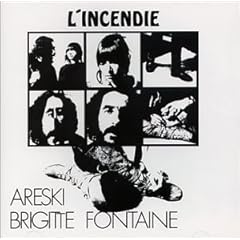 Areski and Brigitte Fontaine make such a cute couple; he's the bearded musical voyager and she's the arty answer to ye-ye pop. Together they were the Gallic version Richard & Mimi Fariña, or maybe Mickey and Mallory. Now, my French is barely beyond high school level so I don't know what the hell they're singing about and I'm afraid to stop and figure it out, but there's a pleasure to be found in ignorance. Side A has Areski's darkly shadowed face on the label. The nursery rhyme glow is there on some songs ('Le 6 Septembre'), sung like a round or other sort of children's workshop. We also get whacked out porn guitar behind Brigitte's fantastic voice ('L'Engourdie') and then dark medieval churchy dirges like 'Nous Avons Tant Parlé'. It's a grab bag of sounds from the 60's/early 70's, with the Eastern vibe laid on thick. When you flip to side B (so you can look at Brigitte's face spinning), you get Areski's solo vocals over bongos and snakecharmer flutes. It's one of only 2 songs over 3 minutes, yet it feels particularly long because it's Brigitte who I came to party with and I can't hear her. But the other "long" track is the whispered 'Après la guerre'. Intimate and kinda sexy, with the odd plink and pluck in the background, it's like that scene in the Blair Witch Project where the one girl just puts the camera on her face in the dark and cries about how scared she is. I thought L'Incendie was their first album but it's hard to tell since when Get Back reissued it, they didn't bother to include any additional contextual notes, such as a date. Some Google 'research' places it at '74, and therefore after Comme la Radio, but I always thought it was '71 and had filed it before. So now when writing this, I have to save this draft til I've reviewed Comme la Radio which means I'm listening to them out of order, an error I will correct when I refile (so Encourager Templates take 2, coming in April 2012, doesn't make the same mistake). Which means this bit I wrote below is now totally wrong and irrelevant, but instead of recycling it for a future qualifying post I'll just dump it here:
I'm always really interested in the records made just before the unfuckwithable ones. I'm drawn to records like The Colour of Spring, Vampire on Titus, The Dreaming - slightly flawed, perhaps, but made during a creative stride with the masterpiece just visible in the distance. Sometimes I like these predecessors even more than the "big" albums, plus sometimes you've listened to the more acclaimed album too much. I recognize Comme la Radio as the masterpiece but have more often pulled out L'Incendie because of this factor. I've always imagine Fontaine as the one calling the shots (despite Areski's top billing - I mean, that's just alphabetical, right?) and feeling frustrated at all of the fruity arrangements - that despite this record's eclecticism, it still just wasn't quite right, ie: she's almost there, but not yet. And only when paired with the Art Ensemble of Chicago do her songs really explode into something magical, but she had to wait til the next album for that. So knowing this, it's improved L'Incendie a bit in my eyes -- you can hear the hesitation, the uncertainty, the hope. And ending with 'Le Chant des Chants', so strident yet abrupt, waiting for a coda that is yet to come.Yeah, well, screwed that up for sure....
24 June 2009
Areski & Brigitte Fontaine - 'Comme la Radio' (Editions Saravah)
 Sometimes a few minds come together and make a record that exists in its own magical vacuum. I'll probably say that about a lot of albums throughout the duration of this lengthy project but you'll just have to get used to my repetition, repetition, repetition. Due to my idiosyncratic filing system, I keep this under 'A' for Areski even though it's really Brigitte Fontaine's show. This is because I owned L'Incendie first, where Areski gets top billing; when I finally scored a vinyl copy of Comme la Radio (a dream fulfilled, really), I didn't bother to refile. Plus I quite like it in the A's because it's rather close to the Art Ensemble of Chicago, the 'backing' band on (some of) this record, who we will be visiting again very soon. So yeah, this record is awesome, by which I mean it's totally mindblowingly great if you like folk or jazz or foreign people or psychedelic music cause it's all of those things plus more. It's like an ice cream sundae with a rainbow streaming out of it. Fontaine's songs are kinda long and jammy, almost in an Astral Weeks way, though the instrumentation is really sparse and the production -- my god, the production! This record sounds a bit like it was recorded in a mailbox, though that suggests that it's thin which isn't really right. Maybe it's better to say it's "distant". And kudos for that - it's probably hard to make a record with the Art Ensemble of Chicago and keep the reeds mixed low. But Areski and Fontaine realised that the beat is the real current they want to ride, so the percussion is up front, the vocals are flush up against it, and the other instruments are there, but not in the forefront. This was made after the Art Ensemble had been in Paris for a few years, and they were about to go home and hook up with Don Moye and enter a whole new period. By it's very nature the songs are gonna hold to a more rhythmic structure than what these dudes were laying down on Tutunkhamen, Reese and the Smooth Ones, etc. - but it feels like the dark side to the Les Stances a Sophie material. Areski's presence is really prevalent too, at least one assumes the dark guitar stuff is him, and he sings lead on 'Le Brouillard' but it's cool. And the credits indicate that most of the percussion is him, though it's clearly funked up by Malachi Favors. But it's clear Fontaine is the driving force behind this. I've always had a real starry-eyed view of the French idea of "pop", probably influenced by a teenage appreciation of Stereolab and Godard films. Side one feels almost like a new form of pop being invented. Side two is the more exploratory side and it burns with a pulse that synthesizes a bunch of disparate strains of humanity. Lyrics, well, I don't know really even though they are printed in a nice purple ink;; I'm happy to just smile and let it all wash over me.
23 June 2009
Area - 'Event '76' (Cramps)
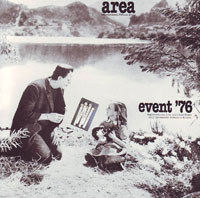 Here's where they really lose the plot, at least for the rockist Area fans. Boasting a somewhat compromised lineup featuring Steve Lacy and Paul Lytton (who sneaked onto Maledetti, if you remember from yesterday's post, and 75% of this album is titled 'Caos part II' so I guess it's the logical followup), this is a full album of free improvisation, containing no trace of the bombastic rock riffs found on Crac! or Arbeit Macht Frei. Despite the jazzy pedigree this is much more akin to NWW-list free playing (ah, that has become a genre of its own now!) such as Jacques Berrocal, Futura label stuff, maybe MEV. But for me this is a great step forward in showing what rock music can be. This whole record is recorded very weirdly - in the red at times, with a strange chorus effect on everything and unusual reverse fade edits popping up, even when the crowd cheers at the end. Lytton's cymbal crashes sound like trashcans and occasionally dominate the proceedings, but it gives the whole record a raw feel that makes the fucked up synths, babbling, and tape manipulations have a rhytmic centre. I love this record and I think it's a must-hear for anyone interested in any of the tangents that cross it: Euro freedom, prog rock, free jazz, musique concrète. But it's really in the context of Area's other work that makes this record slay so much - it's like all of the outtakes and indulgences that they restrained themselves from including on the studio albums - all at once, and all on top of each other. On the cover we get a still from Frankenstein, a scene also featured prominently in Victor Erice's Spirit of the Beehive which I just watched. It's pretty appropriate for the Frankenstein monster on this record: curious, and certainly monstrous, but gentle and approachable. I wonder what the difference is between this recording and what the audience actually heard that night in the Università Statale di Milano -- I'm guessing it was a bit clearer than the saturated sounds on this vinyl, but maybe it was incomprehensible live too. I imagine Stratos running back and forth like a madman or maybe he was just bent over a table of electronics processing his voice. This is a fitting way to end the Area section of the Impenetrable Prog Gauntlet, and I'm sad I don't have Stratos's solo album to be the icing on the cake.
Area - 'Maledetti' (Cramps)
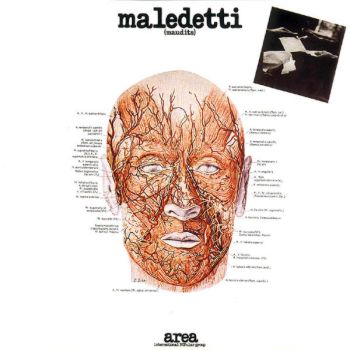 And now, my favorite Area record -- or did I say that about Caution Radiation Area? -- Maledetti is all things to me. It's their most surrealistic and fucked up record, both in the overall Dadaist structure and in the incredible, genre-best closing track 'Caos (parte seconda)' . It's also (I will argue) one of their most complete records, as there's a little bit of everything here. In a perfect world, their reputation would rest on Maledetti alone. You get snippets of a very jazz-oriented Area, perhaps the jazziest we've heard yet with a real McCoy/Garrison current in 'Gerontocrazia' and also an extended lineup that features Steve Lacy and Paul Lytton. The chord changes, complex time signatures, and blister-inducing rapid instrumental passages are here too. You get a second side that in addition to the insane 'Caos' jam (which sounds like Jac Berrocal after eating too much spinach, while watching Benny Hill episodes with the sound muted) opens with a "massacre" of the Brandenberg concerto. You get a track that is Valerie Solanos's 'scum' manifesto set to music, vocalised by the one and only Demetrio Stratos (I've noticed that the spelling of his surname changes from album to album, though there's actually a signature in the liner notes for this one). And you get the surrealist flag in vibrant colors, raised on the opening track 'Evaporazione', which sounds like the tape recorder accidentally left on and is a brilliant and insane way to begin an album. This isn't all "out" like the next entry in our Area gauntlet is, but just bizarre enough to achieve, I dunno, perfectione? Great artwork too; if you ever had any doubts about why Area were on the NWW list, start here. What's the criticism? That it's too short? But not really, cause it doesn't even leave you wanting more. It's often easy to be distracted by diverse sounds. I'm not necessarily impressed by an artist who merely demonstrates that they have a big record collection -- I mean, you can always start an alphabetic blog to do that! We all have shitloads of influences but if you can't take your precendents and make it into something that is yours, then what are you doing besides recycling other records? Area manage to find the perfect balance here - the jazzy parts may trigger a million associations in my mind, but ultimately it's still Area. We get a few measures of Terry Riley, a few measures of Cage, a few minutes of Bach - but it's chewed up and digested and magnified by Area's own brilliance. Soldier on, boys. Though the end is nigh.
22 June 2009
Area - 'Are(A)zione' (Cramps)
21 June 2009
Area - 'Crac!' (Cramps)
 Is this actually a slight step backwards? I mean, it's awesome for sure, but a bit more restrained compared to the electronic mind-fuckery of it's precedent. The experimentation seems slightly more relegated to the details here; with headphones there's some insane dressing on these salads but not as much meat, y'know? Except for the last song, which is a goofy, lurching stop-start debacle, Crac! is very much a 'prog rock' album. I'm not complaining - I guess Area decided to make Crac! a more "guts" album, and as I listen I can't stop tapping my feet (in 27/9 time) and grooving on it anyway. Demetrio is in fine form, blasting away on the opening track and doing some weird American-accented vocalising on 'La Mela di Odessa (1920)' (which it fits the funk-horn stomp). Ares Tavolazzi's basso elettrico is not just played funkier than before, but it has that somewhat "boingy" quality that you expect from progressive rock. Some of these riffs are epic, and some of the melodies are actually catchy. In "Gioia e Rivoluzione" Area present an actual "pop" song - with acoustic guitar strum, bouncy bassline, and relatively accessibly singing, but I don't think they're selling out - just taking their message of revolution politicalVOCALmusic to a larger audience. So yeah, not my favorite, but bonus points because a 30-year old (perfectly preserved) sticker of the 4xegg cover image fell out of the jacket.
18 June 2009
Area - 'Caution Radiation Area' (Cramps)
 The Italian Get Back gang reissued this in a lovely package with super thick vinyl (preserving the original Cramps label) and a heavy cardstock cover that could stop a bullet; plus they were thoughtful enough to include a plastic inner sleeve mounted inside the paper linernotes, so you don't scratch the record like paper does, but it doesn't bunch up like plastic usually does. This second Area record came out in '74 and it's leaps and bounds beyond their first one. It starts with a super fast keyboard/gutar riff that suggests they've stepped up their game, instrumentally, since Arbeit Macht Frei, but then things start to get weirder. 'ZYG' stars with some arrows of synthy white noise fighting with each other, before forcing itself into a rock structure. Ten-minute 'MIRage ? MIRage !' which opens the second side, is a work of utter brilliance. We get a taste of free jazz; a sort-of-drum solo up against someother tape-affected percussion; a thickly layered bit of Stratos (whose first name is now DemeNtrio) whispering, moaning and gasping; and the usual progrock pyrotechnics though minus a bit of , um, whatever that thing is that Yes does that you hear a little bit of in Area's first album. If there's one criticism it's that the piece just feels like a succession of twisted parts rather than a cohesive whole - but thats totally okay if the parts are this mind-melting. The last track, 'Lobotomia', is the most fucked up of all, with shrill toys, delayed chimes, and the feeling of lifting into the sky. Yep, these Eye-talians have found their voice, and maybe they never sounded more on-target. For a band that's on the Nurse With Wound list, you can sure bash your head to it like it's a dumb guilty rock release. This may be the highest synthesis of all of the different strains of brilliance this band was capable of, balanced across one vinyl disc.
16 June 2009
Area - 'Arbeit Macht Frei' (Cramps)
 Here's the thing about the Discloated Underbite Spinal Alphabetised Encourager Template: every once in awhile, without realising it, you'll find yourself immersed deep into the Impenetrable Prog Gauntlet. It's hard to see the end of it, since there's so many weird angles and changes, and often a good explorer has been known to disappear in the darkest regions of the IPG, never to be seen again. Even though it's against official Policy, I'm gonna warn you that the last record we looked at (Arbete and Fritid) actually was the secret entrance to one such Gauntlet, which is dominated by a gang of mostly Italians called Area. Area subtitled their name with "international popular group" which was perhaps meant to be ironic. They were stridently political, but I don't understand Italian and I have no idea what it means to be stridently political in Italy, since I just assume that everyone is at least somewhat political. After all, fascists and commies are still fire-bombing each other in the streets every week. Therefore, I'm incapable of dissecting the layers of irony and/or passion captured by the title and artwork. I like to think of Area as "prog as fuck" because they employ many of the concepts that have created our idea of Progressive Rock in the 1970s: jaw-droppingly fast contrapuntal riffs, complex neo-classical song structures, the occasional tendency to go super dorky with flutes, 6-string bass or smooth saxophones, and a willingness to fuck around and break rules. How much the latter concept is explored generally has a direct correlation with how much I like a band, because I'm not really that interested in flashy showmanship. Arbeit Macht Frei has showmaship a-plenty, though there's significantly less investment in the rulebreaking category than their later records. But it's a debut album, and a grand statement for sure. Vocalist Demetrio Statos doesn't overpower the band, though his dramatic opera voice may not be for everyone. This is the only Area record I would put in the same box with commercial prog like Yes and Crimson; there's definite group jamming and heavily affected instrumentation (though the guitar and keyboards, which do have great tones, don't leap away from Western tuning or anything). It's only the last song, 'L'abbattimento dello Zeppelin' that hints at the gradual rejection of rock music that is to follow - the contrabasson gets a little bit more free (perhaps in reference to the title), and the guitar solo sounds like it's off a Wooden Shjips record. Statos's weird mumbling/yelling in the middle is layered over some sparse, surreal free improv and it's just weird, man - til the rock kicks back in, or does it? Open up the gatefold cover and it explains all. A photo of a concentration camp bearing the titular inscription, across from a handgun emblazoned with the Area logo - it's like Marco Ferreri's object from Dillinger e morto going head to toe with the forces of fascism, through the music of Area. Or something. I noticed that the musicians all look very tired in the photo; I guess it's hard work playing that fast and intricately.
6 June 2009
Arbete och Fritid - 'See upp för livet' (Musiknätet Waxholm)
 Though Sweden is currently on the tongue of all socialism-fearing political pundits today, it's really not a scary place. Even Arbete and Fritid's masterpiece, this double album, is more inviting than frightening. It's not even close to being their most "out" record, sounding downright 'accessible' at times - but then, there's still the indescribable Weird that is present throughout. There's a lot of singing, sometimes cartoonish and sometimes very human, but the voices never sound like demons or totalitarians. The traditional/folk background is the strong suit of this band and this record shows a lot of it. In fact, large sections of this record feel pretty removed from the Idea of Electricity. Fiddles, bells, and a light acoustic strum drive the second LP face, and some more campfire singalongs pop up at the end of side 4. The modern eruption comes on side 3, which takes on a dirt-encrusted 1970s hard rock edge. But it's the edges of this album that are the most interesting parts, particularly the opening track. It's a long improvised piece, slowly fading in over about 15 minutes, and it's what won me over when I first heard this album. None of the musicians overplay; they all hold back and let space build. It's not the most remarkable atmospheric prog track I've ever heard but something feels a bit special about it. The last side of this double LP is a mish-mash of their many directions. It starts with some lovely guitar soloing over a soft bassline, a Harmonia-style Krautjam with a delicate breath. Later, there's some more folky violin melodies, or at least what I always assume Scandinavian folk is supposed to be sound like. The gatefold LP has a great Exile on Main Street feel and there's a booklet inside with all of the lyrics written out. I'm somewhat glad I don't understand any Svensk - there's some narrated sections as well - cause the lyrics could run the risk of being incredibly stupid. And I'd consider Arbete and Fritid to be some of my favorite practitioners of their genre/s - rock, folk, prog, what have you -- so I don't want anything to destroy that image. There is just so much to hear inside the four walls of this record. There's no better aural experience that can make you l feel like you're sitting in a field drinking a dubiously brewed local intoxicant with a group of old Swedish men that you've known forever yet never met.
5 June 2009
Ara - 'Pick up and Run 2007' (What The ...?)
 Lexington, Kentucky husband-and-wife duo Ara grew out of her solo project; he plays in Hair Police and other weird projects but brings the dirty lightbulbs to this recording. We get two live performances, one on each side, followed by a coda of fireworks and the sounds of "hanging out". It's a weird title, Pick up and Run, as it somewhat jars with the hanging out feeling; the music, well, it loops back on itself all the time too. Ara really showcases Sara O'Keefe's talents with reeds; despite the murky fidelity you can hear a great range of tones. Actually, the murky fidelity enhances this record - it's unmistakably part of the Ara sound, if such a thing exists. The vocals and reverb sing through the vinyl and my copy is a little bit warped so there's an even better ebb and flow to these already elliptical musings. The second side has a drumset, musing in an appropriately lackadaisacal Cloudy Murry manner. When it starts to get too jazz it pulls back into psychedelic folkdrone, and vice-versa; this tension is pretty key to the understanding of the whole album. The self-released cassette, which will maybe be reviewed on the forthcoming Erratic Delusional Majestic Spindle Preprocessor blog, feels like the first step and this a steady gait. We await the gallop (and apologies for the horse metaphor, but, hey, it's Central Kentucky we're talking about ....)
4 June 2009
Aphrodite's Child - '666' (Vertigo)
 Any record that starts out with a chant of 'defile the system!' before exploding into a trumpet-accented psych-pop song drenched in fake crowd noise is A-OK by me. Add in the presence of a young Vangelis Papathanassiou (yes, that Vangelis), a weird inner gatefold painting of a car jacknifing through a brick wall, and the cryptic liner note of 'This work was recorded under the influence of "Sahlep"' and I'm even more interested. Did I mention it's a double-LP concept album based on the book of Revelation? While not as Satanic as the cover/title suggests, it's a scorcher. The album, while long, is pretty evenly split between catchy songs, instrumental rock, and a few 'out' jams thrown in, most notably the song that is just an infinity symbol (awesome idea, dudes!) which has the sexiest female orgasm vocals this side of Brainticket. Though there's some slight Jesus Christ Superstar tendencies, A.C (hey, another A.C band!) employ enough wigged out guitar solos and perfect psych production to make this a total classic. The bass thumps in just the right way, and there's some obligatory Greek instruments to remind you of the flavor of this trip. What strikes me now is how catchy these songs are - Vangelis has some real pop hooks up his sleeve that are best situated alongside West Coast psych like Moby Grape or Jefferson Airplane. There's a few goofy genre excursions, such as 'Who Can Find the Beast?' -- which is a bit too 'Bad Bad Leroy Brown' to be convincing (these are Greeks, after all). Side four opens with the big jam, with some axetastic riffing and mixed-in moments from earlier in the record, before ending with the pure pop of 'Break'. This was a smash hit and deservedly so; if you haven't heard this, seek it out and hold onto your (Greek Orthodox) Bible.
Subscribe to:
Comments (Atom)