HEY! Get updates to this and the CD and 7" blogs via Twitter: @VinylUnderbite

Showing posts with label amp buzz. Show all posts

4 September 2017

Hüsker Dü - 'New Day Rising' (SST)

This is imperfect perfection, a joyous contradiction. Your surroundings are still a wall of screaming, distorted electric guitar, and the speed is always above average. Yet comparing this to Metal Circus is like comparing adults to kids. Of course, in between came a 70 minute double LP concept album which I don't have a copy of to discuss here (but I wish I did); that may have been a conditioning exercise. On the other side, well, it's a new day. The voices are a hell of a lot higher in the mix here, and it's like all of the screamy angst gets out during the title track. Mould's first song here is 'I Apologize', a great and catchy song that deftly analyses communication breakdowns in a relationship. Such mature territory! I don't like to oversimplify the intention of a pop song, but one of the things I love about music is how it can be so simple and so complex in a four-minute package. And what I love about albums is how they assemble to a narrative, even when not a concept album. This one has a really cohesive first side and then a messy, blocky second side. It starts and ends with almost abstract ragers, the title track a focused, monotonous banger and then 'Plans I Make' at the end, a total jam-mess with guitar that sounds like Lee Ranaldo is playing it, and a false ending too. Hart's songs are more schizo in tone; 'The Girl Who Lives on Heaven Hill' is a perfect minor key pop song while 'Books About UFOs' has a lurching rhythm and even some honky-tonk piano in it. Mould is incorporating more arpeggios and chorus into his guitar sound than the earlier work, and understandable as the pace slows down a tad so there's actually space for it. 'Celebrated Summer' is a slice of gold, weaving together nostalgia and regret into something still uplifting, and with a beautiful acoustic outro. On 'Perfect Example' and '59 Times the Pain' he's mumbling, even moaning, as if Michael Stipe was crossed with a Beluga whale. It's a mid-LP mood slump, a vocal delivery that absolutely suits the songwriting, and by the end he crawls out and screams again to great effect. I've been listening to Mould for so long that I kinda forget how uniquely odd his voice is; his background vocals behind Hart's 'Terms of Psychic Warfare' are the secret ingredient that makes it click. It's amazing to me how far this band progressed in such a short time; I always think they broke up at the end of the 80s, but Warehouse came out in January '87 and they were kaput soon after. This is the first of two great albums in 1985 alone, and that's coming off Zen Arcade. This may be the peak, but it's a tiny peak among a long, high plateau.

30 August 2017

Human Investment (Rotten Propaganda)

I didn't remember this was in my vinyl accumulation; ah, the glorious days of the late 90s punk/hardcore scene. I was always a fly on the wall here (or fly in the ointment?), discovering this subculture in my own hometown and finding it equally curious in terms of lifestyle/community as with the actual music. These people lived in big houses and spoke a shared language built around historically overlooked (by the mainstream music press) records from the 80s and had their own weird Xeroxed cookbooks and a whole code of ethics that was more inviting than intimidating. I remembered this being a long record of thick, dense songs that were almost prog-leaning in their duration and parts, but my memory was wrong. It's really a mini-LP, eight songs that are certainly dense and thick but not particularly long; there aren't any solos or long instrumental sections here, just hardcore delivered between mid-tempo and fast, and totally angry. Human Investment was a local 'supergroup' and this record is all they have left us; it was a side project for everyone involved, though they were popular and certainly had the pedigree. I know I saw them live once, but I can't remember where or when. I wish I remembered enough about the hardcore field of the time to be able to situate their musical stylings in relation to the other names of the time: Born Against, In/Humanity, Assfactor 4. Guitarist Dan Goldberg tends to favour minor interval riffs, and when he switches instruments with bassist Andy Wright, his bass playing takes an active, riffy element under Wright's more wall-of-noise guitar shredding. The dominating figure is vocalist Dave Trenga of Aus-Rotten, who wrote the majority of the lyrics and delivers them in that ridiculous-if-you-think-about-it hardcore delivery style, where they are mostly unintelligible without the accompanying lyric sheet. Trenga's approach is interesting, or perhaps quotidian - he's throaty and angry but it doesn't veer towards metal as so much hardcore is always tempted to. I would describe his approach to phrasing as 'whatever makes it fit', and while there's often rhyming couplets, the concept of metre is completely jettisoned. Do you like topical? Cause Human Investment tackles the death penalty, corporate media, the American two party system, imperialism, prescription drug addiction, hunger, nationalism, and veganism. I'm amazed at how there can be so many words without saying anything really concrete, just outrage and slogans. This isn't anything against Trenga personally, but a product of the genre; no one comes to records with artwork like this seeking nuance and introspection. There are samples from films or other media where appropriate (particularly chilling before 'Capital Punishment', under which the musicians improvise an apocalyptic soundscape before the song starts properly) which is another product of the time, and one that I sort of miss. I'll never understand why hardcore records from this time are recorded so poorly; this is an 8-track recording done by a competent engineer so it's probably as good as it could sound, but these records are always muddy and murky. I guess the genre is partially responsible - Human Investment, like many of their ilk, weren't exactly interested in creating space in their songs, and the mix is always loud and thick. I know for a fact that these guys used nice tube amplifiers, yet somehow it still sounds like scratchy solid state, the rich dynamic of a powerful band being somewhat dampened by the compression of the recording. The songs have hooks buried in them  ('A Life For Meat' is bouncy and almost sing-along) but like the artwork, forever black and white, there isn't enough colour in the songcraft. Still, it's more than a curiosity and was fun to revisit; maybe in a few years I'll try again and see if it ages like a fine wine.

1 May 2016

Guided By Vocies - 'Bee Thousand (The Director's Cut)' (Scat)

As mentioned a few posts ago, I no longer have my original copy of Bee Thousand, as it was loaned to someone years ago and never returned. It's OK, I suppose; I've committed every second of it to memory over the past 20 years anyway, and while I'll happily replace it when I come across it cheap-ish, for now I survive. Bee Thousand (The Director's Cut) actually contains every song anyway - the first two LPs recreate an earlier, longer version as assembled in 1993, and the final platter contains the seven songs from the official Bee Thousand that weren't on the 1993 version (which includes some of the most definitive tracks of the album: 'Buzzards and Dreadful Crows', 'Hardcore UFOs', 'I Am A Scientist', and 'Gold Star for Robot Boy') as well as The Grand Hour and and I Am A Scientist 7"s. But sequencing is everything, as one listen to any side of The Director's Cut will indicate. So much of the genius of Bee Thousand is how it fits together as a complete whole, without any filler and with the transitions carefully chosen. 'Echoes Myron' without 'Yours to Keep' preceeding it (and that awkward tape splice) just isn't right! And opening the whole thing with 'Demons Are Real' is a bold choice, but the first chords of 'Hardcore UFOs' are the most iconic opening in indie rock history (except, perhaps, for 'A Salty Salute' on Alien Lanes) so it's hard for me to really think of this as Bee Thousand without it. And yeah, not every song here is great - the would-have-been third side gets pretty spotty, so it makes sense that 'I'll Buy You a Bird' and  'Zoning the Planet' were dropped later, when the album we know and love took its final form. And I don't know that the world needs the falsetto-filler of 'Rainbow Billy' for any reason except the historic record. But still, at this point, Pollard and Sprout were just hit machines, churning out such an incredible body of work that fan-assembled outtakes collections are still being assembled to this day. The liner notes, written here by Robert Griffin of Scat, are really nicely done, telling the story of his relationship to the band, and how this album took form over so many iterations. The other running orders are reproduced with Pollard's lyric sheet for the third one, and his cassette track listings for the others; it turns out it's Griffin himself who put together the iconic sequencing, and that the album was actually assembled on an early version of ProTools (not bad for 1994!). So all of this is rather disjointed - Christ, it's a cluttered mess - but it's a glorious one. Some of the songs turned up much later - 'Why Did You Land?' was sped-up and re-recorded as a b-side to 'The Official Ironmen Rally Song'; 'Stabbing a Star' came out on a 7", and bits of 'Bite' and '2nd Moves to Twin' turned up elsewhere on Bee Thousand itself. And even shaken up and put in a blender, there's so much here to love and enjoy, and so much meaning and associations to draw, maybe even amplified by its new juxtapositions. 'Smothered in Hugs' retains it's magic nostalgia; 'Hot Freaks' and 'Her Psychology Today' their rampant sexuality. 'Myron' feels like it ties together many threads, and 'Deathtrot and Warlock Riding a Rooster' has some beauteous self-harmonising. And this is before even getting to this final LP, which contains a few of the greatest GbV tracks (two versions of 'Shocker in Gloomtown', a song so great the Breeders covered it; and an Andy Shernoff-produced version of 'My Valuable Hunting Knife' which never ended up anywhere else, somehow). So even though I still wonder why Pollard originally wanted to end the album with 'Crocker's Favourite Song' instead of 'You're Not An Airplane'. Yes, listen to the original first, but thank God for Griffin's efforts in releasing this, both musically and writerly - this is an important bit of history, at least to people like me.

23 February 2016

GOL, Ana-Maria Avram, Iancu Dumitrescu And Members Of Ansamblul Hyperion - 'Musique Directe' (Planam)

GOL are a French-based quartet of electro-acoustic improvisers who take their soundmap from Musica Elettronica Viva and others which have followed in their wake. It's a spacious sound, and occasionally gets quite extreme in terms of echo/effects/processing, but there's a group feel throughout that doesn't really change when the guests join in. The opening cut is just GOL alone, and while their name suggests football fandom, this is more like water skiïng, cutting against waves of roomspace with tensely attenuated electronics. Avram and Dumitrescu join for the second track and it's a much murkier affair, with Dumitrescu playing a prepared piano frame which (I assume) fills up all the middle space. There's still a lot of negotiating even when there's nervous energy, like a yapping dog knowing when to pull back and wait for a snack. Occasionally some really what-the-fuck sounds drift in, but then they don't overstay their welcome; it's a trick that GOL plays a few time throughout the record but never to the point of gimmickyness. The last cut on side 1 features Dumitrescu on the cello but this doesn't sound like Yo-Yo Ma or even like a recognisable cello in any form. Actually, there's very few points of recognisable instruments across the whole album, at least in a conventional sense. Sometimes a processed sound has a texture that makes it identifiable as a plucked acoustic string or percussive tap, but it's transformed into a sideways ghost here. Yet this processing is not the point - it's not an overly wet record, just one that has a solid mood. Side two starts with a Dumitrescu composition built around a tape piece from 1985, played by Avram, and accentuated by the group's clatter and sturm. It rather seamlessly blends into the last piece, which is the only one to feature "members of Ansamblul Hyperion", in this case two people both named Teodorescu. It's not like the sound is significantly more full when there are seven people playing on a track instead of four, but this one gets into the higher register a bit more and ends around some ringing space tones that have a subtle pulse beneath them. At first I thought the title of this album was somewhat of a joke, but actually there is something 'direct' here, in the direct cinema sense, as in we're witnessing a group collaboration that is natural and unprocessed. The sounds, sure, have their own electronic processing at times, but the cohesive group dynamic is presented without visible editing or subterfuge. The liner notes contain a graphical score for a piece which is not on this album, maybe a Dadaist joke or just something pretty they wanted to include anyway. It's hard to tell the tone of this - it's not an overly joyous sound, nor is it too-serious or academic. And the basic, plain graphic artwork places this in a zone of total neutrality, allowing one to add their own interpretation at will. Direct music, indeed.

15 January 2016

The Garbage & The Flowers - 'Eyes Rind as if Beggars' (Bo'Weavil)

If you wait long enough, eventually everything gets reissued. I had this for over a year and only just now realised there was a CD stuck inside, but my CD player is broken at the moment so I'm not sure what's on it. Maybe I should pay closer attention to things I purchase. In the New Zealand hall of fame, this band occupies a special place, though really they should qualify for the regular ol' "music" hall of fame, if such a thing existed. Thank gosh it doesn't. Originally released in 1997, this double LP is mostly made of lo-fi live recordings, documenting this anarchic, shambolic mess of a band that nonetheless managed to captivate enough listeners to warrant this deluxe reissue, many years later. This is guitar music, occasionally erupting into piles of dissonant feedback and distortion, but it's not the slightest bit aggressive. This is dream music, though it never seduces you with anything too easy or too confectionary. Singer Helen Johnstone and guitarists Yuri Frusin and Paul Yates are the yin and yang, with her gorgeous voice and their hell-guitars pushing and pulling, but the drummer is nothing to scoff at either - this was really perfection, more than the sum of their parts, because of (not 'despite') the rough edges. The album feels more like a collection of whatever was lying around, a document that this existed, rather than a focused project, and I couldn't imagine it any other way. The notes bend and shimmer ('Holy Holy Blue' feels like it's barely held together at all), the recordings sound like their all made during the last night on earth, and the feeling is all warmth and magic, mostly creeping in from the edges. The walls of guitar on 'Nothing Going Down' and 'Rosicrucinn Lover' are almost devotional; they take over the space but never feel self-indulgent. Maybe it's just the Velvet Underground taken to the logical conclusion if it was 25 years later and on the other side of the world, but I love it. There's a quality to a lot of music from New Zealand -- Alastair Galbraith, I'm looking at you -- that is spooky, reverent, and open. This record is saturated in that, while seemingly laid on a fun jammy indie-rock structure. This is all romance without cynicism, a testament to the powers of noise and the energy within a band unit. And it's simple too - listen to 'Nothing Going Down at All' or 'Carousel' - this could be you or I. It's inspiring, and it makes me feel young and old at the same time, and I'm gushing here but I'm just so fucking grateful that this band existed.

22 July 2015

Fugazi - 'The Argument' (Dischord)

The paradox about Fugazi is that as their records get technically better (meaning, more interesting, more distinct, more experimental and more mature) they become less enjoyable to listen to. Ah, I'm a product of my age, what can I say -- to me, the peak is somewhere between 1993's In On the Kill-Taker and 1995's Red Medicine (so, approximately 1994 - the year of In Utero and Bee Thousand). I'm probably still just kicking my pre-teen intelligence failure, because instead of going to see Fugazi in 1993, my MTV-addled brain chose to see fucking Porno for Pyros on the same night. I got my chance in '95 in a much larger venue, and suffered my first blast of tinnitus afterwards, from which I've never fully recovered. The next time I attempt a quiet walk through the forest and can't escape the ringing/hiss inside me, I'll think back to Guy Picciotto flipping out during 'Bed For the Scraping' 20 years ago and re-evaluate "was it worth it?". Anyway. I bought this record the day it was released and probably have played it twice since; this listen, here is like hearing a lost album by an old favourite, which is I guess what it is, though lost in plain sight. By 2001 I had moved on - it was all avant-drone and neo-psych and discovering the post-everything world. Anyway, you get my point - Fugazi didn't change, I did. Or, rather, Fugazi changed too but I wasn't listening; this album was bought mostly out of loyalty. Of course, it's good. It starts with some musique concrete, but no, it doesn't go that far, instead settling into a mid-tempo indie-punk sound with occasional moment of fire, what we now describe as Fugazi-esque. Guy sounds a bit like a cat being swung by its tail on 'Cashout', which follows the 'Public Witness Program'-esque precedent of track 2 being a Picciotto-sung stomper that most of their albums seem to have. Here, it's a tad bit slower, and the 'anthemic' elements are a wooooo-sound that could be background vocals but is actually just a droning guitar lead, I think. Actually, this sounds more like a classic "Fugazi" album than anything after In On the Kill-Taker, or at least side 1. 'Strangelight' opens side two with a moody, arepeggiated guitar line, and when it turns into a rock song, it resists the impulse to go for it. The overall sound of Dischord records really shifted in the late 90s, thinking about bands such as Faraquet and Smart Went Crazy, none of whom I really paid much attention to at the time but now strike me as brilliant, and almost forgotten.The Argument remarkably incorporates this influence while also synthesising it with the more aggressive roots; it's like the post-rock parts of Faraquet are left behind and the intangibles bleed through. There's no red meat for the kids (such as 'Great Cop' on Kill-Taker) but the evolution is felt, and the 'experimentation' is still quite palatable. The formula gets back on track with "Oh", where Joe Lally's bass is dominant and almost, I daresay, 'funky'. There's a fifth member (the guy from All Scars) present on most songs, not credited as a full band member but playing a second drumkit and percussion on other tunes, such as the aforementioned 'Strangelight'. It's not always easy to hear him, or know what he's really adding, but For many of us, who abandoned Fugazi by 2001, The Argument really comes across like a bizarro version of something familiar, and hindsight affords the space to start appreciating. Competing against the infinite streams of other tones available to these ears (and brain) is the true challenge.

13 February 2015

Flying Luttenbachers - 'Destroy All Music' (Bourgeois / Elevated Chimp / ugEXPLODE)

I used to think of the Flying Luttenbachers and that whole Weasel Walter scene as some sort of 'death jazz', made the more extreme by his silly makeup and releasing albums with titles like Destroy all Music. Which makes this listen, a good ten+ years since the last one, so surprising - this is really quite goddamn musical. This is an earlier, more jazz-based lineup of Walter's ever-shifting ensemble and it's really just descended from the New York school of spazzy fusion improv, John Zorn and Massacre, Bill Laswell, etc. Despite the presence of Ken Vandermark, Dylan Posa's guitar is what really drives this (as well as Walter's strangely light touch on the drumset). 'Demonic Velocities/20,000 Volts' opens up the record with a pretty straight-up blueprint of what we'll get - tooting reeds, bumpy electric bass, and sheets of noisy guitar that is mixed low enough that everything else gets to breathe and find space. When Posa gets crazy strumming and picking the bridge, it works well with the chaos ('The Necessary Impossibility of Determinism' being one such example) but really, this is a pretty damn composed record. There's a joy throughout this, a real spirit of living despite the violent sonorities, suggesting that this is really a bunch of softies having a play at being extreme. The chops are undeniable, and when it drops into more traditional jazz swinging ('Tiamat En Arc') the inevitable descent into guitar noise feels integrated rather than sarcastic. Listening to this is fun, and not at all annoying which is how I remember later records like Revenge sounding. The final cut maybe is a preview of that direction, but in a small dosage, it's pretty fun. The synths add a nice touch as well, a bit of a Sun Ra Atlantis vibe (on 'Verlag Aus Den "Turbo Scratcher"'). I just watched Whiplash and decided I hate 'jazz', so this picked up my spirits somewhat. They aren't destroying anything, just creating something ephemeral and alive

10 November 2014

Fille Qui Mousse - 'Trixie Stapelton 291 - Se Taire Pour Une Femme Trop Belle' (Bichon)

I don't know anything about Fille Qui Mousse. This is something that appeared in my life around the time the early days of Internet filesharing opened up and you could start downloading all sorts of NWW-list items that you never thought would be heard. Napster, I think, or early Soulseek - it was before the Mutant Sounds blog, but the same online discovery time. Around then, a friend suggested I check out this album, and I did, and it hit the sweet spot, which is the more discordant, weird side of jammy 70's prog-fusion. It's French, obviously, and the 'Stapleton' in the title makes me really wonder about the Nurse With Wound connection, but I always liked it and therefore swept up the vinyl reissue when it appeared a few years ago. A few tracks on here and out-and-out sound experiments - the monotonous dronescape of 'Esplanade' which closes side 1 in a maddening fashion, or the tinny toy piano freakout of 'Transcription Interrompue'. Trixie Stapleton doesn't feel anything like a cohesive album, because cohesion was the enemy. This was outsider music, progressive without many chops, built around weird improvised bits and getting better the more fucked up it lurches. When it resembles rock music (which it actually does a few times), it's an album that sounds somewhere between Berrocal and a scrawny, withered Krautrock band. When it's looped electroacoustic weirdness, there's a primitivism that the French always do so well. The jazzy/fusion tendencies come through on the 'band' tracks like 'L'eau Était Vitale', but it's not really meant to feel like a band album, I don't think it's a band at all. This was one mad artist's project and thus the other members came and went, which comes through in the recordings. Time has been kind to this record, though since it wasn't actually released until the 90s (though recorded in the early 70's, allegedly 70-72 which would make this very ahead of it's time, even for that scene) I suppose we've had less time with it.

11 September 2014

Faust - 'IV' (Virgin)

The Nurse With Wound list taught us that Faust was not so singular; there were plenty of demented Euro-freaks throughout the entire wonderful 1970s making music that defied logic or categorisation. What made Faust so special was their impact - as a high-profile act, with records on Virgin and singing in English, their brand of madness could seep into a larger market than the so-called 'underground'. IV is really where you hear that - at times their most accessible record, with plaintive ballads such as 'Jennifer', and pop-skews like 'The Sad Skinhead' (which actually makes me think of the Homosexuals and their deconstructed song-based genius), but also opening with the 12-minute blast of 'Krautrock'. Tongue-in-cheek title aside, this track more or less invented the 'ecstatic drone' genre, or whatever you would call artists twenty-plus years later such as Skullflower, Total, Sunroof, Double Leopards, etc. It's not like any of the other dark, dense jams of its time apart from maybe some Japanese artists - the horizontality is more akin to minimalist composition, but the edges are poking out everywhere, nothing sanded down. It's somehow an entirely different beast than 'Sister Ray', too; there's less affect, if that makes any sense; it's muddy and fuzzy and endlessly replayable. The rest of the record is no slouch - 'Giggy Smile' is a jam of jams, and 'It's a Bit of a Pain' is a beautiful way to go out.  The rock parts have a warm, wooly recording and when there's electronic fuckery ('Picnic on a Frozen River') it sounds as soft and encompassing as the glowing guitar amps. If this is a summation of the first three records' experiments, so be it; IV is as cohesive and complete for Faust as Led Zeppelin's fourth record is to them. Why we don't have posters of this hanging in university dorms instead is a true shame. And this is it, really - the end of Faust proper. I know there's the Munich and Elsewhere record and the Tony Conrad collab and then the 90s and beyond, but this was the end of Faust in the 70s; four perfect albums and then they disappeared. As much as I love Rien and some of the later stuff, you can't help but wonder what the legacy would be if they had stayed defunct. There's always been something occult about Faust, even if they were actually more like absurd art-school kids in person (as I suspect); the word 'occult' does come from 'occluded' so maybe that's how it should have stayed.

5 December 2013

Eye Shaking Kingdom - 'With Metal and Swordlight' (LeftHand/Sick Head)

Back from the grave! Or at least another hiatus, this time brought on by a relocation and an actual separation from the vinyl accumulation. We have a week back in its presence so we promise to work through as much as we can, or at least reach the 'F's. Eye Shaking Kingdom is a duo of two Scots, some new school noisemakers who are clearly indebted to the Leeds-axis 'ecstatic drone' scene (aren't we all?) but with a tendency towards darker, more gritty layers. The four tracks here move through all manner of horizontalities, starting with 'Thrown Holy Ghosts' mechanical whirrs, all gears and gristle, before resolving into a piercing, shrill drone. The second track amps up the unease, and on the flip, 'In Opal and In Emerald' is outwardly rambunctious, with a jeweled beacon of cheap synth light cutting over the Japanese noise-esque gurgles and static aberrations. Occasionally it all converges, and just when you start to feel your third eye stir, it jumps aside again. One half of this is Nackt Insecten, whose solo work is not a million miles from this; the collaboration feels natural, if not particularly challenging. But there's a harmony in this dischord, and it suggests a unified vision.

30 August 2013

Exclaim - 'Critical Exploder' (Sound Pollution)

Extreme Japanese hardcore, though there's little in the sound to indicate it's far-East origin. This outlier in my vinyl accumulation exists as a gift from a friend, and a much appreciated one. Though they're probably forgotten already, this 2001 release stands as an document of some amazingly fast, uncompromising hardcore - this is similar to a style known as 'power violence' but I'm not sure if Exclaim strictly qualify (nor do I really care). What I do know is that this is super fast, super aggro, and recorded just poorly enough to be exhilarating, but not too badly as to lose it's impact. Song titles in English, lyrics apparently in Japanese, and a few stick out of the lyrics sheet like 'YES' 'YES' 'KEEP ON PUSHIN'. There's parts where the (single) guitar and the voice becoming indistinguishable as a mess of static. There's always been a lot of back and forth on the boundary between 'noise' and 'hardcore' - some of these are balanced better than others (Combatwoundedveteran, anyone?) and others fall too clearly into one camp. There's not a lot of 'noise' here in terms of electronics or improvised mess - the guitar playing is pretty straight - but it's a total buzzsaw and somehow this transcends everything into truly remarkable territory. I'm not expert on hardcore but my tastes have always gravitated towards the unusual, extreme examples which can be appealing to fans of all/any extreme musics; hence, the continued existence of Critical Exploder amongst all the wimpy folk and indie-pop records. 45 rpm of course, so it's louder, and faster, and while it's pretty short to be a proper 'LP', it's a fully satisfying assault.

12 July 2013

Electric Bunnies - 'Through the Magical Door' (Florida's Dying)

The gimmick of this album is in the packaging - a gatefold which opens into a board-game, complete with die-cut pieces. The game is pretty silly, containing commands like 'Smell someone's feet' and 'Admit your a racist'; I'll admit to being enough of a collector, valuing the sacred quality of record packaging, that I never punched out the pieces and played. If you're expecting similarly lighthearted fare on the record then you're wrong, though I wouldn't describe Through the Magical Door as sombre; rather, it operates on a level of sophistication that makes this the high water mark of the bedroom psychedelia glut of 2008-2010. There's as much jangly guitars and revamped 60's worship here as on the rest of the records on labels such as Shdwply -- but with far stronger songcraft and an electicism that transcends the rest. Compare to the Dead Luke LP, for example - that's a good LP, sure, but I think in ten years Through the Magical Door will be remembered much more fondly. How these guys have managed to escape greater notoriety (now a few years down the line) is beyond me. Each song has something distinct, yet it's all held together nicely. The title track leans towards folk-revival sounds and suggests a longer attention span than is immediate apparent. 'Marigold Flower' is pure retro magic, with the affable amateurism of 80s Flying Nun merged with Summer of Love icing. For a bedroom recordings, there's a shockingly huge sound on 'What's Your Favorite Thing?', anchored by a driving floor tom and being the purest bit of indie rock on the record. Closing cut 'Sweet Dreams My Dear Esmeralda' is a long, murky banger with lotsa layers and losta sauce. It would be my pick were it not for 'Psychic Lemonade', which outdoes the Dukes of Stratosphere using nothing more than backwards guitars, a perfect organ pulse, and some DOD pedals. No, wait, 'A Snowman on the First Day of Spring' is actually the best cut, loaded with searing organic tons and just enough electroacoustic bathwater to create something otherwordly and chilling. There's also 'The Green Octopus', a slow, longing ode that breaks into gritty guitar strums and ends with some musique concrete, another surprise. I assume these guys have broken up or gone on to college, which is a shame, because this is a remarkably adept entry into all-time great psych records, something that is very much of its time but also aware of its own antecedents - in just the perfect balance.

22 June 2009

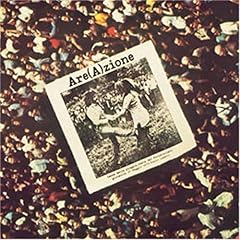
Area - 'Are(A)zione' (Cramps)

The cover to this live album suggests that it's taken from a concert in which there are about a million people there, like an Italian Woodstock; the sound is appropriately trumphant for such a grand presentation of Area's music. This record proves that Area were tight as hell live, and the recording is pretty-hi-fi while still containing that 'live' atmosphere. The more experimental side of Area seen on their second album isn't as prevalent here, as the whitenoise/tape manipulations are definitely more a studio thing - but if you like the rock 'n riffs, you'll find much to delight you here. The first side has the crowd-pleasing prog jams, a rock onslaught that never loses sight of pure technical aspiration yet still wets the panties of the screaming girls pictured in the liner notes. Stratos really comes alive on 'La mela di Odessa (1920)', which vamps a bit harder than the studio version (maybe at the expense of dynamic range, but fuck, I should listen side-by-side another time). Side two embarks on a jazz-fusion tip, with a speedy rumble crunch that takes center stage, relegating Mr. Stratos to the background. The album ends with some guitar heroics rather reminiscent of Albert Ayler's most iconic riffs. Now, while this is a cool enough album I don't know why I'd ever really pull it out instead of the studio recordings. I'm sure if I became a die-hard Area fan I'd appreciate the nuances of the improvisational sections here, much like a Deadhead jizzes over millions of alternate versions - but the rest of the Encourager Template calls, reminding me that I have too many goddamn records to give any of them the deep attention that (some) deserve.