
HEY! Get updates to this and the CD and 7" blogs via Twitter: @VinylUnderbite
Showing posts with label irritants (embraced). Show all posts
Showing posts with label irritants (embraced). Show all posts
26 July 2018
Steve Lacy - 'Moon' (BYG Actuel/Get Back)

19 August 2017
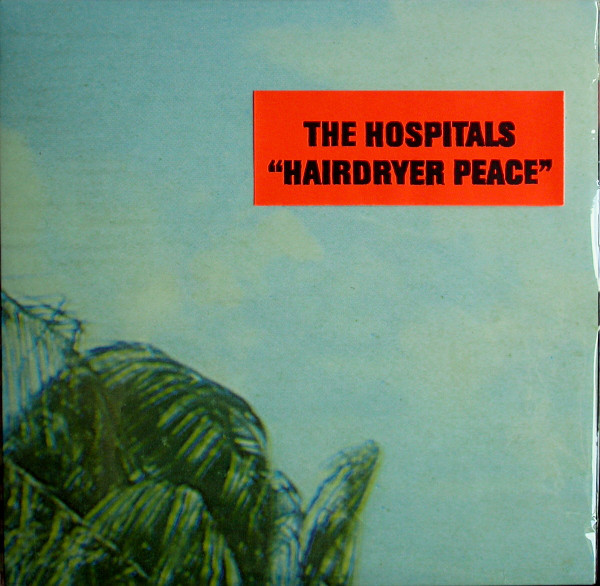
The Hospitals - 'Hairdryer Peace' (no label)
22 July 2015
Fugazi - 'The Argument' (Dischord)

21 October 2010
Car Commercials - 'Eric's Diary' (Soft Abuse)
 Clearly this is some sort of companion piece to Judy's Dust, as it has a similar title, the same style of paste-on covers and the same inversion of teenage nostalgia/futurism. The sounds inside, though, take such an alien, unsettled gambit that it's almost impossible to reach inside this bauble. The few vocal hooks that peer out of Judy's Dust feel like Top 40 compared to Eric's very strange Diary. It's a bit hard to tell what's what, since there seems to be an extra song on each side, but there's much more of a keyboard presence here, though played somewhat ironically on the (aptly titled) 'Teenage Pact' -- the Casio sounds are pushed to the forefront over manic drummin' and strummin', and it serves to isolate Car Commercials' apparent disinterest in their own music. There's less warbly walkman shit here, but the fidelity isn't any better - this is almost like the outtakes of Judy's Dust. 'Bad Plans in Action' and 'In A Hallway' use maddening guitar figures - any sort of riff has disintegrated, leaving only the excess gestures. Vocals, as well, are far more in the stream-of-consciousness/yelping style, though the lyrics are clear enough if you want to suss out whatever these guys are on about. The snare drum and feedback squeals are the punctuation of this otherwise unending miasma. It's a strange and challenging trip, for sure; and though it has the same sonic elements as the 7" and first LP, yet somehow it feels stark and bare. There's a part just before 'Oh My God, it's happening' where my record skipped and it made a rather infectious rhythm loop, but the rules of this game dictate that I had to bump the stylus along. And what came next? More feedback, muttered words and cold clattering. The closing tracks on each side are the most extreme of any Car Commercials vision to date. 'Everything Hurts Me' is long and tough-going -- it's attenuated towards painful yelping and frustrated outbursts, and it starts to take on a hall of mirrors quality. The end of side 2 ('Blew It') which may actually be two tracks (it's hard to tell) is the opposite - sparse, bare, and the most Shadow Ring-style they've ever done --- except minus all the attitude, just bathed in awkwardness. in the middle is a huge piece of silence, and then a fragmentary church-organ coda (maybe this is the bonus track? ). The typewritten track listing has what's clearly intentional typos, certainly a metaphor for the music, so maybe this is Pussy Galore refracted through 15 subsequent years of avant-damage. This is the type of record that I could become easily obsessed over, as it makes me want to keep exploring it's unlit corridors, even though I know there's no fun there.
2 September 2010
Buttecounty Free Music Society - 'Induced Musical Spasticity (1984-2009)' (no label)
 When this came out, of course I had never heard of BUFMS -- I mean, LAFMS, sure, and that was clearly the inspirational model for these weirdos, who seemed to gravitate around Chico, CA in the late 80s. One can only think that they would have taken over the world if only they lived in a bigger city. I saw this 4LP set with additional CD, packaged in a lovely box, and thought 'this looks like fun', and I got a good deal from the man at the psychedelic music store in Athens, so that was that. But then actually listening to it, well, it's a surprising mess of sound inside, and its a collage of many different artists who are all really different configurations of the same core people (OF COURSE!): Ambivalent Dosage, Ziplok, Hypnagogic Jerk, Bren't Lewiis Ensemble, Unlikely Modernists, 28th Day, the Conduits ... it appears that this scene put out 5 tapes, 4 by the Bren't Lewiis Ensemble and one compilation called Everything's DooDoo (which is represented here in its entirety, I think). The 8 vinyl sides of this box are sequenced in a curious fashion, more thematically than chronologically. Side A comes out of the gate with a brash, aggressive outsider sound, containing five tracks based around tape manipulations, repeating/skipped speech, and decidedly non-musical instrumental pluckings. Richard Streeter's 'Cookies Shaped Like Kites (edit)' is a particular highlight, sounding like a mentally retarded take on Robert Ashley. (and that's saying somethin'!) So if you're thinking these guys were purely in the realm of sound-art tape fuckery, it's understandable. But then side B upsets that, beginning with 28th Day's 'Let Go', a new wave tune with spindly guitars, dour vocals, and all the things we loved about the early 80s. Dilwhip's track is more along the same lines - hints of early R.E.M., the db's, Rain Parade -- of course far less polished and amateurish, but still a stab at rock music. The rest of the side starts to devolve that - Bren't Lewiis's 'Sakura Sakura' is an ethnic-derived sketch that could exist on a Jeweled Antler compilaton, and Hypnagogic Jerk's guitar/keys excursion is pretty nice in both sound and aesthetic. Side C continues the realisation that BUFMS were just as much into avant-rock sounds as the outer limits. And that's okay, cause I like R.E.M. AND Pierre Schaeffer! There's an earlier 28th Day track here, significantly more primitive, and without Barbara Manning (who I believe later made a few indie-folk records for Matador, and was in SF Seals). Right when I was starting to think that the BUFMS kids seemed miles removed from 'punk', Walking Jock's sneering 'Seven Year Itch' comes in the middle of side C. It answers the question "Were these guys going to see Black Flag shows during all of this?" and sounds a bit like Dag Nasty. Lots of fun. The Conduits take it back into the outer realm, with their Walkman-quality Ash Ra Tempel impersonation, and Hallucinatory Companion are a cute meandering instrumental that touches on the Young Marble Giants minimal approach. Side D takes things into the out-and-out goofy realm. It starts off with a manic melée of cheap keyboards appropriately named 'Carnival of Headache', by the cleverly named Experimental Artists. The narration reminds me of Jello Biafra, and it feeds into 'What's Your Beef?' by Lawrence Crane and John Young. This continues the atmosphere of fighting toys, but with sense of tug and push that is probably the most musically amazing moment on this set, so far. And right when it gets good, they stick a Monty Python cover in the middle. 'The Lumberjack Song', as performed by Tops Inc. is actually kinda amazing, with buzzsaw guitar and lush, layered yet tuneless singing. It's a vast improvement over the original, and I wonder if Pete Beck (the man behind Tops Inc) was in fact fifteen years old, doing this in his bedroom. The Hypnagogic Jerk track on side A is rehashed here only with brasher keyboards, followed by another Hallucinatory Companion tune. Rory Lyons completes the shift back from avant-rock to outer-limits explorations with a reverb-laden keyboard track that drifts away like magic, echoing bells. We're halfway there! Side E starts with Conduits again, doing a beautiful minimal harmonica and thumping electronics duet. Sidney Afrika does a deconstructed Steve Miller Band cover called 'fly like an algae' (get it??) that comes from some radio session, and the other highlight of Side E -- actually a highlight of the whole set -- is Ziplok's live performance, a pounding yet lush industrial guitar and drum machine set. It was performed under a blanket yet it sounds huge and ever-expanding. The next 2.5 sides are entirely a showcase for the Bren't Lewiis Ensemble, with F's side-long 'Goat Embryo (Covered With Glue)' being the epic kitchen-sink sound exploration. It proceeds slowly, always sounding like 2 or 3 people at a time despite having 14 people listed in the credits (including such musicians as Musclebutt, Joan of Art and Gnarlos). There's moments of the Futura-sound for sure - bending clanking sounds, moans and groans, and space-age warble. There's some spoken pause-button edit tape parts akin to side A, and some deep cosmic jamming, though it never stays focused long enough. There's also some poorly played string instruments (a favourite sound of mine) and it's such a collage that it could be 100 short tracks instead of one big piece. The next side (G, if yer followin') is Bren't Lewiis's 'Industrial Barbeque' event. It's a live recording which means consistent fidelity, but that fidelity is 'average'. There's more moaning, plinking, and scattered, burning foliage. Lots of echo from the room, yet we get a sense of how these weirdos existed as a live act. The fact that all of this was going on in Butte County, not exactly a place known as a metropolis of the bizarre, and in the midst of the Reagan 80s as well -- well, it's astounding. The tape collage on the previous side is a bit more dynamic, but it's nice that both sides of this group, clearly central to the BUFMS "scene", are represented. And Side H shows us yet another facet of Bren't Lewiis Ensemble - that of the goofball country n' western band, singing 'Plastic Jesus' . Next is Unlikely Modernists, a meandering bunch of tin-whistle and bongo hippies, Leaving the City MEV-style, but with some cartoon voices shouting in the mix. Now, we're almost through a four-LP box set, packed with a diverse array of "out" sounds, and to me, this Unlikely Modernists cut is the first "stereotypical weird music" track. That's not to say that I don't like it, but it at least fulfills some stereotypes. Bren't Lewiis gives us one last example from their ouvre (represented most reasonably, since they were 80% of the released cassette output back in the day) -- this one is heavy on the tape edits, with some recorder slowdown and other such grot. And finally, the whole she-bang ends with the Marques, a similar cut to the one that opened side A. A cyclical, mesmerising document of the soundworld of a few miscreants in a forgotten corner of rural California, sure. But a question has to be asked -- does this need to be heard? I enjoy all sides of this box set (though I have yet to get all the way through the bonus CD, which is a lengthy series of radio plays) but I tend to love things that are slipshod and miscellaneous. Can we call these recordings visionary, when no one heard them, and they influenced nobody? I don't actually care to have such debates, so I don't know why I bring it up. Despite whatever level of importance you might want to tack onto this set, these recordings hearken back to a time when creative energy found more innovative and isolated ways to express itself. Yeah, I mean this was pre-Internet, as was most music discussed on these pages, but more specifically they type of social interactions were completely impossible so these artists had only each other. And that type of tunnel vision can produce amazing things. Some of those amazing things are on these eight LP sides, and it's a real treasure to have them presented in such a grandiose manner.
10 August 2009
Axemen - 'Big Cheap Motel' (Siltbreeze)
 Just about every Kiwi noisenik has been in and out of this band at some point, but their available material has been scarce, at least outside of the NZ cassette scene from the early 80s. This vinyl reissue of one such tape, from '84, is quite welcome; it's done with minimal remastering and the properly lo-fi quality is saturated. I mean, this is when lo-fi meant lo-fi; cheap and warbly, but the guitars still know how to slice through things and the low end is surprisingly present as well. The live portions of this come from a concert where they wrote a set the night before to protest the milk company sponsoring the event for their sexist ads. The songs are as ramshackle as it gets, with drum set falling apart, bass farting in and out of time, sax glue and these little prickly guitar lines that skirt all over the place like a stone skipped on a frozen pond. The sloppy black and white graphics, plus the lyrics, suggest some crust-punk, Crass records kinda thing - and I think that spirit is here, cause it's certainly "punk" in some way. The band is all-male but just about every song attacks male attitudes head-on; there's not much subtlety in a song like 'The Pornographic Milk Drink' or 'Can't stand up for 40-inch busts' but I don't think I bought this record looking for subtlety. I can go back to the Au Pairs record from the other day for that -- but funny how the name Axemen suggests a big cleaving phallus? The avant-leaning tendencies of the Axemen come more from ineptitude than staying up all night studying MEV records; but there's also a freedom present, meaning that I don't think these guys had really tightly defined rules about what could and couldn't be done. And these days, that factor is more thrilling to me than whatever subcultural boundaries a certain record might skirt. The purpose of listening to this in 2009? I'm not sure that I can venture a proper guess; I guess great rabblerousing is timeless and this certainly tickles the alveoli. There are a few soaring, anthemic songs that get fairly melodic and recall the Clean's earliest and best work; Wikipedia says that Peter Gutteridge was a member once so maybe there was some cross-pollination at work, and it's a small island anyway.
Subscribe to:
Posts (Atom)