
HEY! Get updates to this and the CD and 7" blogs via Twitter: @VinylUnderbite
Showing posts with label dazzling obfuscation. Show all posts
Showing posts with label dazzling obfuscation. Show all posts
15 October 2016
Hair Police - 'Blind Kingdom' (Ultra Eczema)

29 April 2016
Guided by Voices - 'Vampire on Titus' (Scat)

15 October 2010
Car Commercials - 'Judy's Dust' (Cenotaph)
 This is the new sound of New Jersey, and a pretty carefully cultivated one at that. Half of these guys are in Home Blitz and the other half was affiliated with Ladderwoe, so the resulting mix is pretty accurately a blend - a freeish rock group with a real anti-aesthetic and a particular velocity. The opening track is a long warbling instrumental with noodling casio and scraping, and it never even closely congeals into anything tangible, though with an exactitude and deliberation missing from most free-form ensembles of today's world. When the rock riffs creep in, first heard on '190' and most effecively on 'Babe's out of luck' (which actually approximates a traditional rock song), it's cathartic. A satisfying release to tension and it makes you think the whole mess was quite deliberate. Is it hard to connect to the expressions here? Surely 'Mechanic's yelps and mumbles bear no resemblance to sanity, but then it's hard to deny those rough songforms, when they turn up. 'Collida and Jimmy' begins with an anthemic strum, though soon after the singing starts (an off-kilter warble, of course) it proceeds to follow it's own musings down dark corridors and never comes back. The drumset is used throughout the record with maximum imprecision, but it fits the faux-nostalgia that the sleeve artwork (and liner "notes") create. It's park Jandek, of course, with a smidgeon of Pere Ubu but also a good helping of Kenneth Higney. Just blazing on through in a cavern of one-take songbash, Judy's Dust somehow overcomes it's limitations and communicates. There's no inertia here. The slowly melting, unfolding of 'The Devils' hints at a grand vision, and the occasional intrusion of tape-player speed adjustment or feedback squeal all seems like part of it. Maybe 'The Investigation' is their 'Murder Mystery', I don't know for sure. It's rock music, deconstructed and reinvented yet again. And it ends with a Boomtown Rats cover.
31 May 2010
Tim Buckley - 'Lorca' (Elektra)
 'Lorca' (the song) has a great descending riff, the evil twin to Floyd's 'Interstellar Overdrive', and it feels amazingly focused, searching towards Buckley's own inner destructive soul. The electric piano steps forth, played by Lee Underwood in the same meandering, noodly style that he showed us on guitar those last few albums, but sounding like small burning solar flares. 'Anonymous Proposition' is the kind of song that exemplifies Lorca though - Buckley's own melody is strong and the band is floundering around him. Forty years of rock deconstruction followed but methinks this is a real stab at musical freedom through folk forms. By the time this gets to the end, it's like we're right back where we started, but we've felt. The rhythm section is what's missing - John Balkan's bass has become a lead instrument and apart from some congas (probably most obviously timekeeping on side two and a bit of 'Lorca', actually), we have a beast of a record. But the voice becomes the centre - the ultimate inversion of rock's rules, so already cast-in-stone by 1970 despite all the manic experimentation of the past few years. But this feels relatively uninfluenced by any of that. 'I Had A Talk With My Woman' has some bonafide pop hooks in it, but it continues the atmosphere set by the first side. Then 'Driftin'' enters the scene, which is slowed down miserable country-blues over a campfire ambience. I think of some of Neil Young's most miserable times on the beach when I hear this one, both in temperament and in Underwood's soloing. It ends with a frantic pace, as Buckley is wailing in his teen idol way but the band is cooking a brutal breakfast. I used to think of Lorca as split between side one's radical explorations and side two's more conventional tunes, or rather, they always seemed more like a continuation of Happy Sad/Blue Afternoon. But this time it sounds much more cohesive than I remembered. It's true that 'Lorca' and 'Anonymous Proposition' are the most radical in form, with 'Lorca' itself introducing some real dark juju. But the second side shouldn't be overlooked, just because it has a more rhythmic center. This is Buckley unleashed, and if you think of all three of these records (including the ones before and after) as coming out of the same sessions, then we really have a remarkably productive period of creativity for any one artist to claim.
11 April 2010
Anthony Braxton - 'Creative Orchestra Music 1976' (Arista)
 Jumping off from the concise, quartet-based stuff on Five Pieces 1975, we get this large enesemble masterpiece - in some ways the culmination of everything Braxton 'represents'. He keeps his orchestra on a short leash for the most part, but at some points, particularly cut three on side 2, we hear some of the most fully realised potential of big-band improvisation/composition meetings. But let's start at the beginning - side 1, track 1 is a go-getter, a sprightly or attention-grabber that shows off the potential of what happens when you get 15 talented people together. The tune is concise and everyone is held somewhat in check by each other; solos come out but they're balanced in a brass vs. reeds structure and it's a pretty dazzling opening. And well-recorded too! But then, cut two is 8 minutes of quiet experimentation - with an even larger lineup of twenty. There's MEV guys, AACM guys, and some lesser known names but they all take their time feeling out how they can interact spatially. There's some bass drum rubbing, tuba bleats, and other motifs that people associate with 'smart' free jazz, but it's restrained enough that I would maybe even finger this as a track to pick out as a potential eye-opener for the doubters. Cut three is an experimentation with marching band music and is such really fun and, well, fucking racous. Leo Smith is conductor, and I can imagine him wearing some strange red uniform. The liner notes make a reference to Tutti music but all I know is that is fucking rips. When you flip the record, though, you get a very moody, ECM like exploration that steps through several tonal progressions (while still leaving room for piano tinkles and marimba gurgles). There are improvisational sections but they are like the floss between these heavy, post-classical teeth. I like it, but I've always had a thing for mildewy cobweb jazz composition. Braxton musta really carefully sequences Creative Orchestra Music 1976 to balance the peaks and valleys; these slower bits really work well against the full-fledged rock-out-with-your-cock-out moments. Of which the final cut is definitely that, as mentioned above. Creative? Yes. Orchestra? Well, 20 is an orchestra to me though there's a distinct lack of strings. But not a lack of swing; and even the slower, spatial bits maintain some sort of reflection on 'blues' or whatever it is that is the voice of African-American jazz espression.
5 April 2010
Anthony Braxton - '3 Compositions of New Jazz' (Delmark)
 And thus we begin the Braxton gauntlet, one that runs back-to-back with the Brinkmann gauntlet. What a stunning debut! And even when compared to the other gems of AACM sound resonance emerging around this same era (1968) -- such as Roscoe Mitchell's Sound or the early Art Ensemble stuff on the box set -- 3 Compositions of New Jazz is an incredible explosion of creativity, a new direction for music yada yada yada. But really, as someone who owns ten Anthony Braxton LPs, all of which we are going to explore in the next week or so, this is the one that really started it all and it still sounds great. Maybe we can say that this is a Braxton still exploring his own voice, because these three compositions are modular and fluid, moving from instrument to instrument with nary a pause to reflect. The Art Ensemble of Chicago are of course kindred spirits, but a difference here is a focus on composition rather than group interaction. It's hard not to think some bits of this are improvised, but the vocalisin' is so in tune with the harmonica or violin or trumpet that you know Anthony's kept the reins held tight. The band, by the way, is Braxton, Muhal Richard Abrams, Leroy Jenkins and Leo Smith, and that's about as powerful of a collection of Chicago artists as you'll get. The track titles are unrepresentable in Google Blogspot's UTF-8 limitations, but side 1's a mission statement if I've ever heard it. Jenkins and Smith lock into some dazzling contrapuntal runs, but then also Braxton comes in with a reedy, woody tone that darts around the convetions of blues and jazz to express his youth and wide eyes. Percussion is limited but oh-so-effective - a sharp click of a wooden block can just bite through everything. Side two begins with some a long piece built around duets. At times Jenkins is sawing away while Abrams is creating circular patterns up and down the piano board, and it's manic and calm at the same time. How does he do it? There's never any impulse for "all in" -- instead this while album is a collection of miniatures. Abrams is a constant throughout the side 2 piece, and when everyone else drops out it becomes an impulsive, honest vision into the misty industrial skyline. 'The Bell', composed by Leo Smith, closes things with a somewhat more attenuated sense of dissonance and drama. There's still an emphasis on open spaces and open forms, but that's kinda what we expect from this gang , right?
28 June 2009
Art Bears - 'The World As It Is Today' (ReR)
 A title like this would suggest a bold statement of an album, something both philosophical and direct. Well, sure, this is the pen of Chris Cutler, after all. If you didn't think the man who wrote File Under Popular could knock it out of the park, then you're truly underestimating him. This is concise - a 45rpm mini-album, maybe a long EP - yet leaves nothing to be desired. The lovely little booklet rearranges the running order into a three lyrical groups. 'Law', 'Democracy', 'Truth', 'Freedom', 'Peace', and 'Civilisation' are classified as "6 corpses in the mouths of the bourgeoisie", but despite this heavy concept, the songs are light as air. I often forget how traditional the Art Bears actaully could be, at least in terms of instrumentation; most of these songs are drums, piano and guitars and they achieve their innovation largely through structure, composition and affect rather than effect (if you get my drift). Though 'Civilisation', at the end of side 1, is a thick, slow composition that sounds like Morton Feldman pushing a pram. It hangs in the air and never lets go, always on the verge of resolution. Vocally, Dagmar is perfect -- I can't imagine anyone else interpreting a song that is somewhat anti-democracy and transforming it into something so magical. The second lyrical group is "4 songs" and contains catchy tunes like 'The song of the Dignity of Labour Under Capital' which is more like Brecht than Engels, thankfully. The final standalone song is 'Albion, Awake!', ending the album (and the career of Art Bears) on a platform of hope, though first transformed through the most tape-manipulated section of the band's ouvre. Perhaps this twisted unraveling is an abstracted musical story of the workers of the world. The final line is 'Let banners fly like shrapnel and efface the sky!' and while I jump up with my red flag, I then think to the reality of everything that has happened since 1981, and then I get depressed, and then I just listen to some more records to wash away the pain. The real pain, of course, is that my copy of this is slightly warped, which renders 'The Song of Investment Capital Overseas' and 'Democracy' rather unplayable.
23 June 2009
Area - 'Maledetti' (Cramps)
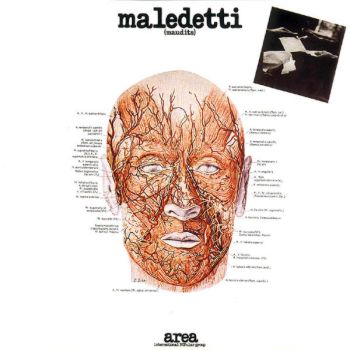 And now, my favorite Area record -- or did I say that about Caution Radiation Area? -- Maledetti is all things to me. It's their most surrealistic and fucked up record, both in the overall Dadaist structure and in the incredible, genre-best closing track 'Caos (parte seconda)' . It's also (I will argue) one of their most complete records, as there's a little bit of everything here. In a perfect world, their reputation would rest on Maledetti alone. You get snippets of a very jazz-oriented Area, perhaps the jazziest we've heard yet with a real McCoy/Garrison current in 'Gerontocrazia' and also an extended lineup that features Steve Lacy and Paul Lytton. The chord changes, complex time signatures, and blister-inducing rapid instrumental passages are here too. You get a second side that in addition to the insane 'Caos' jam (which sounds like Jac Berrocal after eating too much spinach, while watching Benny Hill episodes with the sound muted) opens with a "massacre" of the Brandenberg concerto. You get a track that is Valerie Solanos's 'scum' manifesto set to music, vocalised by the one and only Demetrio Stratos (I've noticed that the spelling of his surname changes from album to album, though there's actually a signature in the liner notes for this one). And you get the surrealist flag in vibrant colors, raised on the opening track 'Evaporazione', which sounds like the tape recorder accidentally left on and is a brilliant and insane way to begin an album. This isn't all "out" like the next entry in our Area gauntlet is, but just bizarre enough to achieve, I dunno, perfectione? Great artwork too; if you ever had any doubts about why Area were on the NWW list, start here. What's the criticism? That it's too short? But not really, cause it doesn't even leave you wanting more. It's often easy to be distracted by diverse sounds. I'm not necessarily impressed by an artist who merely demonstrates that they have a big record collection -- I mean, you can always start an alphabetic blog to do that! We all have shitloads of influences but if you can't take your precendents and make it into something that is yours, then what are you doing besides recycling other records? Area manage to find the perfect balance here - the jazzy parts may trigger a million associations in my mind, but ultimately it's still Area. We get a few measures of Terry Riley, a few measures of Cage, a few minutes of Bach - but it's chewed up and digested and magnified by Area's own brilliance. Soldier on, boys. Though the end is nigh.
11 May 2009
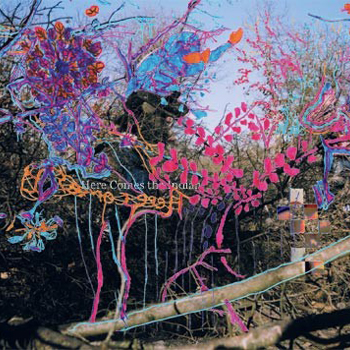
Animal Collective - 'Here Comes the Indian' (Paw Tracks)
Subscribe to:
Posts (Atom)