HEY! Get updates to this and the CD and 7" blogs via Twitter: @VinylUnderbite
Showing posts with label inside and outside simultaneously. Show all posts
Showing posts with label inside and outside simultaneously. Show all posts
19 August 2017
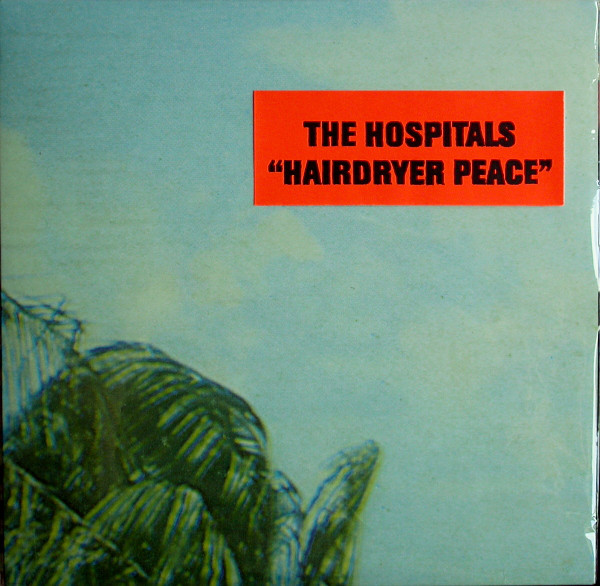
The Hospitals - 'Hairdryer Peace' (no label)

26 January 2016
Gastr del Sol - 'Camofleur' (Drag City)

5 March 2015
Chico Freeman - 'Chico' (India Navigation)

30 July 2013
Essential Logic - 'Beat Rhythm News - Waddle Ya Play ?' (Rough Trade)

6 May 2012
Dead Luke - 'American Haircut' (Florida's Dying)

7 February 2012
Dead C - 'DR503 / The Sun Stabbed EP' (Ba Da Bing)

30 August 2011
Lol Coxhill - 'The Joy of Paranoia' (Ogun)
 Sometimes when I am going through a mild personal freakout, either a "why the fuck do I have so many records?" moment (which I call armchair zen) or a "do i even really like music?" moment, I'll think about all the records I never listen to as a key element (but I'm never sure if it's cause or effect). So I'll have these moments where I wonder why I need to own four different LPs by Lol Coxhill when I never listen to them, etcetera etcetera. This project was embarked upon partially to conquer these freakouts, and genuinely assess all of this plastic and vinyl I drag around with me from place to place, which is not so easy to deal with when you move to a new country every 3 years. Most of the time I end up finding new pleasures here, as I think I've only come across one or two LPs so far that I don't enjoy at all anymore -- yes, I tossed that second Arti + Mestieri record already. I've loved the first 3 Coxhill records here, and had fond memories of Joy of Paranoia. This memory has been mostly upheld, though I'd probably say it's my least favourite of the four. How much you enjoy the paranoia depends on how much you like guitars; side one is an 18 minute jam with three guitarists I've never heard of, one acoustic, one electric, and one bass. Lol is on soprano throughout -- throughout the entire LP - and I think he works well with the other guys. The Spanish guitar in particular gives it a real gentle, adult-oriented-improv feel, and they spill into all margins of speed, timbre and motion over the track. Side two begins with a four-part suite with Veryan Weston on piano, which is playful; the two don't so much intertwine as provoke, and there's a wooly tone to the sax like it's been muted. Or maybe I just need a new stylus. The fourth part of this suite is called 'Prelude to paranoia' and it leads into a solo piece, the almost-title track of the album ('Joy of Paranoia Waltz'). And what a track! This is some multitracked soprano sax, ascending and descending simultaneously to create the maddening tapestry it's title suggests. Paranoia is pleasure here; it's not claustrophobic or even that demanding, but it's an intense and beautiful 2 minutes and 12 seconds - go hear it on YouTube if you don't believe me. It's a Coxhill jam for mixtapes and DJ sets, and it's exuberance is infectious. The last two tracks are longer live improvisations with a hot electric pianist, Michael Garrick. The playful attitude remains though it's most edgy than the acoustic piano tracks with Weston; they combine to make side two a symmetrical sandwich balanced around 'Joy of Paranoia Waltz', with some crowd enthusiasm and applause sprinkled in. 'Perdido' has a great piano solo that is sorta funky at times, or maybe I should say chunky; this brings out Lol's more tuneful side, which is reassuring. Trying to describe these tracks makes them sound pedestrian but they are anything but. Though this album feels a bit like a mishmash of disparate sessions, in a way all four of the records under consideration here have had that attribute. The liner notes here are even more earnest than Ear of Beholder's spoken sections ("I hope that those who accept my more extreme outpourings will find this music as interesting as I did at the time of recording") and that just adds to all the fucking charm this guy has built with me over the past four entries. Sadly, my accumulation of all things Coxhill terminates here.
21 August 2011
Lol Coxhill - 'Ear of Beholder' (Dandelion/Ampex)
 Ear of Beholder is one of those magical artefacts that is delightful from start to finish, though I don't make myself listen to it enough. Coxhill's a great saxophonist and his personality shines through every second of this, whether he's blowing his horn or speaking affably to the listener. Though it's only 3 of the 21 tracks on Ear of Beholder, the songs where Lol sings with David Bedford accompanying him on piano and backing vocals are stunning - their impact on the album is huge. Midway through side 1, after we've been treated to two fantastic live saxophone improvisations (all of which have a lot of great outdoors noise in the background, and 'Deviation Dance' has a great, gritty fidelity), we encounter the first of these songs. 'Two Little Pigeons' is sweet and sort of romantic, having that old-timey feel but fragmented through a London avant-garde of the late 1960's. And 'Don Alfonso' (who works at Oxo) is a bit of sillyness but it balances well and serves to break up what would otherwise be a whole side of saxophone solos. Not that I don't like the sax solos - I wouldn't own so many Lol Coxhill LPs if I didn't - but that these show a humour, versatility and eclecticism that is iconoclastic in the often po-faced UK improv scene. Coxhill's playing is deft; bluesy and swinging when it needs to be, and generally much more human than other UK musicians like Evan Parker. His mastery is felt but he's not beating you over the head with it. But that's just side 1! Side two goes for the documentary feel; 'Feedback' being a noisy dictaphone recording that is aptly namee, and then a larger band ensemble that features Mike Oldfield, though the fidelity is no better. It's got a similar feel to some of those chunky Arbete & Fritid instrumentals, though not quite as woodsy. We encounter a children's choir on 'Mango Walk', and the theme of innocent voices is returned to in side four's cover of 'I Am the Walrus' (though accompanied by Lol's flute and maraccas). Side three is a long piece, 'Rasa Moods', perhaps the most traditional "improv" here, though it also features some strange readings and has that same distant fidelity that characterises the moments with Oldfield on side two. The record's last side is like a mirror of the first one - more solo improvisations, another piano song with Bedford (the edgy 'Dat's why darkies were born' (presented in context, via spoken introduction), and a rocking jam 'The Rhytmic Hooter'. This is a monster of a debut album and it's iconoclastic, political, exploratory, diverse and accessible all at once - which is more than most artists could even dream of achieving in a long career.
30 November 2010
Don Cherry - 'Mu Second Part' (Affinity)
 It's hard to find a decent-sized image to steal out there, because most of them are for the alternate white BYG issue. But I have both Mus on Affinity, and these back covers are adorned with great-yet-frightening photos of Mr. Cherry. In this second part, he's cracking a mad/evil smile and his eyes are bulging out of his head, but the effect casts him more as a lunatic than a villain. I guess only a lunatic would create a medley called 'The Mysticism of My Sound', a piano-driven suite that actually isn't nearly as mystical as anything else found on the two Mu slices. As suggested at the end of part 1, the piano noodlings are some sort of bridge into an extended piano workout. This is very slow-paced, and quite simplistic. There are bluesy overtones (particularly in the medley's opening movement, named after Dollar Brand), but none of the weird fidelity found on part 1's 'Terrestrial Beings'. Blackwell is holding things down but letting Cherry ring on, and the space is again a nice element (there are long sections where Cherry is only playing with one hand, clearly intending to highlight the melody over any sort of dazzling technique or freedom). It segues into bamboo night (in a piece titled, yes, 'Bamboo Night'), where said flute comes back to prominence, then drifts into the ether. Blackwell ends the side with a mini-solo, where he does that thing drummers do, you know, where they kinda push on the skins and warp the sounds. 'Peo Peo Can' (or 'Teo-Teo-Can' depending on whether you believe the sleeve or the label) begins side 2 with some real mysticism. Cherry plays the Indian flute, chants, and speaks in tongues all at the same time. Blackwell is on tiny percussion - one part sounds suspiciously like those rainsticks you get at airport gift shops. Things finally erupt in 'Psychodrama', another medley, which starts with the trumpet/drums freakout we've all been waiting for. But even this is strangely regal, and comes in bursts. But by the end (after going through another section named after Dollar Brand, with more piano of course), things wither away, the lifeforce receding into the distance. I haven't really sat down and listened to these records in years, at least not as closely as this -- which is, of course, the real purpose of this project. But I found a much more diverse and lively array of musical ideas than you would think only two people would be capable of. In some ways this is Cherry's masterpiece, even though it's sketchy, impulsive and unfocused -- but it may be the best representation of him as a musician. Perhaps these need to be paired with Brown Rice for a better picture.
31 May 2010
Tim Buckley - 'Lorca' (Elektra)
 'Lorca' (the song) has a great descending riff, the evil twin to Floyd's 'Interstellar Overdrive', and it feels amazingly focused, searching towards Buckley's own inner destructive soul. The electric piano steps forth, played by Lee Underwood in the same meandering, noodly style that he showed us on guitar those last few albums, but sounding like small burning solar flares. 'Anonymous Proposition' is the kind of song that exemplifies Lorca though - Buckley's own melody is strong and the band is floundering around him. Forty years of rock deconstruction followed but methinks this is a real stab at musical freedom through folk forms. By the time this gets to the end, it's like we're right back where we started, but we've felt. The rhythm section is what's missing - John Balkan's bass has become a lead instrument and apart from some congas (probably most obviously timekeeping on side two and a bit of 'Lorca', actually), we have a beast of a record. But the voice becomes the centre - the ultimate inversion of rock's rules, so already cast-in-stone by 1970 despite all the manic experimentation of the past few years. But this feels relatively uninfluenced by any of that. 'I Had A Talk With My Woman' has some bonafide pop hooks in it, but it continues the atmosphere set by the first side. Then 'Driftin'' enters the scene, which is slowed down miserable country-blues over a campfire ambience. I think of some of Neil Young's most miserable times on the beach when I hear this one, both in temperament and in Underwood's soloing. It ends with a frantic pace, as Buckley is wailing in his teen idol way but the band is cooking a brutal breakfast. I used to think of Lorca as split between side one's radical explorations and side two's more conventional tunes, or rather, they always seemed more like a continuation of Happy Sad/Blue Afternoon. But this time it sounds much more cohesive than I remembered. It's true that 'Lorca' and 'Anonymous Proposition' are the most radical in form, with 'Lorca' itself introducing some real dark juju. But the second side shouldn't be overlooked, just because it has a more rhythmic center. This is Buckley unleashed, and if you think of all three of these records (including the ones before and after) as coming out of the same sessions, then we really have a remarkably productive period of creativity for any one artist to claim.
11 April 2010
Anthony Braxton - 'Five Pieces 1975' (Arista)
 Despite the smokiness of the cover image, this is a record of clear skies and full-steam ahead sailboat ventures. The whiteness of the rhythm section (Holland and Altschul) doesn't hold back the groove, and despite Braxton's usual cryptic symbology in his titles (defended somewhat in the liner notes), the tone is really set by the opening track, 'You Stepped Out of a Dream' (penned by Macio Herb Brown). This is an upbeat record, with a loud, crisp recording quality that brings out Kenny Wheeler's trumpet and flugelhorn, and lets Braxton show off his sharp turns and warm sonorities. This is some of the most straightforward Braxtonisms I've encountered, which is pretty funny since it comes sandwiched between the Derek Bailey duets and the third-stream explorations of Creative Orchestra Music 1976. Maybe this shoulda been called Five Easy Pieces 1975 though maybe the makers of that film would have sued. If you're thinking about countercultural matters put them aside; this is a record that really strikes the balance between accessibility and new composition. Side two in particular ends with a very edgy, nervous bassline from Mr. Holland; the brass trumpet feels like fingernails on a chalkboard at times, but it's driven ahead almost like a Neu! track. Toe-tappin', hip-slappin', yeah all those things - I dig it, it's my pick of the LP for sure - and it's certainly a brighter spot than we've heard in awhile here. This of course recalls the Circle band on ECM which is just so so good, except minus Chick Corea and with Wheeler -- but it's similar how that Wayne Shorter tune sets the tone of that, and this also opens with a 'standard'. The Circle record is a bit more exploratory, but it's not like Braxton has anything to prove by this point. No murky clouds here - it's sunbeams, not icicles.
30 January 2010
Carla Bley / Paul Haines - 'Escalator Over the Hill' (JCOA)
 Actually, you know, Escalator Over the Hill is my favorite chronotransduction ever. Why can't avant-garde jazz have their own Jesus Christ Superstar? As notorious as this is for being an overblown pretentious pile of art-wank, if you actually listen to it you'll find a pretty good time. There's only a few triple LPs that I think are deserving of the length, and this is one of them. A Lot of People Would Like to See Armand Schaubroeck ... Dead is another, but it'll be years til we get to it. Sandanista is not, and something about that forthcoming Joanna Newsom triple gives me a bad, bad feeling. But let's get to Escalator - the lineup is amazingly great, and I could fill this post naming the luminaries who blow 'n pluck on these six sides: Bley and Mantler, of course, and then Charlie Haden, Don Cherry, Gato Barbieri, Jack Bruce, Don Preston, John McLaughlin, Linda Ronstandt (!), Roswell Rudd, Michael Snow (!), Jimmy Lyons, Enrico Rava, Leroy Jenkins, Dewey Redman .... and that's not counting the unsung heroes like Paul Motian (who drives the drumkit throughout). I am a sucker for Bley's style of brainy big-band deconstructions; I love Tropical Appetites and a lot of the songs here follow a similar pattern, though with Paul Haines' perplexing lyrics. There's a lot of great, soulful movements here; the whole set opens with Roswell Rudd's trombone aching in pain. This Hotel Lobby Band comes back and forth like a Greek chorus, with other smaller breakout groups driving forward the story and the band returning - used to great effect at the end of 'Holiday in Risk'. I'm not going to be a literary critic here, so you won't get any comments on the themes present in the lyrics (mutation, India, conflict, the body, etc.). But as one who enjoys delicate, female-driven songwriting, big-band swing, and weird electro-acoustic sound fuckery -- this has everything for me. It's amazing how incredibly consistent it is over two+ hours. I guess this took a few years to assemble so Bley really could take her time to keep the wheat from the chaff, you know? But while "it's all good", there's still highlights. Linda Ronstadt really has a shit-hot voice, and whenever she takes a tune, it slays ... check 'Why?' on side 2 if you don't believe me. I wonder what this stage production looked like? I can only imagine actors dealing with sounds like the ring-modulated piano or the calliope bits. Jack's Traveling Band (which is McLaughlin, Bley, Bruce and Motian) rip it up in rock-fusion fury on side 3-- to the point where you can only dream of an offshoot LP. It resembles Tony Williams' Lifetime on more than a surface level, though contained into a five minute "rock song" and somehow fitting in place with the rest of this. They come back in 'Rawalpindi Blues' and get a bit more room to explore, when McLaughling busts this nutty guitar line that is super staccato repeated notes. The piece goes into this weird chanted "What will we ever do with you?" vocal part over what sounds like AMM or something, and then the theme is taken up by the other recurring band in Escalator Over the Hill -- the Desert band. They actually appear earlier on side 5 to introduce the Eastern section of the story. This is where Jenkins shines, though it's also copiloted by Don Cherry's ethnoclouds of trumpet (and later his vocal glossolalia). The cello (played by Calo Scott) has a tambura/Bharat vibe, and these sections feel like a slice of curry-flavoured gristle in the middle of wedding cake. Overall, cause it's been a few years since I last listened to this, I'm kinda blown away by how good it is. I could probably go to this at any point during the last ten years and found something in there to reflect on my current interests. When I was into jammy, spacey rock explorations I would have enjoyed the Jack's Traveling Band sections; when I was interested in oblique songwriting, well, pretty much all of the parts with singing would apply. Free jazz? Of course, and more restrained improvisations are all over this, too. Outsider, NWW-listy sounds? Sure, they're the glue that holds this together really. There's also a few tunes where the voice drifts over the instrumentation in the same way that outsider/free folk does, which I can't explain any better. 'Oh Say Can You Do?' on side four (which is voice and calliope) is what I'm talking about. Ethnic free explorations: see the Desert band, above. Complicated art-rock ideas: the whole thing. Right now what I take from this the most is the idea of composition as a means of liberation, not control. This is a pretty tightly knit triple LP, probably the most tightly knit 3xLP I can think of except for maybe that one Vitamin B12 release. But at the same time, it invites exploration across a shitload of different genres, and can probably be studied to the point of microscopic detail.
Subscribe to:
Posts (Atom)