 Fast-forwarding about a decade from Stockholm, we find Ornette deep in the orgasmic revery of jazz-rock fusion. Dancing in Your Head is 85% a long jam with a jazz-rock band and 15% a jam with the Master Musicians of Joujouka. And a "jam" indeed is 'Theme from a Symphony variation one', as the thunderous blasts of discordant guitars, bass spurts, and Shannon Jackson (I assume the Ronald has not yet been added to his name) pounding away in a Beefheartian, yet swinging style. There's a chorus, a simple melody that the band falls back into at times, but the holes only appear in this dense fog because everyone is playing the same thing. And when the verses are in effect, we get every type of post-Django guitar rivulets, often piled on top of the other guitar's dirty palm-muting. Both guitarists are credited as 'lead' guitars - Bern Nix and Charlie Ellerbee - and there's a genius to it, a self-consuming inward looking thrash that has a primitive monotony that outlasts most other efforts of its time. The second variation, on side two, begins with a tease of jazz guitar glory before getting back into the tune that by this point has bored into my brain. Throughout the eleven minutes of the second variation we're occasionally teased with fuzz pedals, bursts of rock riffage, and Coleman's alto skronk, but it's always returns to the central theme. It's maximal minimalism, and I can't help but think that the parts where the guitars and saxes are fighting to out-ascend each other to the next note is total Zoot Horn Rollo. 'Midnight Sunrise' is recorded in Morocco and finds Ornette's alto accentuated by clarinet, Moroccan reeds and percussion. I don't think it's a great title, or only half-great, because this is dark music of the night with nothing on the horizon. Despite the exploratory gusts of air, the percussion swarms around everything and encloses it, and I'm left wishing there was more than a 4-and-a-half minute document of Ornette's trip to Africa. Promo copy.
HEY! Get updates to this and the CD and 7" blogs via Twitter: @VinylUnderbite
Showing posts with label circular logic. Show all posts
Showing posts with label circular logic. Show all posts
8 May 2011
Ornette Coleman - 'Dancing in Your Head' (Horizon/A&M)
Fast-forwarding about a decade from Stockholm, we find Ornette deep in the orgasmic revery of jazz-rock fusion. Dancing in Your Head is 85% a long jam with a jazz-rock band and 15% a jam with the Master Musicians of Joujouka. And a "jam" indeed is 'Theme from a Symphony variation one', as the thunderous blasts of discordant guitars, bass spurts, and Shannon Jackson (I assume the Ronald has not yet been added to his name) pounding away in a Beefheartian, yet swinging style. There's a chorus, a simple melody that the band falls back into at times, but the holes only appear in this dense fog because everyone is playing the same thing. And when the verses are in effect, we get every type of post-Django guitar rivulets, often piled on top of the other guitar's dirty palm-muting. Both guitarists are credited as 'lead' guitars - Bern Nix and Charlie Ellerbee - and there's a genius to it, a self-consuming inward looking thrash that has a primitive monotony that outlasts most other efforts of its time. The second variation, on side two, begins with a tease of jazz guitar glory before getting back into the tune that by this point has bored into my brain. Throughout the eleven minutes of the second variation we're occasionally teased with fuzz pedals, bursts of rock riffage, and Coleman's alto skronk, but it's always returns to the central theme. It's maximal minimalism, and I can't help but think that the parts where the guitars and saxes are fighting to out-ascend each other to the next note is total Zoot Horn Rollo. 'Midnight Sunrise' is recorded in Morocco and finds Ornette's alto accentuated by clarinet, Moroccan reeds and percussion. I don't think it's a great title, or only half-great, because this is dark music of the night with nothing on the horizon. Despite the exploratory gusts of air, the percussion swarms around everything and encloses it, and I'm left wishing there was more than a 4-and-a-half minute document of Ornette's trip to Africa. Promo copy.

27 April 2011
Leonard Cohen - 'Songs of Love and Hate' (Columbia)
 When I was getting into Leonard Cohen, age 16 or so, Songs of Love and Hate seemed like the most extreme and fierce of the infallible four. The cover sets it apart - a badly contrasted photo, with Cohen looking deranged and unshaven compared to the zenlike calm on his first two records, plus the 'The fools/They locked up the wrong man' lines on the back - and the music feels even more stark and bare than Songs from a Room. Except listening now, it's not so much the case. 'Avalanche', yes, sets things off with a ferocious pallor, but it's still orchestrated with quite bold string sweeps. 'Last Year's Man' continues this with glowing violins and haunting, childlike backing vocals. So the musical sparseness was surely my own mental construct - I also saw this as sloppy and resigned to failure, maybe because the inclusion of the live track 'Sing another Song'. Now I feel some revisionism, sure, but like all Cohen records the lyrics of some tunes get more relevant with each listen. Is it all a bit of melodrama, or is this a record of pure pain? Songs of Love and Hate is not a slow record; 'Dress Rehearsal Rag' and 'Diamonds in the Mine' both have a somewhat frantic momentum, not to mention 'Avalanche's eponymous arpeggios. And the pain is probably the hate we're promised. 'Dress Rehearsal Rag' is just a downer, but 'Diamonds' is like a goofy descent into madness. Of course, is it Len's usual somber voice that makes his shrieking cackle sound extra-insane? On the flipside, 'Love Calls You By Your Name' has the same creeping malevolence as 'Avalanche' and is an underrated gem in the Cohen catalogue, in my opinion. There's not much to say about 'Famous Blue Raincoat' which I can't help but love despite 40 years of coffeehouse open mic fuckers ruining it; I've never been sure how genuine it's sentiments are - though it's probably closer to the hate side of Love and Hate, despite L. Cohen's backhanded forgiveness. 'Sing Another Song, Boys' is essentially a new lyric to 'So Long, Marianne', a bit freewheeling and adorned with a nice meandering organ part. The live recording leads to some great imperfections in the singing which I love, even if I've never quite clicked with this tune lyrically. And then, 'Joan of Arc', the epic closing tune which is almost like a restoration of the first album style. It's a story, with an out-of-sync dual vocal track which is actually my favorite thing about the song. But how can I say something is infallible and then criticise it? Thanks for cutting loose a bit, Leonard!
15 October 2010
Can - 'Moonshake' (Cherry Red)
 I thought this was an odd release when I stumbled across it - a 12", 45prm single for 'Moonshake' released a decade too late. And on Cherry Red records! But this makes sense - it's an early 80's label, very much 'of its time', looking back to an influence on its own sound. A bit of retro fun, recast in moody 80s low-lighting. And it works -- and 45rpm never hurts for great bass resonance. As mentioned before, my copy of Future Days disappeared somehow, so this is my sole way to hear 'Moonshake' on vinyl until a new copy arrives. I forgot all of the business happening between the notes here - it's such a busy track, with Can really trying to cram as much into a fairly low-key, repetitive groove as possible. In some ways it's as forward thinking as 'Aumgn', but just expressed within the song instead of around it. But the real reason I treasure this single is 'Turtles Have Short Legs', the greatest Can non-album track. This is Damo spazzing out with a bit of anthropomorphic nonsense over a silly, stupid piano riff. It has to be a holdover from the Malcolm Mooney days, but maybe not; the only thing I really know about it is that 'Parappa the Rapper' stole the backing music and stuck it in a playstation game, one of the more head-scratching wtfs ever. But it's a great, silly song, and Damo sorta sings 'regs' instead of 'legs' which is such a great great stereotype, captured in vinyl forever (and at 45rpm!). On the AA side, 'One More Night' sounds as great as always, a window into an endless maze of its own architecture. It says on the sleeve that Epic Soundtracks helped "compile" this, though picking 3 songs isn't really hard work. Thanks, Cherry Red!
11 October 2009
Captan Beefheart and His Magic Band - 'Trout Mask Replica' (Reprise)
 It feels like the Underbite has hit on a bunch of classic/infallible/etc. albums lately but looking back it's really just this and Pet Sounds. But I should stick to my policy of trying to actually say something new, worthwhile and (I guess) personal about these rather than repeating clichés and foregone conclusions. So what can I actually draw from listening to this, for the millionth time? The words flow by like a river, albeit one very familiar; pause button edit techniques recall Gyson but i think of Anton Bruhin dancing with Charles Olson. I used to listen to this and be amazed at the logical patterns that emerge, for example the ending rodeo of 'Pachuco Cadaver'. Now I just try to feel it - it's all about Drumbo for me tonight. The Captain may have been pissed off at John French (leaving him off the credits) but at least he was smart enough to keep him prominent in the mix. The date printed on the back of this cover reveals this to be a late 70's reissue, and it's in great shape so I can hear every wispy cymbal flick and thud-thud. About midway through you need a break, which is why I can't imagine listening to this on CD. It's not the most demanding record ever made - I am listening to it quite casually - but it's such a complete vision that it feels like one complete symphony in 28 movements. Yeah yeah yeah, this'll get the "changed music forever" tag of course, but what's remarkable is listening in sequence cause I just did Strictly Personal and Mirror Man - even though those are 'transitional' works, blending between the edgy 4/4 stomp of Safe as Milk and more open, damaged compositions -- it's still a giant leap forward from that stuff to Trout Mask Replica. It helps that everything gel'd into a summit of personal expression and power - not just the utterly demented approach to rock songwriting, but the artwork and lyrics have stepped it up a few notches. 'Martian blues' is what they always call this stuff right? Sure, you can hear the remnants of that tradition especially in stuff like 'China Pig' but really, entire genres of music and thousands of musicians have still never progressed past this album. And no one has ever really equaled it as an accomplishment either. The raw sexuality of Beefheart's lyrics has always seemed like the perfect fit for music at least somewhat based in the blues - and it's pretty flagrant here, like 'My Human Gets Me Blues' and 'Big Joan'. The soprano sax that spits out all over this album makes sense too - I mean, that's the load he's shooting right? Also, 'Veterans Day Poppy', with it's awesome half-time bridge and Vietnam-era lyrics is a hell of a closer, and one of the most underrated Beefheart songs in general. Raw, primitive, insert whatever adjectives you usually read here -- it's all true, and it's maybe one of the pieces missing from earlier records. The story that's emerged from Drumbo and the others, about how this record was created through a brutal cult-like regiment, should make the bleeding hearts among us reevaluate Trout Mask's greatness, but I don't really care. Does anyone believe something this intense could be created through normal conditions? I like how certain songs reveal more traditional music characteristics, for example 'She's Too Much For My Mirror' has chord changes that remind me of Steely Dan or something. This is probably not the point, but rather a bad habit that I gravitate towards when trying to re-evaluate the very familiar.
30 April 2009
Amon Düül - 'This is' (Metronome)

You ever wonder why Amon Düül split? I'll tell you the answer - "chops". Amon Düül II, which we'll get to soon, are total wizards with their instruments. I mean, it ain't King Crimson but it ain't the Ramones either. But you listen to this one, and it makes the Ramones look like Yngvie. I'm never one to fellate musicians for their technical ability, and in fact, it's the utter lack of it that makes this record interesting and compelling. The first track is the quintessential hippy strumjam. It goes on and on and on, sounding like a loop of a jam band being filtered through a kazoo. It shifts only so slightly, but mostly stayed locked to it's (somewhat irregular) ryhthm. When the track finally ends (it's hard to tell since the bands aren't clearly marked on the vinyl) it switches to a Teutonic guitar riff for a few moments before the familiar heavy rhythm lurches back into place. Bonehead German hippies - whose fashion on the sleeve make them look more like a biker gang, membership restricted to te back rows of the classroom. Stereo effects galore, mangled vocals, and megathick warm fuzz make a pretty sick blanket to picnic on. Side two "varies" a bit: the pieces open up and changes are actually recognizable. The vocals and synths sound haphazard, if not random, though the songs still don't go anywhere. At the very end we get some heavy tape manipulations overtop of a somewhat more frantic strum; it's fucking amazing and meatheaded and trippy, and unfortunately just too short. I did some Internet "research" to discover that this is the same album usually called Psychedelic Underground, just repackaged/retitled. That is a better title because it really sounds underground, as in covered in dirt and never seeing any sunlight. This (and the two subsequent records) all came from one big jam in '68, supposedly. I like how the songwriting credits on every track are all 'Amon Düül/Amon Düül' - lyrics and music?
29 April 2009
American Analog Set - 'Promise of Love' (Tiger Style)
 Source: Paul's, bought new when it came out.
After The Golden Band, the American Analog Set changed labels and direction a bit with 2001's Know By Heart. That's a more sing-song approach, with Andrew Kenny emerging as a frontman (whereas one would have to be a true nerd to pick him out from their previous records). Promise of Love maybe turns and looks backward a bit, as there's some long, drawn-out jamming at the ends of songs like 'Come Home Baby Julie, Come Home' (which is just totally fucking ace, by the way), and the thick organ swells that hearken back to The Fun of Watching Fireworks. Though 'Fool Around' has just the slightest rockstar attitude in Kenny's singing; close your eyes and imagine it's Huey Lewis. The title track is as close as AmAnSet ever get to writing a punk rock stomper, though it's still gentle (but not fey); hey guys, maybe listen to '12XU' a few times before trying this again? The last song, 'Modern Drumming' ends with a 'Health and Efficiency'-style demo tape of the opening track. Maybe one of the reasons I love this band is that they play their instruments like robots but they're still full of feeling. The cover cops out on the LP format by concentrating the nice two-layer print-job in the center at the same size it is on the CD, with craploads of "padding" (as it's called in CSS) - the photo on this post is the CD version but it's close enough that I'm not gonna bother scanning. I never bought their last album but I've been digging Kenny's stripped-down, all-songs-sound-the-same Wooden Birds album.
19 April 2009
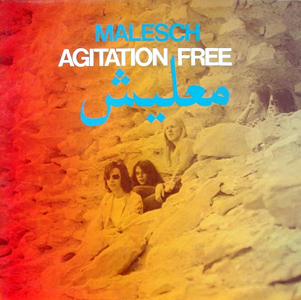
Agitation Free - 'Malesch' (IRI)
 Source: Ross, 22 May 2002, about $5.
This is the sound of six hairy Germans holed in a Berlin recording studio, conveying Orientalist sounds of psychedelic excess with maximum shimmer. Notes bend and bongos pulse but it holds to a center, while guitar tentacles merge with synth butter to make one of the best records of the genre. The cover art and the samples of the Middle Eastern street market really help to set the vibe of this album, but the melting organ swells and distant crying voices also drench this in desert sun. I wonder if this was actually recorded while Berlin was covered in snow. When the groove sets in these dudes don't let the mellow buzz their harsh; the drones are deep and the guitars continue to pierce. Maybe it's just my French pressing but the recording is a bit dull - I want the sounds to leap out and grab me but everything sounds slightly murky, like it's under a thick cloud. Maybe it's just the pot smoke.
Subscribe to:
Posts (Atom)