
HEY! Get updates to this and the CD and 7" blogs via Twitter: @VinylUnderbite
Showing posts with label know your modal scales. Show all posts
Showing posts with label know your modal scales. Show all posts
12 May 2017
Henry Cow - 'Unrest' (Virgin)

15 February 2016
Goblin - 'Suspiria' (Attic)

24 June 2011
Coronarias Dans - 'Visitor' (Inner City)
 The leader of Coronarias Dans is clearly Kenneth Knudsen, the keyboardist, who composed all eight of these jazzy fusion/prog jams, and dominates with his vibe-like electric piano. The liner notes tell me that this an exciting chapter in Danish music, but I'm not so sure. This has lingered in my accumlation of vinyl for so long mostly because I forgot about it; does my passion for wonky 70's Scandinavian prog have limits? Visitor really catches fire at the end of each side, when the band starts to rawk; until the we get a lot of noodling, and Peter Friis Nielsen's bass guitar continually poking it's head through the dirt, like a worm. 'Morning' is abstraction at its best, a nice dewdawn despite the aforementioned punchy bass. Some of these guys used to be in Secret Oyster, and also Burnin' Red Ivanhoe, and I guess that's what the Købehavn kids were jamming in the mid-70's when they weren't busy making those Tegn pornos. Actually my entire concept of Denmark in the 1970s comes from porn, but not actual porn as much as that Rodox magazine which I once saw a bunch of photos from, all cropped to be PG-rated, and one of the most amazing things I've ever seen. I feel that same sense of toppling into a mystery here, but only if I strain. I think I grabbed this cause it was on Inner City, which did release some Art Ensemble of Chicago records around the same time, and because I was hoping for something as far-out as Flasker-Brinnet or Arbete/Fritid. Had I noticed the telltale name of Friis I woulda not mistaken this Danish band for being Swedish. This could of course benefit from being further out, though the rocking bit of 'Don't Know' does have a nice burning drone underneath, like a hurdy-gurdy thing on a guitar. On the flipside, the title track has some snappy drumming but the bassist is in total Bill Laswell mode; you wonder how these guys would sound with some Rodoxed vocalist wailing on top of everything. There's one section when the drum solos for a few measures, right before the song sputters out, and it's like a dub track because they've kicked the treble or done something weird. I dunno, but it's kinda cool in a This Heat way. 'Tied Wawes' immediately takes it down a notch; it's the sensitive ballad. (Yawn.) The compositions are actually quite open - there are times when everyone is playing well with each other around nothing at all. 'Which Witch' is the most aggressive tune of the album but it never rips free from it's shackles; it's a bit frustrating overall, Knudsen's compositional style, as it's rooted in its own navel-gazing but without really being willing to say anything. I'm being too harsh on it - the whole LP ends in a bit of Canterbury-esque chordal crashes that are kinda nice in a familiar way. I guess I'm just tough on the Nordics.
3 March 2010
Hamiet Bluiett - 'Birthright' (India Navigation)
 This is "a solo blues concert" and that's always a bold move; solo saxophone records are not an everyday thing and presenting yourself as this type of soloist in concert is often demanding. Hamiet presents here what I assume is an unedited concert, with extensive liner notes in a cursive font that is too hard to read. Here's what I like about this record: it's diverse, and the recording is such that you really get the live feel. You can hear the room, and you can hear him moving around different parts of the stage. Bluiett is definitely rooted in melodic and blues-based forms, but there are some excursions into circular breathing and heavy affectation that usually accentuate the intent of the piece. 'Doll Baby aka Song Service', the 10 minute opener, is a tribute to his grandmother; it introduces the theme of family and history that carries through the album. The piece moves through a few different movements - slow, placid tones at first, and then a more sinewy speedrush through the higher registers of his instrument. Side two's counterpoint is the 'My Father's House' 3-part suite, which is fast, free, and chunky. This and the subsquent 'In Tribute to Harry Carney' are both described as "free-form telepathic", which me question how a solo performance can involve telepathy. Unless he means his instrument has a mind of its own. I love the way baritone saxophones sound; if I played saxophone, it would be my choice, except I think it's too heavy. Heavy as in carrying it, I mean; the sound of the instrument can certainly carry some gravity too, but his pieces avoid being overbearing. The conceptual, personal nature of Birthright is a nice complement to Endangered Species' more mind-based strategies. Bluiett got his start playing in the Mingus band -- well, actualy he got his start in a St. Louis grade school under George Hudson,who gets his own ballad at the end of side one -- but you can feel the eternal Mingus swing underneath some of the more dazzling runs. There isn't really any point where I am overdazzled though - I'd never point to this as an example of technical mastery, though he is more than competent - for me this is a record that showcases the range of his voice amplified by the range of his heart. There are some squeaks and squawks, but they don't take away from the color of his tune.
16 June 2009
Area - 'Arbeit Macht Frei' (Cramps)
 Here's the thing about the Discloated Underbite Spinal Alphabetised Encourager Template: every once in awhile, without realising it, you'll find yourself immersed deep into the Impenetrable Prog Gauntlet. It's hard to see the end of it, since there's so many weird angles and changes, and often a good explorer has been known to disappear in the darkest regions of the IPG, never to be seen again. Even though it's against official Policy, I'm gonna warn you that the last record we looked at (Arbete and Fritid) actually was the secret entrance to one such Gauntlet, which is dominated by a gang of mostly Italians called Area. Area subtitled their name with "international popular group" which was perhaps meant to be ironic. They were stridently political, but I don't understand Italian and I have no idea what it means to be stridently political in Italy, since I just assume that everyone is at least somewhat political. After all, fascists and commies are still fire-bombing each other in the streets every week. Therefore, I'm incapable of dissecting the layers of irony and/or passion captured by the title and artwork. I like to think of Area as "prog as fuck" because they employ many of the concepts that have created our idea of Progressive Rock in the 1970s: jaw-droppingly fast contrapuntal riffs, complex neo-classical song structures, the occasional tendency to go super dorky with flutes, 6-string bass or smooth saxophones, and a willingness to fuck around and break rules. How much the latter concept is explored generally has a direct correlation with how much I like a band, because I'm not really that interested in flashy showmanship. Arbeit Macht Frei has showmaship a-plenty, though there's significantly less investment in the rulebreaking category than their later records. But it's a debut album, and a grand statement for sure. Vocalist Demetrio Statos doesn't overpower the band, though his dramatic opera voice may not be for everyone. This is the only Area record I would put in the same box with commercial prog like Yes and Crimson; there's definite group jamming and heavily affected instrumentation (though the guitar and keyboards, which do have great tones, don't leap away from Western tuning or anything). It's only the last song, 'L'abbattimento dello Zeppelin' that hints at the gradual rejection of rock music that is to follow - the contrabasson gets a little bit more free (perhaps in reference to the title), and the guitar solo sounds like it's off a Wooden Shjips record. Statos's weird mumbling/yelling in the middle is layered over some sparse, surreal free improv and it's just weird, man - til the rock kicks back in, or does it? Open up the gatefold cover and it explains all. A photo of a concentration camp bearing the titular inscription, across from a handgun emblazoned with the Area logo - it's like Marco Ferreri's object from Dillinger e morto going head to toe with the forces of fascism, through the music of Area. Or something. I noticed that the musicians all look very tired in the photo; I guess it's hard work playing that fast and intricately.
5 June 2009
Ara - 'Pick up and Run 2007' (What The ...?)
 Lexington, Kentucky husband-and-wife duo Ara grew out of her solo project; he plays in Hair Police and other weird projects but brings the dirty lightbulbs to this recording. We get two live performances, one on each side, followed by a coda of fireworks and the sounds of "hanging out". It's a weird title, Pick up and Run, as it somewhat jars with the hanging out feeling; the music, well, it loops back on itself all the time too. Ara really showcases Sara O'Keefe's talents with reeds; despite the murky fidelity you can hear a great range of tones. Actually, the murky fidelity enhances this record - it's unmistakably part of the Ara sound, if such a thing exists. The vocals and reverb sing through the vinyl and my copy is a little bit warped so there's an even better ebb and flow to these already elliptical musings. The second side has a drumset, musing in an appropriately lackadaisacal Cloudy Murry manner. When it starts to get too jazz it pulls back into psychedelic folkdrone, and vice-versa; this tension is pretty key to the understanding of the whole album. The self-released cassette, which will maybe be reviewed on the forthcoming Erratic Delusional Majestic Spindle Preprocessor blog, feels like the first step and this a steady gait. We await the gallop (and apologies for the horse metaphor, but, hey, it's Central Kentucky we're talking about ....)
4 May 2009
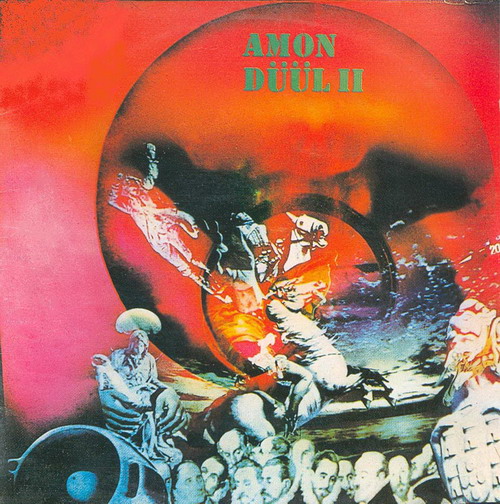
Amon Düül II - 'Dance of the Lemmings' (United Artists)
Subscribe to:
Posts (Atom)