 I really like records that have that shiny, mirrored cover, even though when they are 35 years old (in this case) they really start to look shitty, almost like the sleeve is going rusty. I never know how to rate Soon Over Babaluma. This is Can's first album without an exclusive vocalist, but should that matter? Future Days, which somehow disappeared from my accumulation, is one of my favourite Can records, perhaps the one where they most truly explore the idea of 'Inner Space'. Soon Over Babaluma actually amps things up a bit, but there's a really strong Italian prog influence. It's heard most notably on "Splash', though since this LP is so beaten I couldn't get all the way though that track without having to pick up the stylus FOUR TIMES to circumvent skips. Michael Karoli and Irmin Schmidt are more than adequate vocalists for this type of music, which is frantic, yet horizontal; it finds a nervousness and stays locked between two poles, oscillating in a way that allows Karoli to do some lead guitar heroics. 'Chain Reaction' is the longest track here, at 11 minutes, but it doesn't really get into the more bizarre soundregions the earlier albums explore. When it breaks, it sorta rolls with a funk/jazz feel. The basslines are properly monotonous, but Can has migrated by this point into a (very, very good) prog-rock band. It's still great music on that level, but it's not the truly special sound explorations we heard on 'Peking O'. And I hate to say it, but it feels compositionally scattered. Jaki has moved from drums to "perc." and you can hear it here - this resembles King Crimson's Starless and Bible Black-style Fripp leads + wacky percussion. Or maybe that's Lark's Tongues, I always forget which one has the extra percussionist. The maracas and shakers tend to overwhelm things. There's not nearly as much space in these songs, but there's certainly a more sci-fi feeling (just look at the cover)! 'Dizzy Dizzy' and 'Come Sta. La Luna' are the two leadoff tracks and potential singles, though if you listen to a hit like 'Spoon' and then come back to this, well, it's just not the same. 'Come Sta. La Luna' is Irmin singing and it sounds like some dark miscreant horror movie spawn; it's oddball even in the diverse catalogue of Can and one that's sure to be repeated. 'Quantum Physics' is the closer, a dark piece that's hard to really sort out, but it has some nice textural work. I stop after this, with Can, though a bit of the later stuff I've heard is very very nice, probably in a way that if it were any other band, I'd listen to lots. But because it's Can, my standards are too high.
HEY! Get updates to this and the CD and 7" blogs via Twitter: @VinylUnderbite
Showing posts with label bongos. Show all posts
Showing posts with label bongos. Show all posts
14 October 2010
Can - 'Soon Over Babaluma' (United Artists)
I really like records that have that shiny, mirrored cover, even though when they are 35 years old (in this case) they really start to look shitty, almost like the sleeve is going rusty. I never know how to rate Soon Over Babaluma. This is Can's first album without an exclusive vocalist, but should that matter? Future Days, which somehow disappeared from my accumulation, is one of my favourite Can records, perhaps the one where they most truly explore the idea of 'Inner Space'. Soon Over Babaluma actually amps things up a bit, but there's a really strong Italian prog influence. It's heard most notably on "Splash', though since this LP is so beaten I couldn't get all the way though that track without having to pick up the stylus FOUR TIMES to circumvent skips. Michael Karoli and Irmin Schmidt are more than adequate vocalists for this type of music, which is frantic, yet horizontal; it finds a nervousness and stays locked between two poles, oscillating in a way that allows Karoli to do some lead guitar heroics. 'Chain Reaction' is the longest track here, at 11 minutes, but it doesn't really get into the more bizarre soundregions the earlier albums explore. When it breaks, it sorta rolls with a funk/jazz feel. The basslines are properly monotonous, but Can has migrated by this point into a (very, very good) prog-rock band. It's still great music on that level, but it's not the truly special sound explorations we heard on 'Peking O'. And I hate to say it, but it feels compositionally scattered. Jaki has moved from drums to "perc." and you can hear it here - this resembles King Crimson's Starless and Bible Black-style Fripp leads + wacky percussion. Or maybe that's Lark's Tongues, I always forget which one has the extra percussionist. The maracas and shakers tend to overwhelm things. There's not nearly as much space in these songs, but there's certainly a more sci-fi feeling (just look at the cover)! 'Dizzy Dizzy' and 'Come Sta. La Luna' are the two leadoff tracks and potential singles, though if you listen to a hit like 'Spoon' and then come back to this, well, it's just not the same. 'Come Sta. La Luna' is Irmin singing and it sounds like some dark miscreant horror movie spawn; it's oddball even in the diverse catalogue of Can and one that's sure to be repeated. 'Quantum Physics' is the closer, a dark piece that's hard to really sort out, but it has some nice textural work. I stop after this, with Can, though a bit of the later stuff I've heard is very very nice, probably in a way that if it were any other band, I'd listen to lots. But because it's Can, my standards are too high.

4 September 2010
Cabaret Voltaire - 'Red Mecca' (Rough Trade)
 There's a lot to like in Red Mecca, particularly if you dig cold-yet-still-rambuctious songs in the CV mold. But things are so sharp and metallic it's more like rust than mould. Side one is pretty slow but continues from Mix-Up's more thoughtful moments, with lots of open spaces, more acoustic percussion, and more clearly enunciated singing. Though it's not exactly crooning. It culminates in 'A Thousand Ways' which feels weightless and never-ending, but without any exaggerated qualities at all. I've always gone to Cabaret Voltaire for their experimentalism, their approach to tapes and the interesting guitars vs tapes textures. But the songwriting here isn't half bad. Side two feels slightly more song-oriented, though there aren't any chart-toppers here. I didn't grok enough lyrical content to relate to anything specifically, but there's definitely a confidence that was lacking before. 'Red Mask' is practically a single, with Watson's tape loops dancing all around the more standard industrial rock grind. And it's pitted against 'Black Mask' (the titles are probably something to do with contrasting views of Islam or religion?) which is somewhat looser, around a standard mid-tempo drumbeat and with bleating synth hissing and distant atmospheric textures skirting around a songform. This record reminds me a lot of Savage Republic in a variety of musical manners - the monobeat, the chanted vocalising, the percussive single-mindedness. And like Savage Republic, Cabaret Voltaire are an 80's avant-rock band that hasn't really had their dues yet, at least in the sense that we're not making documentaries about them and they aren't doing reunion tours and these records aren't being reissued. And like Savage Republic, Cabaret Voltaire maybe didn't directly influence many of my peers but more likely were an influence on an influence. One inversion is that Savage Republic were a rock band with heavy industrial leanings, and I would probably flip that around to describe Cabaret Volatire. But like the last record, there are a few guitar lines that, while not exactly Led Zeppelin, have some sort of anthemic, cheerful lift that looks a bit more like on AOR radio than you'd expect -- in this case I'd say the harmonic progression of 'Split Second Feeling'. 'Spread the Virus' is pure evil though - despite a slight free jazz/circus feel at times - it's a goofy dark trip trying to break out of a straightjacket, and there's a nice shuffle to the beat despite all of the tortured growling. Moody, yes, and thirty years old now!
14 December 2009
Birdsongs of the Mesozoic - 'EP' (Ace of Hearts)
 I love Great Pop Things, the comic strip done by the dude from the Mekons, and if he ever did one for Birdsongs of the Mesozoic the subtitle would be "They tried to change the world through dinosaur masks and embracing chamber music!". Of course it's the Mission of Burma connection that lodged these records in my consciousness, but I'm glad for it. They came to me at a time when I was looking for something smarter to go with my meat and potatoes rock/punk diet. Instrumental rock music with synths, lots of tape manipulations courtest of Martin Swope, and synths/keyboards to boot - what could go wrong? Now I hear this as fitting into that whole New York school of art music, like Elliot Sharp and Glenn Branca, though I don't really know why since it's a lot more rock than I remember it being. Not stadium-filling, Aerosmith-style rock, but rather the Henry Cow/Crimson variant. Though they're not afraid to use canned/synth drums, which provide a weird plastic centre over which 'Triassic, Jurassic, Cretaceous' can ebb and flow. I also like how 'Transformation of Oz' has this manic piano breakdown where Roger Miller is bashing about on some tom-toms and then it cuts out into a more elliptical, neo-classical piano solo - and then the riff comes back in. Martin Swope actually plays electric guitar here, so all of the Burmaisms have been inverted. I used to spin the full-length quite a bit but this EP is less known to me. A shame too, cause 'Drift' is a truly lovely seaside raft in turbulence. This EP is rather dominated by Roger Miller's piano, which sounds great though slightly Windham Hill at times. When complemented by Karen Kaderavek's cello on 'The Orange Ocean', I can't help but think of this music as a reaction to punk's naievete. Birdsongs of the Mesozoic, despite their dinosaur schtick, are the first few steps towards the indie-classical hybrid that got big about fifteen years later - artists like Louisville's Rachel's and maybe even you could throw Godspeed You Black Emperor into that category. These five songs pass by relatively quickly, but there's a full-length just around the corner.
25 June 2009
Areski & Brigitte Fontaine - 'L'Incendie' (Get Back)
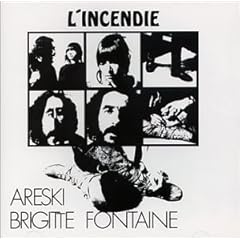 Areski and Brigitte Fontaine make such a cute couple; he's the bearded musical voyager and she's the arty answer to ye-ye pop. Together they were the Gallic version Richard & Mimi Fariña, or maybe Mickey and Mallory. Now, my French is barely beyond high school level so I don't know what the hell they're singing about and I'm afraid to stop and figure it out, but there's a pleasure to be found in ignorance. Side A has Areski's darkly shadowed face on the label. The nursery rhyme glow is there on some songs ('Le 6 Septembre'), sung like a round or other sort of children's workshop. We also get whacked out porn guitar behind Brigitte's fantastic voice ('L'Engourdie') and then dark medieval churchy dirges like 'Nous Avons Tant Parlé'. It's a grab bag of sounds from the 60's/early 70's, with the Eastern vibe laid on thick. When you flip to side B (so you can look at Brigitte's face spinning), you get Areski's solo vocals over bongos and snakecharmer flutes. It's one of only 2 songs over 3 minutes, yet it feels particularly long because it's Brigitte who I came to party with and I can't hear her. But the other "long" track is the whispered 'Après la guerre'. Intimate and kinda sexy, with the odd plink and pluck in the background, it's like that scene in the Blair Witch Project where the one girl just puts the camera on her face in the dark and cries about how scared she is. I thought L'Incendie was their first album but it's hard to tell since when Get Back reissued it, they didn't bother to include any additional contextual notes, such as a date. Some Google 'research' places it at '74, and therefore after Comme la Radio, but I always thought it was '71 and had filed it before. So now when writing this, I have to save this draft til I've reviewed Comme la Radio which means I'm listening to them out of order, an error I will correct when I refile (so Encourager Templates take 2, coming in April 2012, doesn't make the same mistake). Which means this bit I wrote below is now totally wrong and irrelevant, but instead of recycling it for a future qualifying post I'll just dump it here:
I'm always really interested in the records made just before the unfuckwithable ones. I'm drawn to records like The Colour of Spring, Vampire on Titus, The Dreaming - slightly flawed, perhaps, but made during a creative stride with the masterpiece just visible in the distance. Sometimes I like these predecessors even more than the "big" albums, plus sometimes you've listened to the more acclaimed album too much. I recognize Comme la Radio as the masterpiece but have more often pulled out L'Incendie because of this factor. I've always imagine Fontaine as the one calling the shots (despite Areski's top billing - I mean, that's just alphabetical, right?) and feeling frustrated at all of the fruity arrangements - that despite this record's eclecticism, it still just wasn't quite right, ie: she's almost there, but not yet. And only when paired with the Art Ensemble of Chicago do her songs really explode into something magical, but she had to wait til the next album for that. So knowing this, it's improved L'Incendie a bit in my eyes -- you can hear the hesitation, the uncertainty, the hope. And ending with 'Le Chant des Chants', so strident yet abrupt, waiting for a coda that is yet to come.Yeah, well, screwed that up for sure....
Subscribe to:
Posts (Atom)