HEY! Get updates to this and the CD and 7" blogs via Twitter: @VinylUnderbite

Showing posts with label kitchen sink. Show all posts

15 December 2019

Jason Lescalleet's Due Process - 'Combines XIX, XX' (We Break More)

It appears that Due Process was previously a trio or quartet featuring not just Mr. Lescalleet but also Ron Lessard of RRR/Emil Beaulieu fame and some other collaborators. This is billed as being led by Lescalleet so I've always filed it under L next to his others. But while the first moments of 'Combine XIX' suggest the ringing, haunting resonance of Electronic Music is going to be the vibe here, it quickly combusts into a grab bag of layers and intentionally conflicting ideas, containing some vocalisations even which give it a nice throwback 80s industrial feel. The name of this group draws attention to their working and editing methodology, though I guess almost all music is just 'processing' now, and maybe it always was. The middle drops back to breathe, and it really does, gaining some wind through a chilling, distant echo that started to bring in ringing ghost echoes. It's not a long side, and the short runtime is probably partially responsible for it sounding so good - this is experimental electronic music (you can call it 'noise' even, if you insist) that really has a great mastering job. 'Combine XX' opens the B-side with a wavering, uncentered continuation of the previous side's feel. I'm not sure what the material comes from –– if the processing in question sticks to strict source material, or if it's incorporating the work of other artists, or if it lacks the formally defined rules. But the palette is stark, carefully chosen, for this is the deep listening part of the record. Static is there as on Electronic Music, not so much a foreground element here as a mood, a colouring. About halfway through it fades into a more demonic movement, with an Ash Ra ambience, a pulse that slowly becomes relentless, and disembodied, unarticulated voices that combine with mysterious higher frequencies to resemble a malfunctioning shortwave radio. This is night music, all the way, and the explosive bursts, French accents, and squealing pitches recall the greatest mysteries of the evening sky, transcribed into sound and funnelled through a vision of these Northeastern guys. I tend to overlook this record as it's filed between two bigger 'statements' by Lescalleet, but it's a pretty well-structured and complete work of its own that was really nice to revisit here. 

13 May 2017

Henry Cow/Slapp Happy - 'In Praise of Learning' (Red)

I have a lot of records; some would say 'too many', and I probably must concur, even though I find it hard to part with any. One sign that your accumulation is too vast is when you don't actually remember if you own a record or not. One of the many things I've enjoyed about doing this project over the past 8 years is realising these possessions and omissions, and now I've realised that I do NOT own a copy of Desperate Straights, the one credited to Slapp Happy/Henry Cow (in that precise order of credit, and which I guess came from the same sessions as this LP). I always thought of these two bands as having briefly merged for two albums, rather than merely 'having collaborated', and In Praise of Learning is probably the high point for both bands' careers, though I realise I said in the last post that Unrest was the best Henry Cow record. By now you should know to ignore my superlatives, anyway. But anyway, the distinct sensibilities of each band are perfect in combination, different enough to challenge and pull the musicians in new directions, but unified in their passions and penchant for adventure. This LP is credited to Henry Cow (except on the spine, where Slapp Happy gets some love), and this makes sense as this is much more of a Henry Cow album with Slapp Happy's spin, as opposed to Desperate Straights which is the other way around. Plus it has a sock on the cover, dyed red in case you had any fucking doubt about their politics. The opening cut, 'War', is the most explosive juxtaposition of the two ensembles, opening with Blegvad's voice briefly before Dagmar Krause (credited here by her first name over, a proto-Madonna if there ever was one) comes crashing in. This is the first Art Bears song for sure, with violent poetic imagery and rhyme soaring over a potent mix of musicians. Former Henry Cow member Geoff Leigh returns to guest and Mongezi Feza is also present; it's almost a pop song and a perfect introduction to 'Living In the Heart of the Beast'. This is Tim Hodgkinson's composition, and it's an epic number, taking up the rest of side 1 and moving through an absolute plethora of words, printed on the back sleeve like the polemic/essay it properly should be read as. This piece is hard to grasp, with its title the most memorable thing, but in its density lies many rewards. As it proceeds through several movements, it gradually takes on the role of the anthem, as if Henry Cow has figured out how to write aggressively political music that avoids cheap sensationalism or inconsistent wavering; indeed, 'Beast' finds its own footing by the end, where it comes marching to a conclusion over a what's probably the most conventional "progressive rock"-sounding moment on the record. Side two (as usual) has the free improvisations, though they are just the bread around 'Beautiful as the Moon - Terrible As an Army With Banners'. This sound is a bit more stripped down, with Greaves/Cutler locking into a plodding groove over which Frith's piano arpeggios perfectly complement Krause's rising and falling voice. I guess to some people her singing might be an acquired taste but I love it, and would buy any record of hers sound-unheard; I remember already gushing here about Babble and the Commuters EP, and this is another one of her greatest accomplishments. Her timbre is so uncompromising that it's a perfect match for Henry Cow, one of the most principled bands there ever was (to me, they approach Crass-like territory), and 'Beautiful as the Moon' finally releases in it's conclusion into a cadence that is actually catchy, probably the most hummable part of this record and of Henry Cow in general. The improv tracks on either side are both wonderful and I can only dream of what outtakes there must be; 'Beginning - The Long March' is a little punchier, but 'Morning Star' gets into some truly extended technique'z recalling eastern gong music as much as it resembles rock, jazz, or anything western, really. Cooper in particular shines here, especially over scraped guitar strings that occasionally sound like bowls of water rotating on a giant animal skin. The lyrics are printed on the back, which you really need to follow, and at the bottom is the (amazing) quote by John Grierson: 'Art is not a mirror - it is a hammer'. I find that as inspiring today as I did at 17, even if it feels like more of a struggle to believe it (or to implement it). I don't know much about the personal journeys of the Henry Cow people over the years, but they've at least managed to keep a public image that they have really lived this ethos without compromise. I'm not sure if any young musicians today listen to Henry Cow for inspiration, but they really should.

18 February 2017

Hampton Grease Band - 'Music to Eat' (Columbia)

You probably thought the last Gunter Hampel record was responsible for the months-long bottleneck here at the Underbite (if you thought anything at all) but no, that was written and just not posted for some reason, ages ago. It's the Hampton Grease Band that's kept this from going forward, and I'm not quite sure why. Music to Eat lies somewhere between 'funny thing to play people at parties' and 'something I genuinely love', but I vacillate between the two states, so maybe this is Schroedinger's LP. This is truly one of the stupidest bands to ever get a major label release, and I include the Barenaked Ladies and Green Jellö in that list. But the Hamptons fit into some sort of vision I have about late 60s/early 70s freak music, even if the music isn't particularly visionary. I love the whole lore around this band - that it was somewhere between prog-leaning bar rock and and dadist art experiment, that members of the band would invite their friends up on stage to eat breakfast in their bathrobes during live gigs, and that the drawing of the military tank on the back cover is because they forgot to send any artwork for the back cover and it was just a drawing one of the band members had lying around. But the music is a pretty intense jam. I've worn out side 1, 'Halifax', where the band teaches us all about that Canadian city and establishes their formula: jammy blues-rock, occasionally prog-leaning, and with random nonsense sung over top. Bruce Hampton's pipes are great though, a regular Robert Plant, and his cry of 'Wouldn't you like to come to Halifax?" is an all-time great album opener. Fifteen minute later they are still at it, and there are passages of this song that are totally great. The fast boogie guitar solo about halfway through sounds a bit like the Italian prog band Area if you're reaching, and I think I just always wished this band was just a tad more in the cosmic direction. But 'Halifax' and 'Herndon' (side 4) are perfect, glorious kitchen sink rock jams, embracing the absurdity of the era and probably deconstructing something at the same time. 'Maria' opens side 2, with a much more overtly novelty-learning song, drenched in sexuality and coming off as the alpha-rock counterpoint to the Holy Modal Rounders' 'Griselda', though I think this predates it. And then it goes on and on through a variety of shorter songs, and it's a maddening experience. The sheer ambition and lack of editing here are remarkable but it becomes quickly impossible to sort out the diversions and jams. The resulting mess is a bit too close to Zappa/Mothers from the same era for my tastes, though I'd by lying if I didn't admit the teenage me loved 'Billy the Mountain'. Anyway, there's a LOT of Music to Eat, and side two starts to wear out its welcome. Side three is mostly dominated by the 18 minute suite 'Evans', but there's still room for another nearly 8 minutes of 'Lawton'. Jesus Christ, is this record long. I swear I have triple LPs that feel shorter - Armand Schaubroeck's first one, for example, or that Daphne Oram set. But the endurance test is part of the charm, if ya feel it; the Hampton Grease Band, if anything, are underrated. 'Evans' feels like a blizzard of guitar solos but then the track that follows it up, 'Lawton', is probably the musically most interesting part of the record - a dark, jammy psych instrumental that sounds like the Davis Redford Triad or some murky space-rock outfit from the late 90s, only this is '71. It all builds up to 'Herndon', where Hampton sings the label from a can of spray paint, before it segues into more nonsense. It becomes increasingly hard to pay attention by the end of this record, after one has been listening to it basically all night long. The fortitude is astounding for both self and the artists themselves. Discogs shows some odd post-Hampton Grease Band paths for them. One guitarist put out a solo 7" years later on Hib-Tone, the label famous for releasing R.E.M.'s 'Radio Free Europe' single; another played with Henry Kaiser in a band called Obsequious Cheesecake. As for Colonel Bruce Hampton himself, he seems to have enjoyed quite a long career in various projects I've never heard. This is the infamous record, and maybe part of its infamy is that it's not a slam-dunk - it's no Trout Mask Replica, but it really has some pretty good parts. I feel like I've written this much about Music to Eat now and come nowhere closer to solving my 'is it actually good or is it a party record?' dilemma. But obviously I don't throw parties anymore, anyway.

1 May 2016

Guided By Vocies - 'Bee Thousand (The Director's Cut)' (Scat)

As mentioned a few posts ago, I no longer have my original copy of Bee Thousand, as it was loaned to someone years ago and never returned. It's OK, I suppose; I've committed every second of it to memory over the past 20 years anyway, and while I'll happily replace it when I come across it cheap-ish, for now I survive. Bee Thousand (The Director's Cut) actually contains every song anyway - the first two LPs recreate an earlier, longer version as assembled in 1993, and the final platter contains the seven songs from the official Bee Thousand that weren't on the 1993 version (which includes some of the most definitive tracks of the album: 'Buzzards and Dreadful Crows', 'Hardcore UFOs', 'I Am A Scientist', and 'Gold Star for Robot Boy') as well as The Grand Hour and and I Am A Scientist 7"s. But sequencing is everything, as one listen to any side of The Director's Cut will indicate. So much of the genius of Bee Thousand is how it fits together as a complete whole, without any filler and with the transitions carefully chosen. 'Echoes Myron' without 'Yours to Keep' preceeding it (and that awkward tape splice) just isn't right! And opening the whole thing with 'Demons Are Real' is a bold choice, but the first chords of 'Hardcore UFOs' are the most iconic opening in indie rock history (except, perhaps, for 'A Salty Salute' on Alien Lanes) so it's hard for me to really think of this as Bee Thousand without it. And yeah, not every song here is great - the would-have-been third side gets pretty spotty, so it makes sense that 'I'll Buy You a Bird' and  'Zoning the Planet' were dropped later, when the album we know and love took its final form. And I don't know that the world needs the falsetto-filler of 'Rainbow Billy' for any reason except the historic record. But still, at this point, Pollard and Sprout were just hit machines, churning out such an incredible body of work that fan-assembled outtakes collections are still being assembled to this day. The liner notes, written here by Robert Griffin of Scat, are really nicely done, telling the story of his relationship to the band, and how this album took form over so many iterations. The other running orders are reproduced with Pollard's lyric sheet for the third one, and his cassette track listings for the others; it turns out it's Griffin himself who put together the iconic sequencing, and that the album was actually assembled on an early version of ProTools (not bad for 1994!). So all of this is rather disjointed - Christ, it's a cluttered mess - but it's a glorious one. Some of the songs turned up much later - 'Why Did You Land?' was sped-up and re-recorded as a b-side to 'The Official Ironmen Rally Song'; 'Stabbing a Star' came out on a 7", and bits of 'Bite' and '2nd Moves to Twin' turned up elsewhere on Bee Thousand itself. And even shaken up and put in a blender, there's so much here to love and enjoy, and so much meaning and associations to draw, maybe even amplified by its new juxtapositions. 'Smothered in Hugs' retains it's magic nostalgia; 'Hot Freaks' and 'Her Psychology Today' their rampant sexuality. 'Myron' feels like it ties together many threads, and 'Deathtrot and Warlock Riding a Rooster' has some beauteous self-harmonising. And this is before even getting to this final LP, which contains a few of the greatest GbV tracks (two versions of 'Shocker in Gloomtown', a song so great the Breeders covered it; and an Andy Shernoff-produced version of 'My Valuable Hunting Knife' which never ended up anywhere else, somehow). So even though I still wonder why Pollard originally wanted to end the album with 'Crocker's Favourite Song' instead of 'You're Not An Airplane'. Yes, listen to the original first, but thank God for Griffin's efforts in releasing this, both musically and writerly - this is an important bit of history, at least to people like me.

15 February 2016

Godspeed You Black Emperor! ‎– 'F♯ A♯ ∞' (Constellation)

I heard about this band from the Internet; the exalted droneon list, the archives of which I still dream of (and will continue to mention on here until someone unearths them). Some rumours were coming in about this really wild large ensemble band from Montreal who were doing massive soundscapes with a full string section and they had this crazy name and projected films while they played. I was intrigued and I saw them! It was on my first-ever trip to New York City, to catch a cool show at the Cooler headlined by Tower Recordings (who I don't think we even stayed to see), Sandy Bull (who was fucking great and I suspect I already told this story back when I covered his record), Roy Montgomery (the reason we went), and then the opening band, Godspeed You Black Emperor!. What a fucking delight; they were crammed onto a small stage, falling off it (probably a cellist or someone had to be on the floor) and they made this slowly crawling drone which built into a real racket and they really played, you know - really poured their hearts into it, all melodramatic and epic and swinging for the fences and whatever. My mind was blown. I bought this LP, an ornately packaged limited pressing on the fledgling Constellation label (later reissued on CD by Kranky with an extra 20 minutes, and you know I have that too so if we ever make it to the CDs again I can listen to it again) and it had all these neat photos and cryptic Xeroxes and drawing and artwork inside and a crushed penny! (crushed by a train, supposedly, so I can't tell if it's a Canadian or American penny and it's so cool anyway that I overlooked the fact Wimp Factor 14 already did that on a 7" years before) and the music, oh the music, well it's everything my little heart could have dreamed of. I was 17 years old. And I played the fuck out of this record, all the time, until the CD came out, but then I sorta played the record still cause the CD mixed things up and it wasn't quite the same - and looking now, while brushing dust off it, I can see that I scratched the hell of of it - it's really taken a beating over the years, even though I haven't probably played this at all in the past ten.We got song titles on the CD ('The Dead Flag Blues') but I just knew this as 'nervous, sad, poor' cause that's what scrawled into the runout groove, and side B as 'bleak, uncertain, beautiful'. This has Ennio Morricone draped all over it, but then this voice that sounds like Sam Elliott starts talking about his wallet being full of blood, and it's really cinematic, and then the second piece starts which is just a bunch of shimmery drone strings - electric guitars which sound like glass, an echo into a sunset, and some sliding tonalities. For as much as I now think about this band as being all about films and violins, there's so much guitar and bass that you could really mistake them for a rock band, and it's so soundtracky that it's nice to cover this right after Goblin, though it's all subdued and mellow, just making a groove. When the drums come in about halfway through side 1, all ride cymbal gallops, it sounds what I always imagined Calexico to sound like (but I've never listened to Calexico). This blew my mind almost twenty years ago and now it sounds good, but rather incomplete - it just rolls along, never quite fulfilling the promise of the spoken intro which is all mysterious and malevolent - it turns into another semi-ambient, delay-pedal driven haze, which is not unlike those interstitial segments on early Deerhunter records, and then a sorta jaunty, carnivalesque coda (where some jingling bells counterpoint a chord progression and a passionate violin lick). It's a good bummer trip all around though maybe it just coasts a bit on mood. Things stop, a voice says "I don't know what to do", someone fucks around on a banjo for a bit, and then the side is over. And then the flip; it opens with bagpipes! More voices, an organ drone, and the heretofore unheard-of-at-least-in-my-1997-record collection instrument of bagpipes (cause I didn't yet have that great Pierre Bensusan album 2 - check the archives!). It's all little sound vignettes here - some more soundtracky Morricone stuff, then a little interlude of processed vocals which could be right off an 80s 4AD record, and then another clean channel guitar post-rock piece. This melody builds and builds, the strings kick in, the drummer starts rocking out, and eventually it's a wall of sound that keeps crescendoing and crescendoing. It ends with a locked groove, cause, F sharp A sharp INFINITY, dig? You know, around the same time as this, Mogwai were doing these wall of sound instrumental pieces that all the kids were going wild about, but I never got much from them - to me, their music was always too cold, too distant. GYBE! were all about their emotions, wearing their wet romantic visions on their sleeves even if (let's be honest) they're somewhat entry-level art-school moves. I'm not knocking this band at all - this is as lush and inviting to listen to now as it was in 1997, and I'm regretting how much I kinda turned on them (more about that later) - but hindsight shows me now that even as sophisticated as this sounded to my teenage ears (because a string section = instant sophistication, dig? as well as the abstractions of instrumental music and cryptic packaging), the music, at least on this record, is really a series of short sketches (probably mostly improvisational) woven cryptically into something which appears superficially greater as opposed to the grand vision I thought they had. And the aesthetic feels somewhat in line with this perception I have of the Montreal avant-garde (I have never been there, of course) - not necessarily that different from, say, the first Lewis Furey record or even Leonard Cohen in his most hedonistic days. That's not to discount anything about this band - they are/were great (they are still around!) but their true greatness was really yet to come and I realised it later.

6 February 2015

Fleetwood Mac - 'Tusk' (Warner Brothers)

What do we say about Tusk, now? For years it was mentioned by people like Byron Coley as a masterpiece, which I always figured was a joke or some sort of needless contrarianism; in those times of fear I stayed away and thus missed out on really absorbing this into my formative years. At some point curiosity took over, and its ubiquity in charity shops and secondhand stores means I eventually took the gamble (apparently risking $4, if this is my original price sticker). And then there was this gradual period where Tusk started becoming incredibly fashionable among my music-obsessed friends, as we finally learned to eschew the punk orthodoxy and listen for ourselves. Perhaps, initially with some degree of irony (though a variable amount, depending on the person). Hey, I actually liked this, I discovered; it's unsurprising as I love great pop music and fucked-up pop music, which Tusk is both; I found that the manic/ragged/experimental quality that made this so talked-about was really there. So now I would definitively say yes, Tusk is a great album, with surprisingly little filler given its length (I can only really count 'Never Make Me Cry' as such, as I'm sure many people would argue for its merits). The hooks are catchy, the production somehow both cold and intimate, and it contains a disjointed collection of songs that range from angry to disconnected and druggy. But most importantly, it was the followup to the most successful pop record of all-time, and thus it's 'edgy' qualities attain more sharpness in comparison. So yes, we may occasionally overrate it, but that's cause there will probably never be anything like this again. This isn't like Radiohead making Kid A and confounding their alterna-rock fans, or Lou Reed's obvious fuck-yous; instead, it's experimental precisely because its not, if that makes any sense. Tusk is a band who became so big that they no longer had to listen to anyone telling them what to do, and it turns out their inner path was a pretty righteous one anyway, but the pressures of stardom and interpersonal relationship fallouts inject so much conflict into this that it never quite lifts off cohesively. But unlike most sprawling messes, there's enough genius here and perhaps the external context of their previous success infuses a certain swagger into it all. If you told me that none of the three songwriters played on each other's tracks, I wouldn't be the least bit surprised; Lindsay Buckingham's tracks sound as fucked-up and home-recorded as most of McCartney II and I suspect he wanted to be nowhere near Stevie Nicks at this time. The fact that the title track was the biggest hit on the whole album is fairly incredible, since it's by far the most demented song. If you turn it up loud - and you should - you can hear all of these buried, twisted layers of gibberish vocals behind the marching band, sounding a bit like an anachronistic guest appearance by Dylan Nyoukis's Blood Stereo (actually, it kinda sounds like Animal Collective). Even the idea to lead off the record with 'Over & Over' - a great song, but hardly a side 1, track 1 - feels like a brick in the wall of perversity. Over four million people bought this record, and you can find it for pennies now (unless you live in Europe, where I regularly see it priced over 25€). As much as I'm a massive Camper Van Beethoven fan, their full-scale covering of the whole album never resonated too much with me beyond being a mere novelty. There's probably a whole bunch of people who have never delved deep into Tusk and I'm actually jealous that you get that feeling of discovery and fascination that I once had. This is one of the best arguments for cocaine use ever committed to vinyl.

18 June 2014

Family Fodder - 'Monkey Banana Kitchen' (Fresh)

About half of this record appears on the Savoir Faire best-of CD (which we'll get to, soon) so I'm a bit disorientated by the sequencing of this, Family Fodder's first proper album, which I've listened to much less than I've listened to the CD. So the opening cut, 'Darling', while a great a-capella vocal experiment, is a bit of a what-the-fuck - as much of an anti-logical side1track1 as the forthcoming Fleetwood Mac Tusk (which starts with the naturally finishing 'Over and Over' as some sort of oddball paen to Finnegans Wake, I think, but enough of that for now). Family Fodder struck me as an utterly astounding calvary of post-punk art-school weirdness when I first heard them back in 2001 or so, but now with all the other magic that's been unearthed by blogs and reissue labels, they are less earthshattering. The tendencies between pop and experimental are held in check, mostly, and there's every imaginable influence that turn-of-the-80s British art punks were digesting. Monkey Banana Kitchen ranges from primitive indie-clatter (the sublime 'Cold Wars', aggro 'Wrong', and 'Savoir Faire', which predates Stereolab and adds a healthy dose of amphetamines) to dub ('Monkey' is the obvious one, but it's integrated into songwriting, Slits-like, in 'Symbols', a fantastic song left off the greatest hits album for some reason); straight-up reggae is attempted in 'Bass Adds Bass', which is the album's only real misstep besides the child rave-up 'Philosophy'. Romance is deconstructed in the duet 'Love Song', which looks for 'a new kind of love song'; 'Cold Wars' deals with similar territory, with the lyric 'We're just like America and Russia' reaching a new significance given recent world events. But romance is just one element - the grand brushstrokes are wilfully obscured by the strong sense of musical play throughout. Overdubs are used brilliantly - there's some bells, or a few seemingly random pianochords, or some discordant voices - and studio phasing/flange/fluter techniques are not shied away from. 'Organ Grinder' creates a eerie mood, with a cadence akin to Wire's 'French Film Blurred' and German chanting which balances 'Savoir Faire's frantic French on the flipside - it's a beautiful mix, ending in a dissipating sound bed of scraping string instruments and echoing xylophones. It's a song I've listened to a zillion times but I find something new to hear each time through.

19 December 2013

Jad Fair & Kramer - 'Roll Out the Barrel' (Shimmy-Disc)

Recently, Jad Fair released a 99-song CD set called Beautiful Songs, a career retrospective. That's a pretty apt title, as both words seem to describe the man's output: beauty is a strange one, his not a traditional notion of it by any means, but nonetheless evident in his naive, gentle subject matter and constructed idiot-savant delivery. And "songs" indeed, for even in Half Japanese's most frantic and anti-melodic early work, a dedication to songcraft can still be heard. This collaboration with Kramer hails from 1988 and it's an often overlooked record, at least by me - its been on my shelf since I was in high school but I rarely give it a spin. It's a strong collection, though, as Kramer uses Fair's songs as a framework on which to hang various production and arrangement techniques. These are sometimes spooky and ethereal; he mostly avoids Galaxie 500 reverb on Fair's voice, but Don Fleming's guitar playing is atmospheric and searing on cuts like 'Bird of Prey', 'Best Left Unsaid', and 'When Is She Coming'. Other tracks are a surreal cornucopia of sound techniques, often deconstructing cover versions in that Shockabilly manner. This is around the time Bongwater was releasing Too Much Sleep and that same style of kitchen-sink addition is evident in how these are put together; and honestly, listening to Kramer's most recent release The Brill Building, as tough as I found it to get through, his approach hasn't really changed. Roll Out the Barrel, while diverse and curious, is never slick; even more clean electronic-tinged songs, such as 'Better Safe than Sorry', support rather than overpower Fair's tenor wails. The covers are possibly meat to be ironic - 'Help!', 'On the Sunny Side of the Street' - and the Penn Jilette-assisted 'Twist and Shout' and 'Subterranean Homesick Blues' are all pretty great. I fear that Jad Fair's presence might push this into 'novelty music' territory for many, who would then overlook what's a great collection of late 80's art-rock. Despite being NYC-based for so long, the Shimmy-Disc scene sounds so different now from other avant-leaning artists from that place and time, though they were all part of the same gang. Now that we've gone through a few iterations of the hip ebb and flow around song-based work from NYC (with Thurston Moore somehow remaining central to so much of it, present here too) this feels strangely contemporary in the post-everything era, or whatever a more educated cultural commentator would view the 2013 soundworld. My point: blow the dust off this and enjoy it as much as I just did.

6 July 2013

El Jesus de Magico - 'Scalping the Guru' (Columbus Discount)

Scalping the Guru was the original name of Guided by Voices' Alien Lanes album (which we'll get to, eventually) so this may be some sort of reference to their Ohio brethren. The only real influence is in the production, where the dirty, anthemic guitars of 'Summer of Luhv' could be lifted straight from those mid-90s GbV classics. But instead of catchy, hooky melodies, El Jesus's vocalist takes a different approach: less grandiose, without any element of being a 'front man'. The opening cut is more hi-fi though, appropriately titled 'Ancestor Worship', and laying down a pretty good Kraut-like groove, recalling Yeti's tectonic plateshifts (with with a bit less cosmic dust). I file this under E which shows my own Anglican bias towards respecting articles; just like Los Llamarada will appear under Lo, not Ll. But I don't think there's anything hispanic about El Jesus de Magico - this is a great synthesis of white avant-rock influences, an assemblage that is confident and experimental as well. Feedback, synths or some other electronic forms appear throughout - side two starts with a track built from static and space, sounding like a dirty needle, but in a hypnotic compelling way. When the band hits a mid-tempo groove, as on 'Whistle Cock', their improvisational side is allowed to unfold, as the drummer holds things together just barely. But I wouldn't call this noise-rock or even particularly ramshackle; it's a unique balance of together and apart, which is why I'd cite these guys as one of the more interesting rock bands in whatever passes for the American 'underground' today.

7 June 2011

Chris Corsano - 'Another Dull Dawn' (Ultra Eczema)

Coincidence and circumstances places two Ultra Eczema LPs back-to-back here, this one being #71 in the label's run and showcasing Chris Corsano's personal, idiosyncratic brand of percussive noisemaking. These were recorded in Edinburgh when Chris was living there and seem to reflect the manic-depressive nature of Scottish temprement while reflecting the uniquely bleak weather of the region. For someone as powerful at pounding things, there's an equal amount of scraping and breath here. The 15 short pieces, all recorded in a wooly, murky manner, run the gamut from drumset freakout to toy gamelan (the beautiful 'Kittenish Gnawing pt 2' is a particularly highlight), with a lot of wind instrument mouthpieces, often modified with plastic pipes. There's a primitive, guttural feel t stuff like 'The Misread Altimeter', which is a searing, sharp wave of human breath often redlining into gutbucket territory, only with a skiffle-band aesthetic. The pieces flow; it's a really coherent statement of one man's energy, simultaneously referencing all the solo free drum classics by Milton Graves and Andrew Cyrille while also trying to stake out something new. The speedy drumset work is certainly remarkable - 'The Wreck' is a total explosion, and the full kit parts of the closing track ('The Chair Dustless in the Tiled Room') are practically blast beats. Said closing track swings between these energetic bursts and pot lid/gong melodies, which unfold into a really loose expression of rhythm. Eclectic, yes - expressive, even more so. This style of solo Corsano - also exhibited in his Cricketer album - seems to perfectly bridge the gap between the noise underground's focus on dense, textural material and his own passion for free jazz/improv. What's remarkable is how natural it feels, and how flowing and introspective it manages to be despite carving out an original, singular language. Though I think this maybe flew under the radar a bit (due to the limited nature of the pressing) this might be a high water mark for the genre, if the genre could be defined.

19 March 2010

Bongwater - 'Too Much Sleep' (Shimmy-Disc)

I'm not sure what's up with my bizarro version of Too Much Sleep, as it seems to have a different cover than anything I can find online, and is missing quite a few tracks from what Wikipedia/AllMusic reports. Which means I apparently miss a cover of 'Why Are We Sleeping?' but that's okay since the Slapp Happy tune 'The Drum' remains - probably my favorite of any Bongwater (or even Shockabilly) cover version. As if there was any doubt that these guys were into Blegvad! But they wear it well, cluttering up the lovely chord changes with sampled voices that are totally eerier instead of just superflous. But that's the name of the game with Bongwater. Too Much Sleep is a messy, goofy bundle of singsong flapping about, which has a lot of that Kramer reverb sound and enough double-tracked male-female vocals to totally drive a stake through the corpse of Sonny and Cher. There's a few tunes that have a proto-Chicks on Speed Eurotrash sound, like 'Talent is a Vampire', where Kramer seems to have calculated the right way to throw electric guitar shards in a way that conjures monster truck rallies, MA opening shows, and melting eyeliner. The spacey production occasionally works psychedelic wonders, particularly when keyboard/organ notes swell up and meander around the guitar-based rhythms. Dave Rick, who played in King Missile, shreds all over this record and I wonder if people would revere him the same way they do Alan Licht if he hadn't played in such goofy projects. 'Mr. & Mrs. Hell' is like an American reboot of the Mekons' 'Trouble Down South', and the electronic resonance has it's complement in side 2's 'Khomeni Died Tonight', a bit of Ralphy weirdness if I've ever heard it. 'One so Black', a Dogbowl-penned composition, has a lovely vocal arc and more of Rick's enlightening fretboard scratching. It all ends with the creepy, yet strangely affecting 'No Trespassing'. Overall I think this is Bongwater's most solid album though I can't say I've heard any of the others in recent years. The logo's designed by Gary Panter, who 20 years later has enjoyed a hipster resurgence though those kids probably wouldn't touch a Bongwater record with a 20 foot pole.

13 August 2009

Kevin Ayers - 'The Confessions of Dr. Dream' (Island)

This is the definition of uneven. Pushing his tendencies to their extremes, Kev lays down some of the darkest and most twisted excursions of his career on the title track but also some of quite banal funk-rock. This record is saturated with female backing vocals, on almost every track; Lol Coxhill and Mike Oldfield turn up too, though it barely resembles the work of the Whole World. Side one is almost a total writeoff. "Day by Day" is tough to make it through, though it does make me think about why I've come to equate that sound with 'bad' music. It's not inherently any worse than half the other rock on my shelves, but I've just come to hold aesthetic biases. I guess the campy genre-hopping is less than convincing for me - Ayers' exaggerated Britishness on 'Ballbearing Blues' makes it sound like a Monty Python skit. But yeah, the title track, which fills most of side 2 in four parts -- definitely it makes this record a keeper. Hypnotic, circular guitar patterns, gurgling ARP synths and some crazy gothic freakouts put this in the Aphrodite's Child camp. There's smoother parts but they're no less exploratory - the whole thing has a compositional cohesiveness that would make a Gong member jealous. If you tacked this suite onto a CD reissue of Shooting at the Moon, you'd make a strong case for Kevin Ayers as one of psychedelic music's greatest practitioners. Instead it's a relatively forgotten album that can be found on the cheap - I know I only paid $3 for it. This was probably the first Kevin Ayers record I heard, actually, when I was just getting into the Soft Machine. Clearly it was the gateway drug that led me to buying six others, though I always forget about this one.

23 June 2009

Area - 'Event '76' (Cramps)
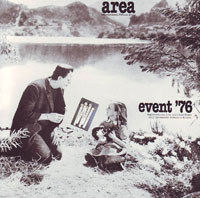
Here's where they really lose the plot, at least for the rockist Area fans. Boasting a somewhat compromised lineup featuring Steve Lacy and Paul Lytton (who sneaked onto Maledetti, if you remember from yesterday's post, and 75% of this album is titled 'Caos part II' so I guess it's the logical followup), this is a full album of free improvisation, containing no trace of the bombastic rock riffs found on Crac! or Arbeit Macht Frei. Despite the jazzy pedigree this is much more akin to NWW-list free playing (ah, that has become a genre of its own now!) such as Jacques Berrocal, Futura label stuff, maybe MEV. But for me this is a great step forward in showing what rock music can be. This whole record is recorded very weirdly - in the red at times, with a strange chorus effect on everything and unusual reverse fade edits popping up, even when the crowd cheers at the end. Lytton's cymbal crashes sound like trashcans and occasionally dominate the proceedings, but it gives the whole record a raw feel that makes the fucked up synths, babbling, and tape manipulations have a rhytmic centre. I love this record and I think it's a must-hear for anyone interested in any of the tangents that cross it: Euro freedom, prog rock, free jazz, musique concrète. But it's really in the context of Area's other work that makes this record slay so much - it's like all of the outtakes and indulgences that they restrained themselves from including on the studio albums - all at once, and all on top of each other. On the cover we get a still from Frankenstein, a scene also featured prominently in Victor Erice's Spirit of the Beehive which I just watched. It's pretty appropriate for the Frankenstein monster on this record: curious, and certainly monstrous, but gentle and approachable. I wonder what the difference is between this recording and what the audience actually heard that night in the Università Statale di Milano -- I'm guessing it was a bit clearer than the saturated sounds on this vinyl, but maybe it was incomprehensible live too. I imagine Stratos running back and forth like a madman or maybe he was just bent over a table of electronics processing his voice. This is a fitting way to end the Area section of the Impenetrable Prog Gauntlet, and I'm sad I don't have Stratos's solo album to be the icing on the cake.