
HEY! Get updates to this and the CD and 7" blogs via Twitter: @VinylUnderbite
Showing posts with label woven carpets. Show all posts
Showing posts with label woven carpets. Show all posts
7 November 2017
Joseph Jarman - 'Song For' (Delmark)

26 January 2016
Gastr del Sol - 'Camofleur' (Drag City)

15 July 2013
Don Ellis - 'Haiku' (MPS/BASF)

14 January 2013
Ducktails - 'Landscapes' (Olde English Spelling Bee)

25 June 2009
Areski & Brigitte Fontaine - 'L'Incendie' (Get Back)
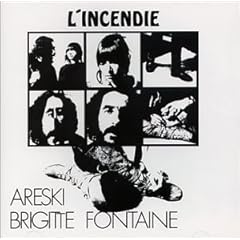 Areski and Brigitte Fontaine make such a cute couple; he's the bearded musical voyager and she's the arty answer to ye-ye pop. Together they were the Gallic version Richard & Mimi Fariña, or maybe Mickey and Mallory. Now, my French is barely beyond high school level so I don't know what the hell they're singing about and I'm afraid to stop and figure it out, but there's a pleasure to be found in ignorance. Side A has Areski's darkly shadowed face on the label. The nursery rhyme glow is there on some songs ('Le 6 Septembre'), sung like a round or other sort of children's workshop. We also get whacked out porn guitar behind Brigitte's fantastic voice ('L'Engourdie') and then dark medieval churchy dirges like 'Nous Avons Tant Parlé'. It's a grab bag of sounds from the 60's/early 70's, with the Eastern vibe laid on thick. When you flip to side B (so you can look at Brigitte's face spinning), you get Areski's solo vocals over bongos and snakecharmer flutes. It's one of only 2 songs over 3 minutes, yet it feels particularly long because it's Brigitte who I came to party with and I can't hear her. But the other "long" track is the whispered 'Après la guerre'. Intimate and kinda sexy, with the odd plink and pluck in the background, it's like that scene in the Blair Witch Project where the one girl just puts the camera on her face in the dark and cries about how scared she is. I thought L'Incendie was their first album but it's hard to tell since when Get Back reissued it, they didn't bother to include any additional contextual notes, such as a date. Some Google 'research' places it at '74, and therefore after Comme la Radio, but I always thought it was '71 and had filed it before. So now when writing this, I have to save this draft til I've reviewed Comme la Radio which means I'm listening to them out of order, an error I will correct when I refile (so Encourager Templates take 2, coming in April 2012, doesn't make the same mistake). Which means this bit I wrote below is now totally wrong and irrelevant, but instead of recycling it for a future qualifying post I'll just dump it here:
I'm always really interested in the records made just before the unfuckwithable ones. I'm drawn to records like The Colour of Spring, Vampire on Titus, The Dreaming - slightly flawed, perhaps, but made during a creative stride with the masterpiece just visible in the distance. Sometimes I like these predecessors even more than the "big" albums, plus sometimes you've listened to the more acclaimed album too much. I recognize Comme la Radio as the masterpiece but have more often pulled out L'Incendie because of this factor. I've always imagine Fontaine as the one calling the shots (despite Areski's top billing - I mean, that's just alphabetical, right?) and feeling frustrated at all of the fruity arrangements - that despite this record's eclecticism, it still just wasn't quite right, ie: she's almost there, but not yet. And only when paired with the Art Ensemble of Chicago do her songs really explode into something magical, but she had to wait til the next album for that. So knowing this, it's improved L'Incendie a bit in my eyes -- you can hear the hesitation, the uncertainty, the hope. And ending with 'Le Chant des Chants', so strident yet abrupt, waiting for a coda that is yet to come.Yeah, well, screwed that up for sure....
24 June 2009
Areski & Brigitte Fontaine - 'Comme la Radio' (Editions Saravah)
 Sometimes a few minds come together and make a record that exists in its own magical vacuum. I'll probably say that about a lot of albums throughout the duration of this lengthy project but you'll just have to get used to my repetition, repetition, repetition. Due to my idiosyncratic filing system, I keep this under 'A' for Areski even though it's really Brigitte Fontaine's show. This is because I owned L'Incendie first, where Areski gets top billing; when I finally scored a vinyl copy of Comme la Radio (a dream fulfilled, really), I didn't bother to refile. Plus I quite like it in the A's because it's rather close to the Art Ensemble of Chicago, the 'backing' band on (some of) this record, who we will be visiting again very soon. So yeah, this record is awesome, by which I mean it's totally mindblowingly great if you like folk or jazz or foreign people or psychedelic music cause it's all of those things plus more. It's like an ice cream sundae with a rainbow streaming out of it. Fontaine's songs are kinda long and jammy, almost in an Astral Weeks way, though the instrumentation is really sparse and the production -- my god, the production! This record sounds a bit like it was recorded in a mailbox, though that suggests that it's thin which isn't really right. Maybe it's better to say it's "distant". And kudos for that - it's probably hard to make a record with the Art Ensemble of Chicago and keep the reeds mixed low. But Areski and Fontaine realised that the beat is the real current they want to ride, so the percussion is up front, the vocals are flush up against it, and the other instruments are there, but not in the forefront. This was made after the Art Ensemble had been in Paris for a few years, and they were about to go home and hook up with Don Moye and enter a whole new period. By it's very nature the songs are gonna hold to a more rhythmic structure than what these dudes were laying down on Tutunkhamen, Reese and the Smooth Ones, etc. - but it feels like the dark side to the Les Stances a Sophie material. Areski's presence is really prevalent too, at least one assumes the dark guitar stuff is him, and he sings lead on 'Le Brouillard' but it's cool. And the credits indicate that most of the percussion is him, though it's clearly funked up by Malachi Favors. But it's clear Fontaine is the driving force behind this. I've always had a real starry-eyed view of the French idea of "pop", probably influenced by a teenage appreciation of Stereolab and Godard films. Side one feels almost like a new form of pop being invented. Side two is the more exploratory side and it burns with a pulse that synthesizes a bunch of disparate strains of humanity. Lyrics, well, I don't know really even though they are printed in a nice purple ink;; I'm happy to just smile and let it all wash over me.
Subscribe to:
Posts (Atom)